
Gel polymer electrolyte for lithium-air battery containing zwitterion salt and lithium-air battery comprising same
a lithium-air battery and polymer electrolyte technology, which is applied in the direction of cell components, electrochemical generators, cell component details, etc., can solve the problems of lithium dendrites, non-uniform current distribution during charging, and to be solved
- Summary
- Abstract
- Description
- Claims
- Application Information
AI Technical Summary
Benefits of technology
Problems solved by technology
Method used
Image

Examples
example 1-1
of Gel Polymer Electrolyte for Lithium-Air Battery
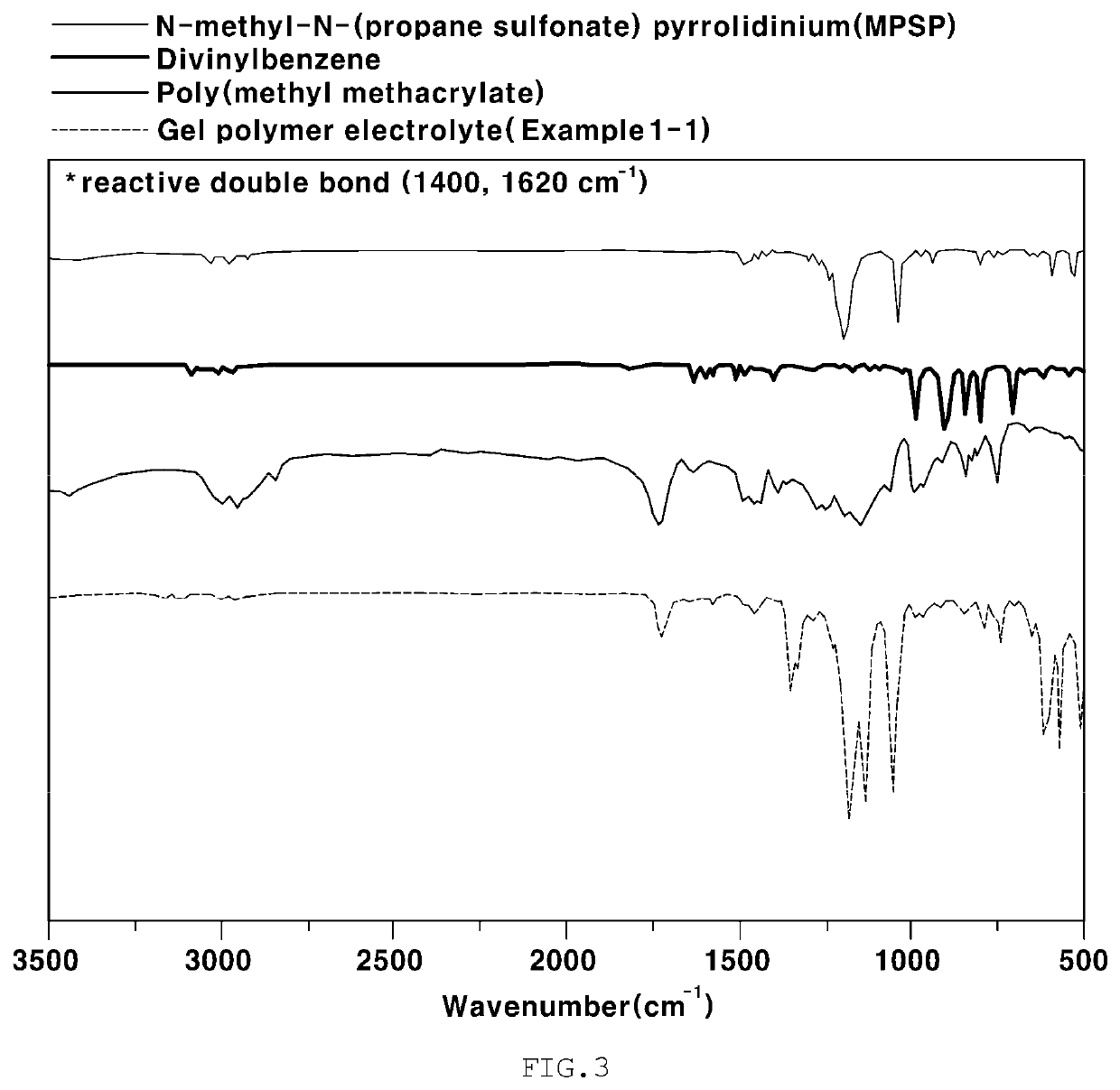
[0090]A gel polymer electrolyte was manufactured under the following conditions. Specifically, in order to manufacture a composite polymer resin, 0.18 g of a 0.2 M PMMA polymer (average molecular weight: 350,000) as a linear polymer and 0.02 g of DVB as a crosslinking agent were prepared. Also, 0.01 g of N-methyl-N-(propane sulfonate)pyrrolidinium (MPSP) as a zwitterion salt including both an anion functional group and a cation functional group was prepared, and the above components were dispersed in 3 g of an organic solvent THF. Next, 0.133 g of LiTFSI as a lithium salt, 0.33 g of 1-ethyl-3-methylimidazolium (EMIm-TFSI) as an ionic liquid, and 0.001 g of AIBN as an initiator were mixed. Next, a PE separation membrane was placed on a release sheet, and 100 μl of the mixed solution was dropped thereon and was thus uniformly distributed only on the separation membrane due to the surface tension between the solution and the release she...
example 1-2
of Lithium-Air Battery Including Gel Polymer Electrolyte
[0091]A lithium-air battery was manufactured using the gel polymer electrolyte manufactured in Example 1-1, lithium metal as an anode, an air electrode using air, namely oxygen as a cathode active material as a cathode, and a polyethylene separation membrane. Here, in order to wet the cathode, 0.5 M LiTFSI dissolved in 1-ethyl-3-methylimidazolium bis(trifluoromethanesulfonyl)imide (EMIm-TFSI) as an ionic liquid was used, and the amount thereof was 30 μl. As the cathode, the air electrode was manufactured by uniformly applying conductive carbon and polytetrafluoroethylene (PTFE) as a binder on a gas diffusion layer (GDL).
PUM
| Property | Measurement | Unit |
|---|---|---|
| wt % | aaaaa | aaaaa |
| wt % | aaaaa | aaaaa |
| wt % | aaaaa | aaaaa |
Abstract
Description
Claims
Application Information
 Login to View More