Self-stacking conveyor belt and method

a conveyor belt and self-stacking technology, applied in the direction of conveyors, transportation and packaging, etc., can solve the problems of entire machinery being taken off line at a substantial cost to the operator, fatigue cracks in the welded joints between the side plates and the transverse rods, and the fatigue limit of the welded joints and adjacent areas reached

a conveyor belt and self-stacking technology, applied in the direction of conveyors, transportation and packaging, etc., can solve the problems of entire machinery being taken off line at a substantial cost to the operator, fatigue cracks in the welded joints between the side plates and the transverse rods, and the fatigue limit of the welded joints and adjacent areas reached

US20030075418A1Inactive Publication Date: 2003-04-24GEA REFRIGERATION NORTH AMERICA

Image

Smart Image Click on the blue labels to locate them in the text.
Viewing Examples
Smart Image
  • Self-stacking conveyor belt and method
  • Self-stacking conveyor belt and method
  • Self-stacking conveyor belt and method

Examples

Experimental program
Comparison scheme
Effect test

Embodiment Construction

)

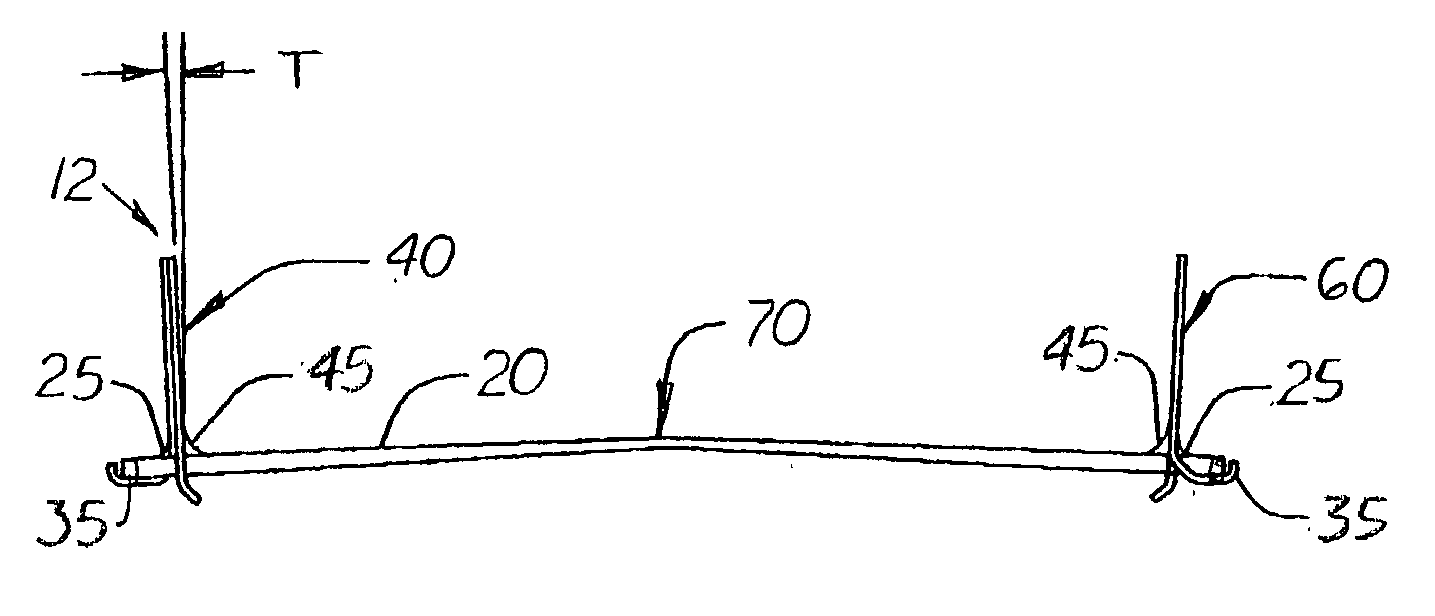
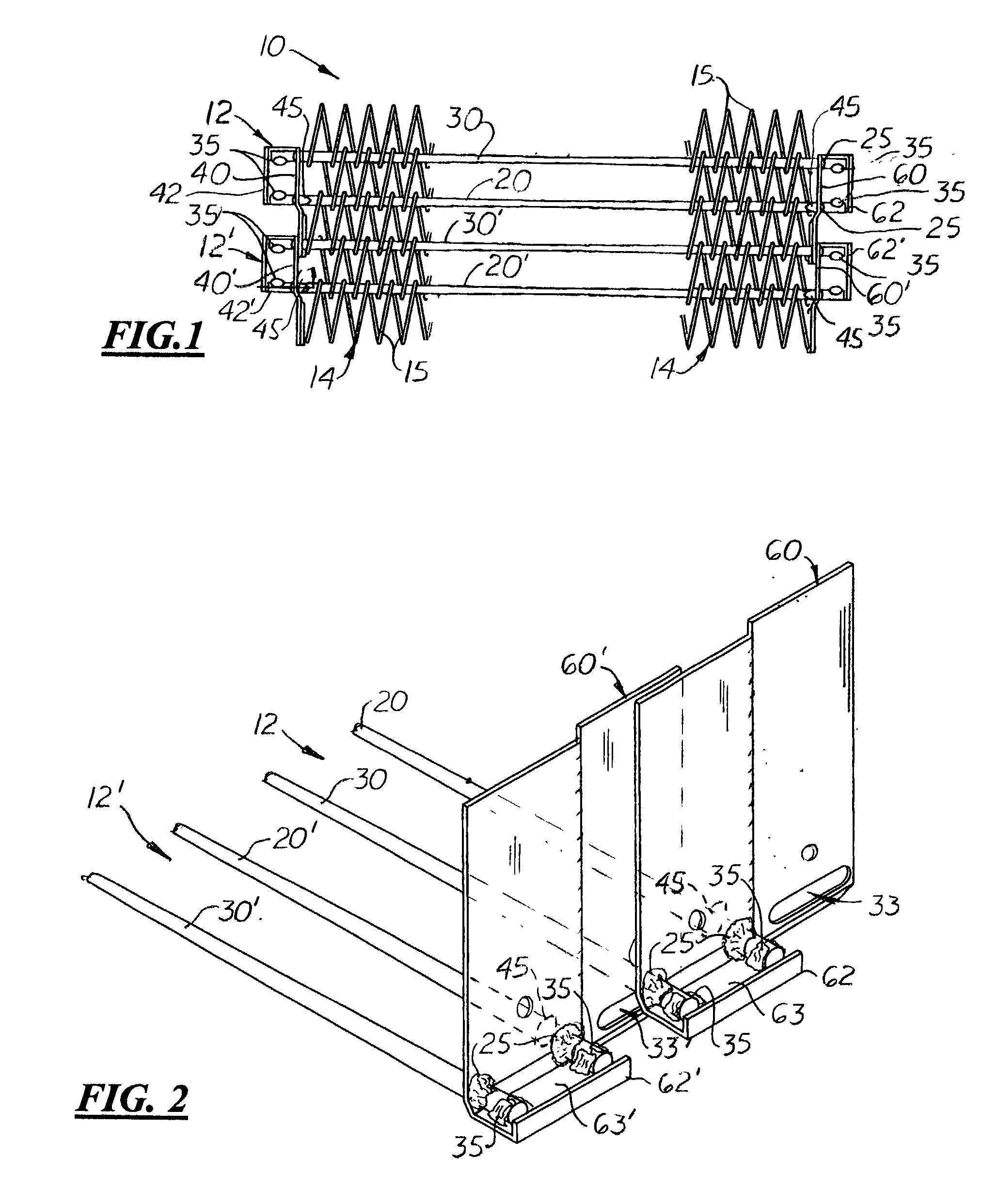
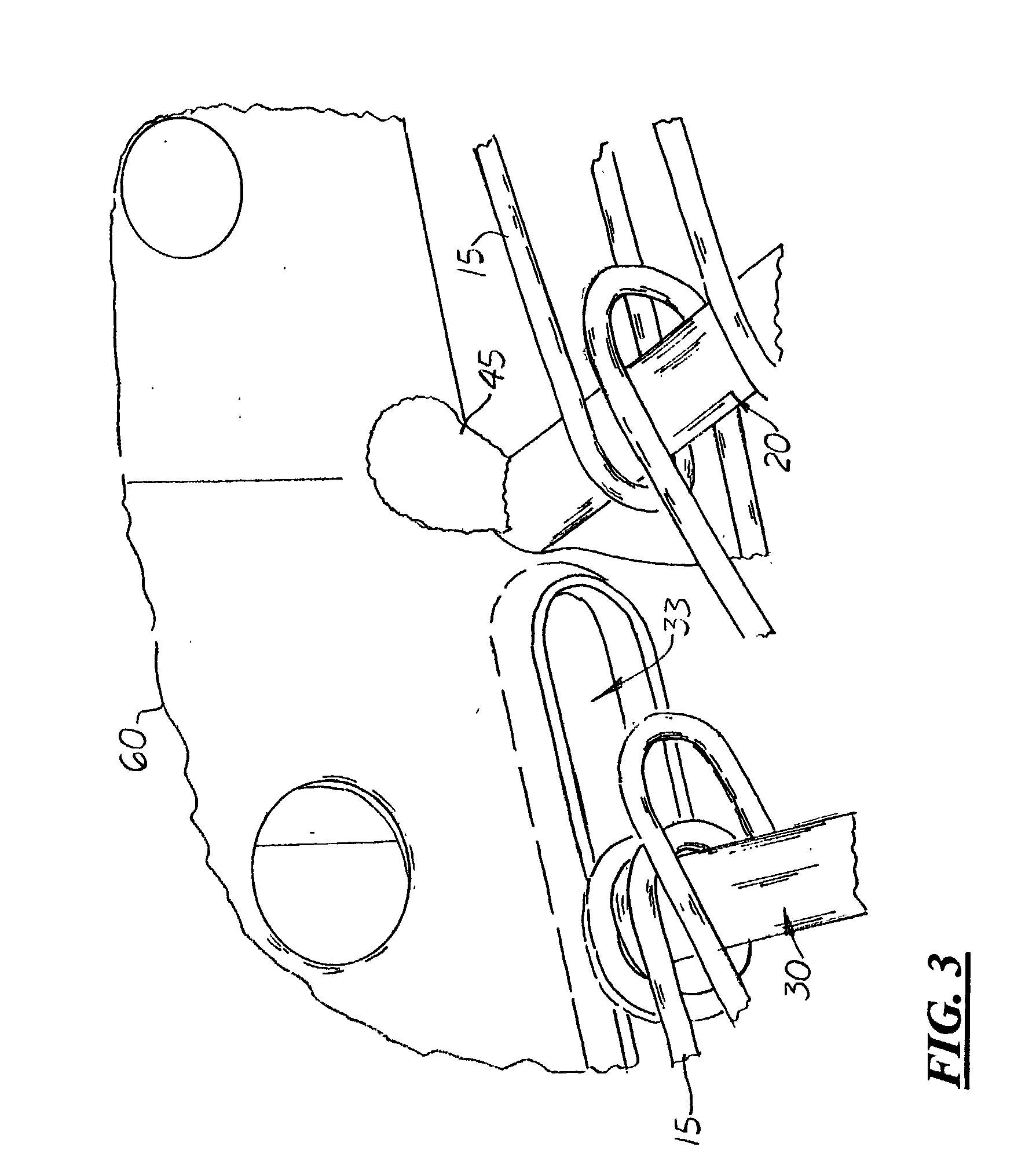
[0022] There is shown in FIG. 1 an improved endless self-stacking conveyor belt 10, similar to the conveyor belts disclosed in U.S. Pat. Nos. 4,603,776, 4,941,567 5,190,143 and 5,803,232 and incorporated by reference herein. The conveyor belt 10 includes a plurality of transversely aligned interlocked links, 12, 12'. Each link 12, 12' includes two traverse rods 20, 30, 20', 30' and two vertically aligned side plates 40 60, rigidly connected to the opposite ends of the two transverse rods 20, 30, 20', 30', respectively. A flexible mesh 14 made of a plurality of small loop structures 15 that individually wrap around adjacent transverse rods 20, 30 is disposed between the side plates 40, 60 and used support products on the conveyor belt 10. The conveyor belt 10 disclosed herein is specifically designed to overcome the development of fatigue cracks between transverse rods 20, 30 and the two side plates 40, 60 on each link 12 caused by repeated cyclical stress on them.

[0023] FIG. 2 is a...

the structure of the environmentally friendly knitted fabric provided by the present invention; figure 2 Flow chart of the yarn wrapping machine for environmentally friendly knitted fabrics and storage devices; image 3 Is the parameter map of the yarn covering machine
Login to View More

PUM

No PUM Login to View More

Abstract

An improved endless conveyor belt made of a plurality of interconnected links, each including two rods with two side plates perpendicularly aligned and attached to their opposite ends. The improvement comprising the addition of an internal buttress-type welded joint located between the inside surface of each side plate and one or both transverse rods with at least one bendable section. During use, the transverse rod is allowed to bend so that the side plates may deflect when force is exerted on them. By adding the welded joint and by adding the bendable section to the transverse rod, the number of cracks or breaks in the conveyor belt is substantially reduced.

Description

[0001] This Utility Patent Application claims the benefit of Provisional Patent Application Serial No. 60 / 335,113, filed on Oct. 23, 2001.[0002] 1. Field of the Invention[0003] The invention pertains to conveyor belts commonly used for the freezing and cooking of foods and other processing applications, and more precisely to improvements that make such belts more resistant to fatigue cracks.[0004] 2. Description of the Related Art[0005] Endless, self-stacking conveyor belts used in the freezing and cooking food industries are described in U.S. Pat. Nos. 4,603,776, 4,941,567, 5,190,143 and 5,803,232. Such conveyor belts comprise a plurality of interconnected links, each including two transverse rods and a pair of upward extending side plates. The two transverse rods are parallel and horizontally aligned and extend through holes formed near the lower edge of each side plate. Formed on one-half of the each plate is a laterally extending foot over which the ends of the two transverse ro...

Claims

the structure of the environmentally friendly knitted fabric provided by the present invention; figure 2 Flow chart of the yarn wrapping machine for environmentally friendly knitted fabrics and storage devices; image 3 Is the parameter map of the yarn covering machine
Login to View More

Application Information

Patent Timeline
24 Apr 2003
Publication
US20030075418A1
IPC
B65G17/06; B65G17/08
CPC
B65G17/064; B65G2201/02; B65G21/18; B65G17/086
Inventors
BYRNE, RICHARD K.; HEBER, GERALD J.