

Chronic treatment regimen using glucagon-like insulinotropic peptides
a technology of glucagon-like insulin and treatment regimen, which is applied in the direction of peptide/protein ingredients, extracellular fluid disorder, metabolic disorder, etc., can solve the problems of short half-live, limited use of glp-1 peptide therapy, and no published papers reporting clinical data in humans using long-acting glp-1 analogs or derivatives
- Summary
- Abstract
- Description
- Claims
- Application Information
AI Technical Summary
Benefits of technology
Problems solved by technology
Method used
Image

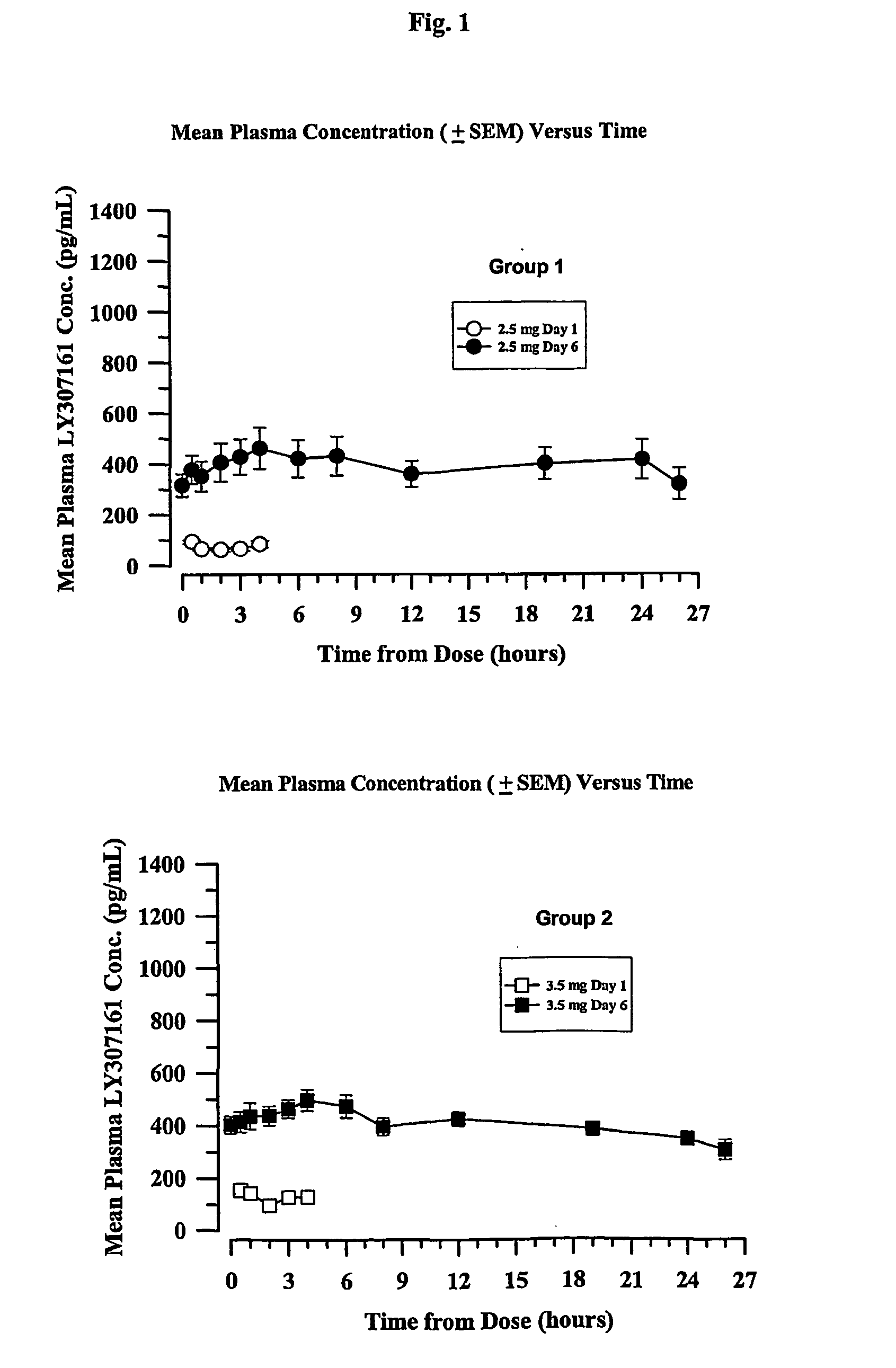
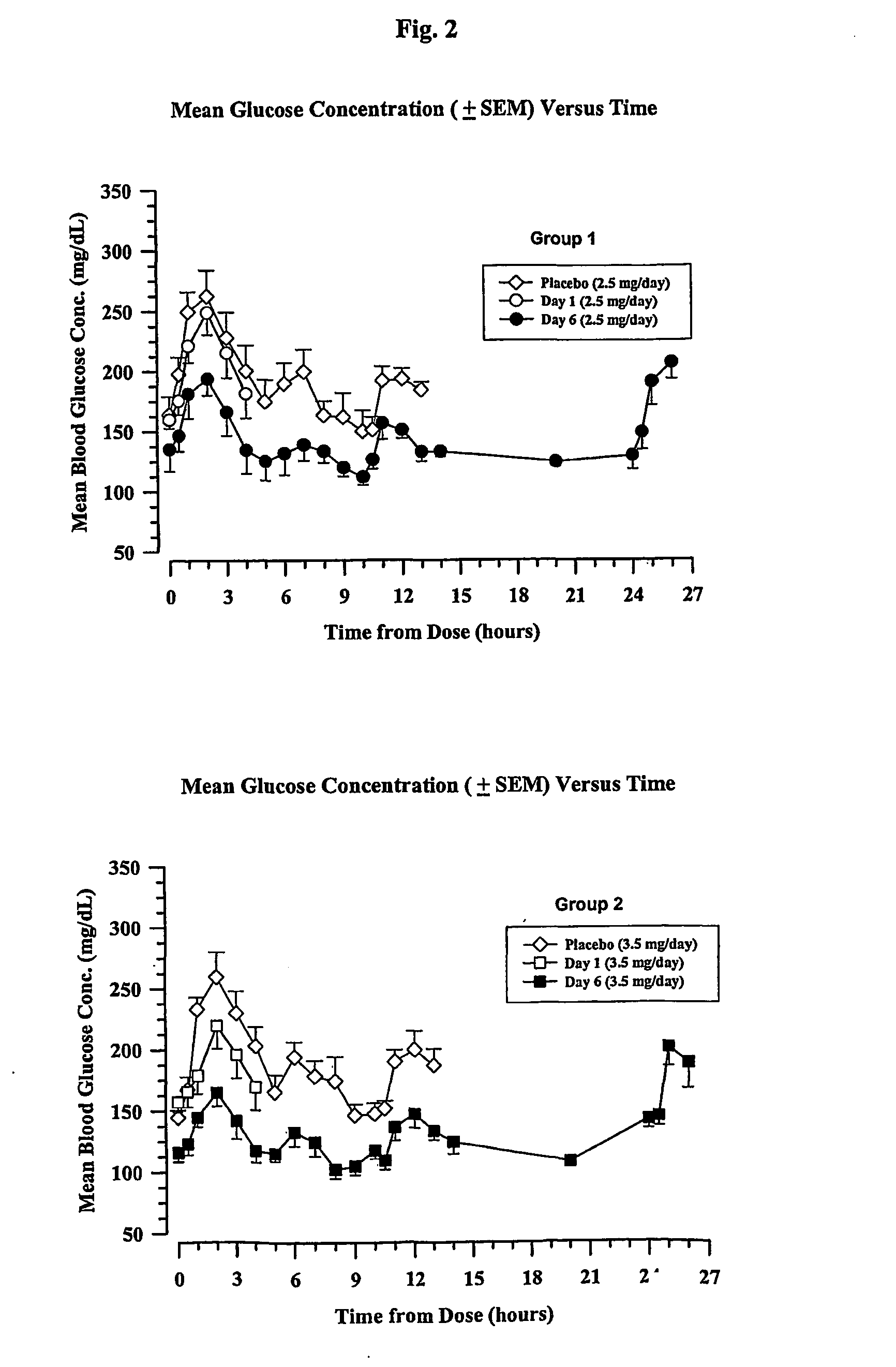
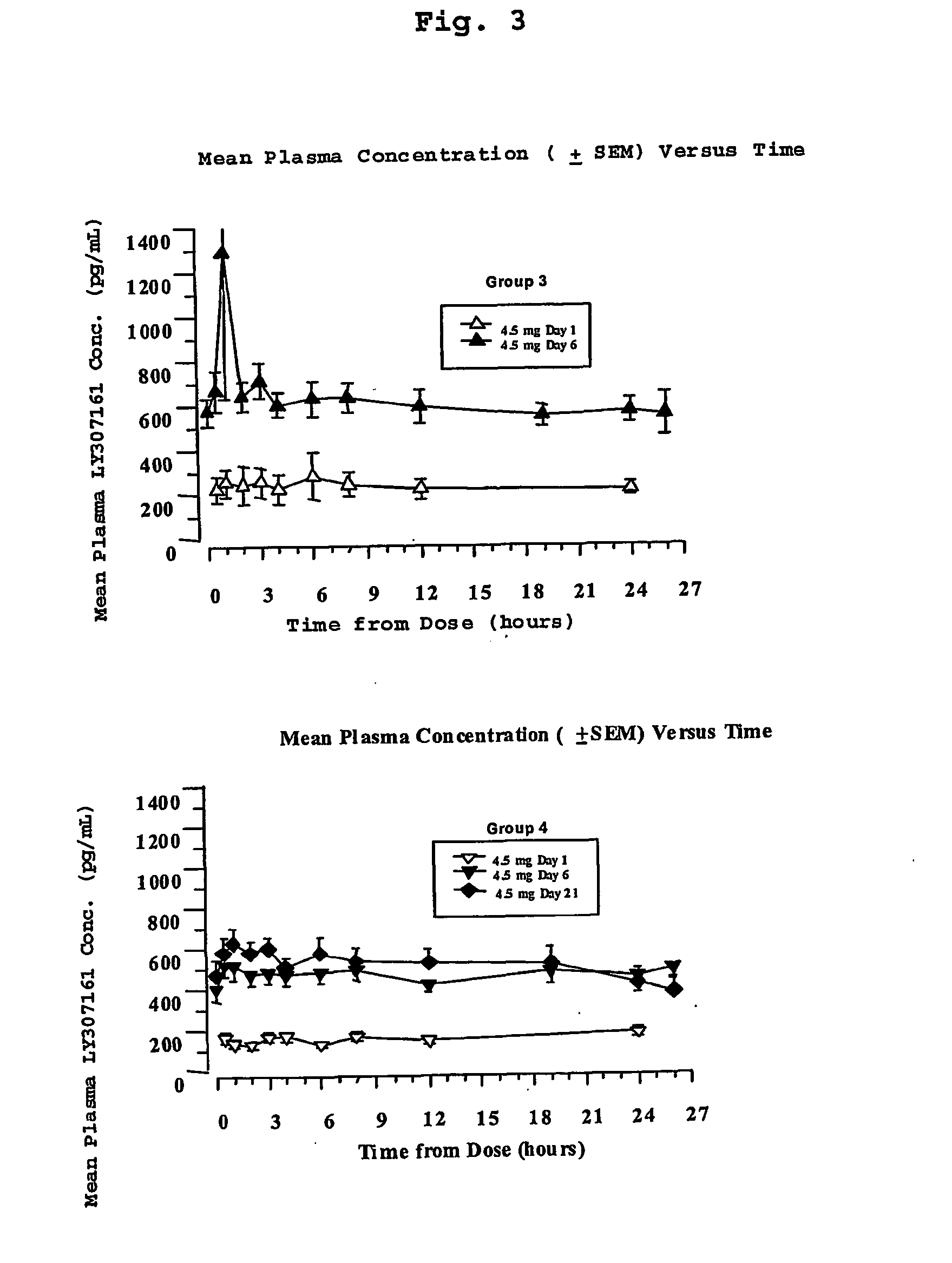
Examples
example 1
[0158] Clinical Study in Type 2 Diabetics
[0159] Four groups of eight type 2 diabetic patients were treated with a long-acting formulation of Val.sup.8-GLP-1(7-37)OH. The first three groups received either 2.5 or 3.5 or 4.5 mg once a day for 6 days. The fourth group received 4.5 mg once per day for 21 days. On the day before the study, each patient received a saline injection as placebo. Blood glucose was followed for 13 hours. All meals during the evaluation days were strictly standardized. Patients were outpatients except for the Day 6 and Day 21 evaluations over 24 hours. Following the injection on Day 1, blood samples were taken for glucose and Val.sup.8-GLP-1(7-37)OH plasma levels during 4 hours. Patients were dosed each morning. On the sixth day of dosing (and also Day 21 for Group 4), samples were collected up to 26 hours post dose for the blood glucose and Val.sup.8-GLP-1(7-37)OH plasma level determinations. Val.sup.8-GLP-1(7-37)OH plasma levels are represented in FIGS. 1 and...
example 2
[0160] Determination of Val.sup.8-GLP-1(7-37)OH Plasma Levels:
[0161] Due to the presence of endogenous concentrations of native GLP-1 peptides and degradation products such as GLP-1 (9-37)OH by DPP-IV, concentrations of intact Val.sup.8-GLP-1(7-37)OH were measured using an ELISA assay in which full-length non-degraded Val.sup.8-GLP-1(7-37)OH is specifically recognized. Immunoreactive Val.sup.8-GLP-1(7-37)OH is captured from the plasma by an N-terminal anti-Val.sup.8-GLP-1(7-37)OH specific antisera immobilized onto a microtiter plate. This antisera is highly specific to the N-terminus of Val.sup.8-GLP-1(7-37)OH. An alkaline-phosphatase conjugated antibody, specific for the C-terminus of GLP-1, is added to complete the "sandwich." Detection is completed using pNPP, a colormetric substrate for alkaline phosphatase. The amount of color generated is directly proportional to the concentration of immunoreactive Val.sup.8-GLP-1(7-37)OH present in the sample. Quantitation of Val.sup.8-GLP-1(...
example 3
[0162] In Vitro Potency Assay:
[0163] HEK-293 Aurora CRE-BLAM cells expressing the human GLP-1 receptor are seeded at 20,000 to 40,000 cells / well / 100 .mu.l into a 96 well black clear bottom plate. The day after seeding, the medium is replaced with plasma free medium. On the third day after seeding, 20 .mu.l of plasma free medium containing different concentrations of GLP-1 agonist is added to each well to generate a dose response curve. Generally, fourteen dilutions containing from 3 nanomolar to 30 nanomolar GLP-1 compound were used to generate a dose response curve from which EC50 values could be determined. After 5 hours of incubation with GLP-1 compound, 20 .mu.l of .beta.-lactamase substrate (CCF2-AM--Aurora Biosciences--product code 100012) was added and incubation continued for 1 hour at which point the flourescence was determined on a cytoflour.
PUM
| Property | Measurement | Unit |
|---|---|---|
| Time | aaaaa | aaaaa |
| Time | aaaaa | aaaaa |
| Molar density | aaaaa | aaaaa |
Abstract
Description
Claims
Application Information
 Login to View More