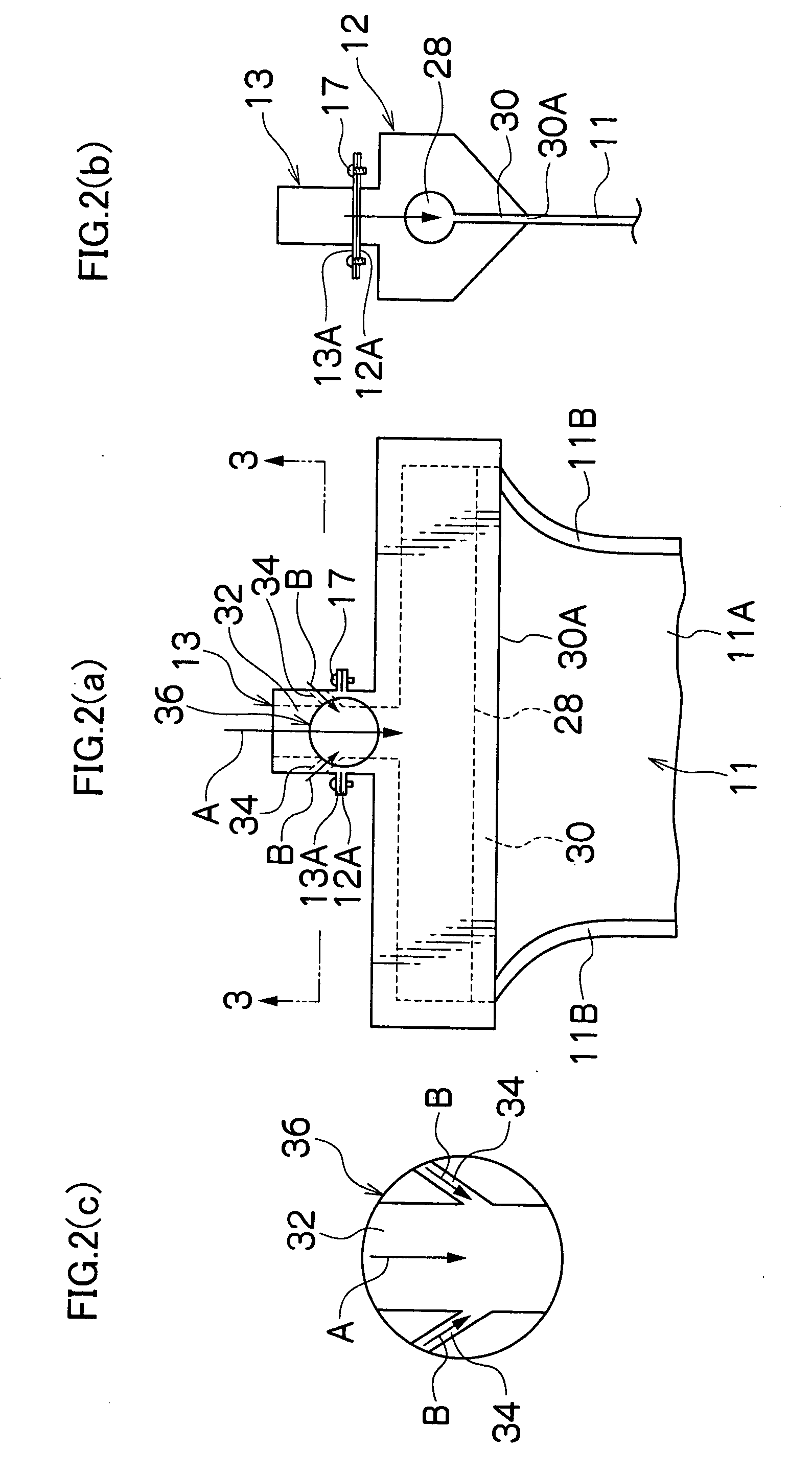
[0010] Joining the resins for the middle portion and for the edge portions in such a manner as to enclose both side edges in the crosswise direction of the resin film main body with the resin for the edge portions. (herein after referred to as "the joining method of the present invention") can reduce the disorder at the boundary between the resins for the middle portion and for the edge portion, while preventing the film separation of the two resins. This makes it possible to avoid the inclusion of the resin for the middle portion in the trimmed-off selvages as much as possible, which in turn increases the recyclability of the selvages, and hence the yield and the productivity of the product.
[0011] Preferably, a degree of enclosing the resin for the middle portion with the resin for the edge portions is adjusted according to a difference in Melt Flow Rate (MFR) between the resins. Generally, the larger the difference in MFR between the resins for the middle portion and for the edge portions becomes, the more the film separation of the two resins is apt to occur; therefore, when the difference in MFR is larger, the degree of enclosing is required to be higher. Conversely, when the difference in MFR is small, even if the degree of enclosing is lowered, the film separation does not occur between the resins. Accordingly, the degree of enclosing which reflects the difference in MFR between the resins for the middle portion and for the edge portions can be achieved by changing the degree according to the difference in MFR between the two resins. Doing this avoids the unnecessary inclusion of the resin for the middle portion in the trimmed-off selvages, and moreover, prevents the film separation of the two resins reliably. In this case, when the difference between the resins for the middle portion and for the edge portions is expressed in terms of MFR ratio, preferably the MFR ratio is in the range of 0.5 to 2. This is because if the MFR ratio is as large as more than 2, the film separation may sometimes occur between the resins even with the joining method of the present invention.
[0013] Preferably, a degree of enclosing the resin for the middle portion with the resin for the edge portions is adjusted according to a difference in
extrusion rate between the resins. Generally, the larger the difference in
extrusion rate between the resin for the middle and the resin for the edge portions becomes, the more the disorder is likely to occur at the boundary between the resins. However, if the degree of enclosing is increased with the increase in the difference in extrusion rate, the disorder at the boundary can be reduced. Conversely, when the difference in extrusion rate is small, even if the degree of enclosing is lowered, the disorder does not occur at the boundary between the resins. Accordingly, the degree of enclosing which reflects the difference in extrusion rate between the resins for the middle portion and for the edge portions can be achieved by changing the degree according to the difference in extrusion rate between the two resins. Doing this avoids the unnecessary inclusion of the resin for the middle portion in the trimmed off selvages, and moreover, reduces the disorder at the boundary between the two resins reliably. In this case, when the difference between the resins for the middle portion and for the edge portions is expressed in terms of extrusion
rate ratio, preferably the extrusion
rate ratio is 0.2 or less. This is because if the extrusion
rate ratio is as large as more than 0.2, not only the film separation may sometimes occur between the resins, but also the disorder is more likely to occur at the boundary between the resins even with the joining method of the present invention. More preferably, the degree of enclosing is changed according to the two factors: the difference in extrusion rate; and the difference in MFR.
[0015] Preferably, a degree of enclosing the resin for the middle portion with the resin for the edge portions is adjusted according to a width of the resin film. Generally, the larger the width of the resin film becomes, the larger the disorder becomes at the boundary between the resins. However, if the degree of enclosing is increased with the increase in the width of the resin film, the disorder at the boundary can be reduced. Conversely, when the width of the resin film is small, even if the degree of enclosing is not increased, the disorder does not occur at the boundary between the resins. Accordingly, the degree of enclosing which reflects the width of the resin film can be achieved by changing the degree according to the width of the resin film. Doing this avoids the unnecessary inclusion of the resin for the middle portion in the trimmed off selvages, and moreover, reduces the disorder at the boundary between the two resins reliably. In this case, preferably the width of the resin film is 5 meters or less. This is because if the width is more than 5 meters, the disorder is more likely to occur at the boundary between the resins. More preferably, the degree of enclosing is changed according to the four factors: the width of the resin film, the difference in resin temperature, the difference in MFR and the difference in extrusion rate.
[0017] According to the present invention, the disorder at the boundary between the resins for the middle portion and for the edge portions is decreased while preventing the film separation of the two resins. Accordingly, it becomes possible to avoid the inclusion of the resin for the middle portion in the trimmed off selvages as much as possible, which in turns increases the recyclability of the selvages, and hence the yield and the productivity of the product.
[0020] According to the present invention, since the feed block is so constructed that any one of the joining part blocks, which specify the joining configuration, is exchangeable for another depending on the condition under which the resin film is formed, even if the condition, such as physical properties of the resin for the middle portion and the resin for the edge portions and the applying condition of the same is changed, it is only necessary to exchange the joining part block for a suitable one. Thus, resin films are very conveniently formed.


 Login to View More