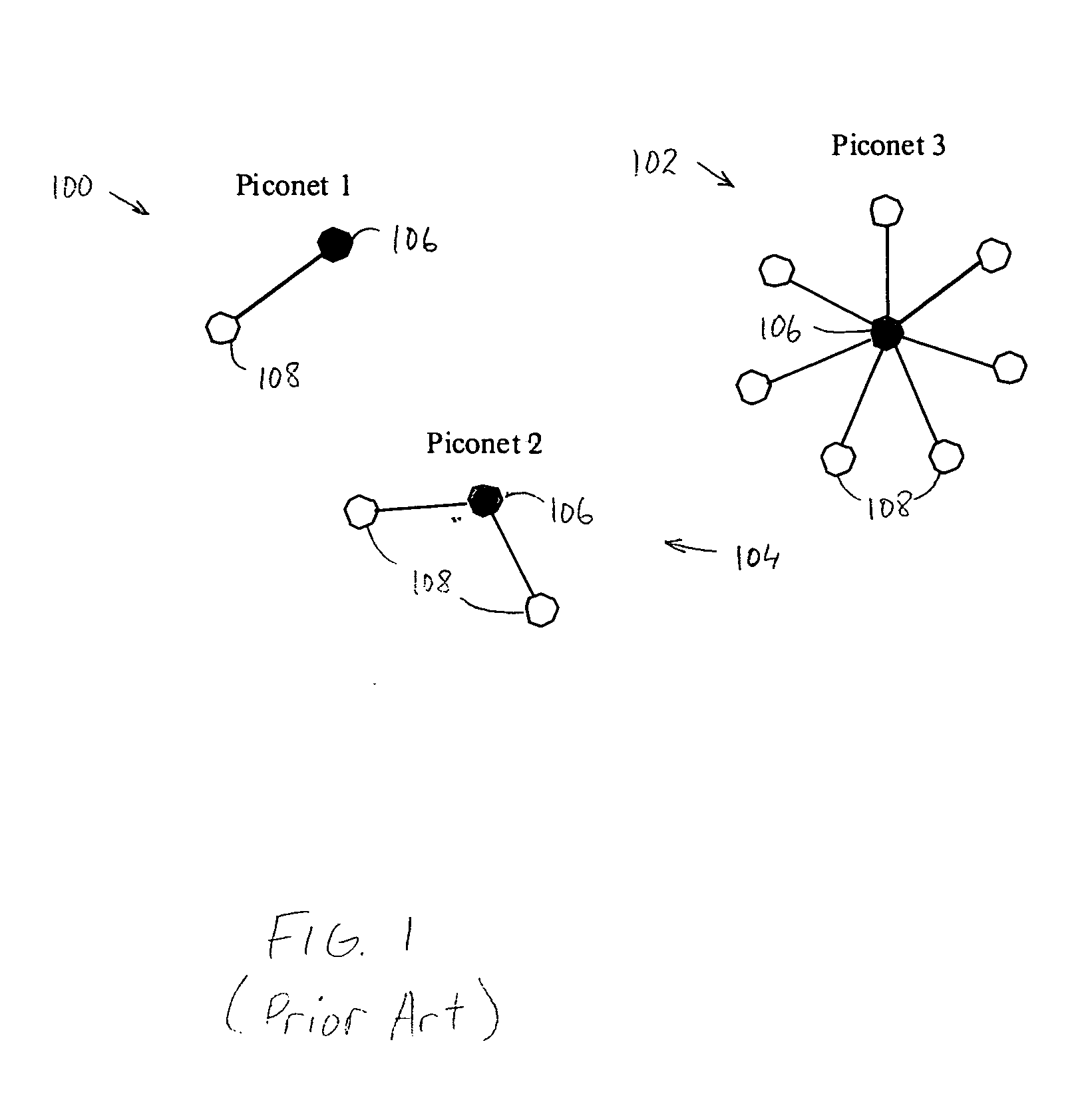
Consequently, there is no way for a slave to send data to another slave in a
piconet (there is no way for one slave to address another slave, and
direct communication between slaves is not allowed).
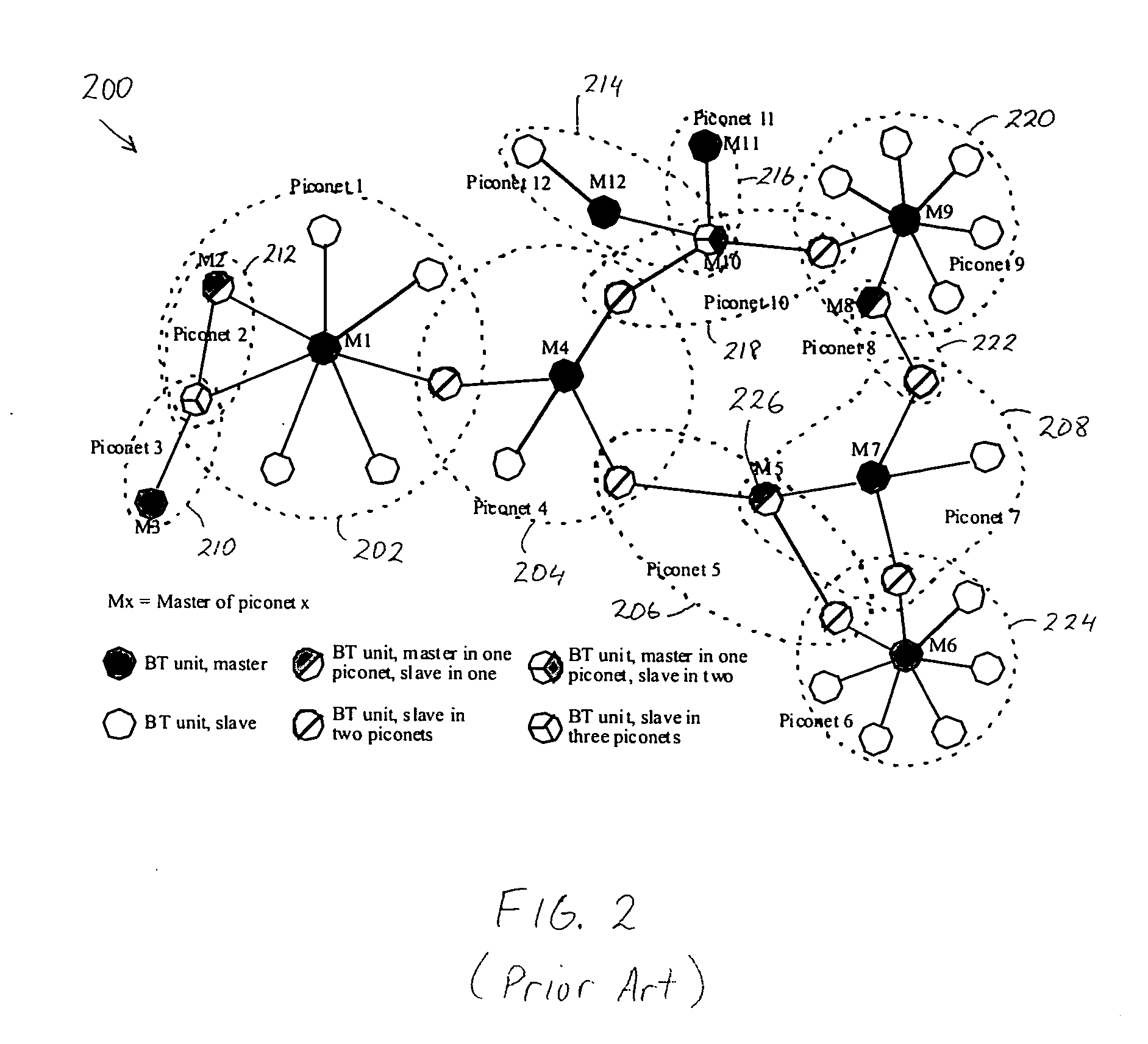
Another limitation of the Bluetooth
system is that, in the current standard, there is no way to address and
route packets from one
piconet to another.
Without a neighbor discovery procedure, a BT unit would not be able to find any other BT units to communicate with and, consequently, no ad-hoc network would be formed.
Also, knowing the internal
clock value of the BT unit to be paged will potentially speed up the PAGE procedure.
A problem with the above contemplated application is that the Ethernet link
layers and the Bluetooth link
layers are so different.
Unicast packets, on the other hand, are not delivered to all nodes as would be the case on a LAN, since this would waste too much of the limited bandwidth in a scatternet.
However, even with these tools, a number of problems arise.
Some of these problems are due to the large difference in capacity between the scatternet and the LAN.
The large difference in capacity makes a truly unrestricted extension of the LAN into a Bluetooth scatternet impractical.
Other problems are due to the difference in how packets are delivered in the LAN compared to the scatternet.
The difference in packet delivery creates a problem of matching the
routing protocol of the NAL with the delivery mechanism of the
shared medium of the LAN.
Still other problems are due to the ad-hoc nature of a Bluetooth scatternet.
The ad-hoc nature of a scatternet creates problems when multiple NAPs are within reach of a scatternet.
If the NAPs are attached to different LANs, the problem is manifested at the IP level where each LAN constitutes one IP subnet.
Such bypass of the
router can result in problems with IP routing, allocation of IP addresses, and uniqueness of link-local IP addresses.
For one thing, the existing solution is not a complete solution to the bridging problem.
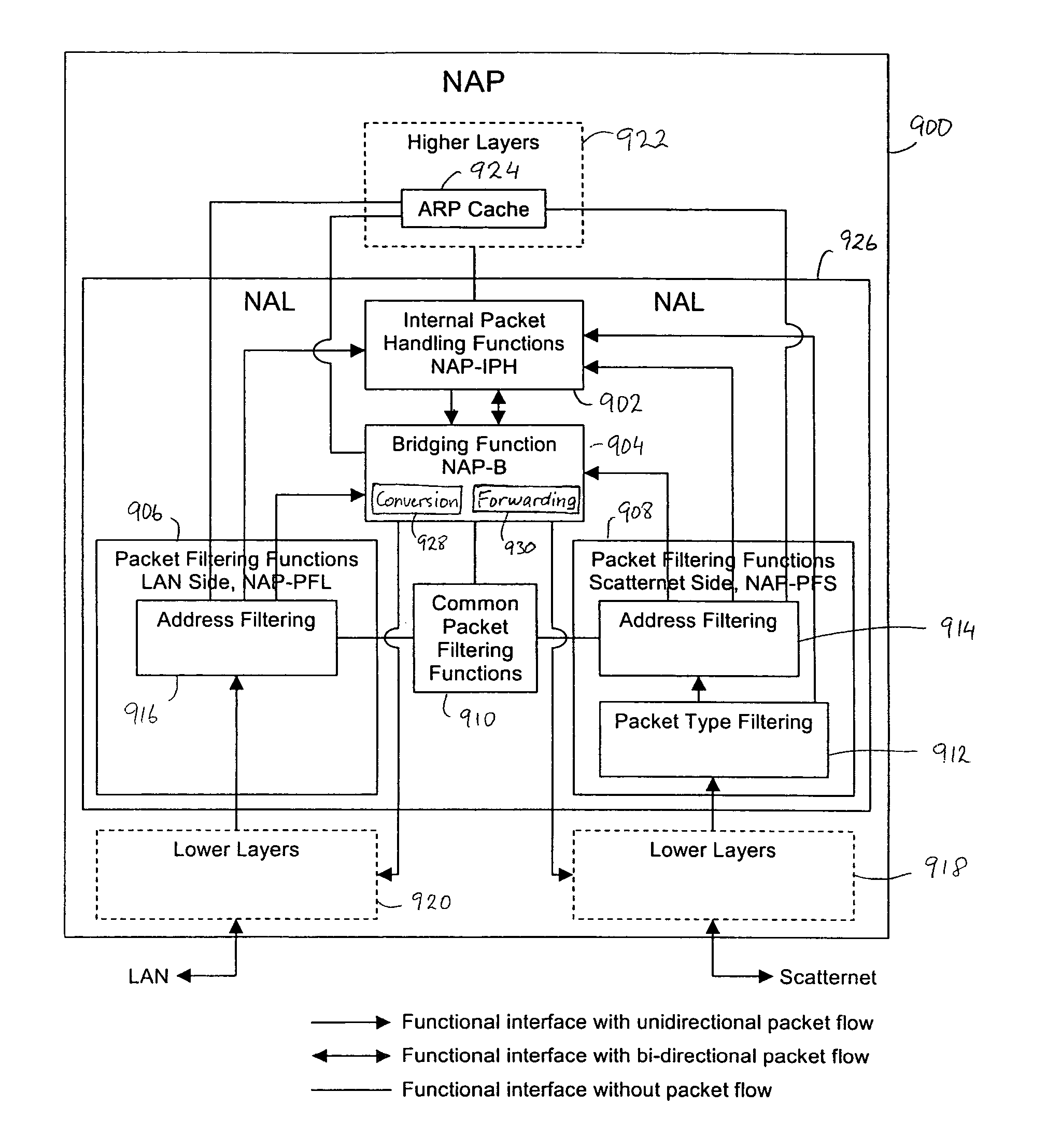
In particular, it does not address the forwarding mechanism needed to couple the scatternet
routing protocol with the distribution procedure on the LAN.
The existing solution also does not address
packet filtering to reduce unnecessary traffic in the scatternet.
Secondly, the existing AD model does not address the criteria used by a Bluetooth node for selecting an ADAP, or for changing an ADAP.
It also does not address how to
handle scatternet "islands" breaking loose from the bridged scatternet, or when a scatternet with two ADAPs splits into two scatternets with one ADAP each.
Finally, the maintenance of existing AD and ADAP areas are too rigid and not dynamic or flexible enough.
Such rigidity may result in suboptimal ADAP selections so that the selected ADAP is not the closest one to the node, and may also result in uneven division of a scatternet where there are two ADAPs.


 Login to View More
  Login to View More