Unlock instant, AI-driven research and patent intelligence for your innovation.

Method and apparatus for synchronization control of forward link transmitting power during soft handoff in wireless communication systems

a wireless communication system and forward link technology, applied in electrical equipment, wireless communication services, wireless commuication services, etc., can solve the problems of system performance degrading to a great extent, power control information received by bs2 is received at a higher error rate, and the flpc will no longer meet the requirements of the previous slow speed

Active Publication Date: 2004-10-14
ZTE CORP
View PDF4 Cites 34 Cited by
  • Summary
  • Abstract
  • Description
  • Claims
  • Application Information

AI Technical Summary

Problems solved by technology

In CDMA2000-1X systems, when a mobile station enters a fast Rayleigh fading area, especially in the case when a high speed data traffic channel (SCH) works concurrently in the forward channel, the previous slow FLPC will no longer meet the requirements.
As shown in FIG. 1, if no special measure is taken during soft handoff, the system performance will degrade to a great extent during soft handoff.
Due to the influence of distance, shadow and fading, the reverse link of BS2 is so weak that higher error rate occurs in the power control information received by BS2 in the reverse link.
BS1 may correctly receive the instruction of decreasing power from the mobile station, but the power control bit error rate received by BS2 is relatively high due to the faded link between the mobile station and BS2, which results in a slower and more inaccurate power adjustment of BS2 than that of BS1.
The pointless transmission of BS2 at higher power level not only results in the loss of system capacity, but also enlarges the multipath noise in the system.
If 10% of this 70% is used to maintain a link with poor quality, the system capacity is bound to decrease.
Of course, BS2 may possibly increase the transmitting power by mistake and may possibly decrease the forward transmitting power by mistake since the reverse link between BS2 and the mobile station has greatly faded and the power control bit error rate received by BS2 is relatively high.
This situation may lead the case that the transmitting power of BS2 is too low to maintain this link and the link will be dropped at last.
Therefore, the forward link corresponding to a reverse link with poor reception quality will transmit high power unreasonably, so that the forward capacity of the system decreases and the severe interference in communications among other users within the system occurs; or the forward link transmitting power corresponding to the reverse link of poor reception quality is too low to maintain the link, decreases the stability of handoff process and the success rate of handoff.
Therefore, there are large deviations between reverse links of all base stations involved during soft handoff.
That is to say, the signal-to-noise ratio (SNR) of base stations in the reverse pilot channels differs from each other, which results in different forward power control bit error rate located in the reverse pilot channels and finally results in greater deviations of transmitting power between forward links.
Moreover, the reception quality of a reverse link represents directly the forward link power control bit error rate in the reverse pilot channel.
Namely, the better the reception quality of a reverse link, the lower the power control bit error rate of the forward link; the poorer the reception quality of a reverse link, the higher the power control bit error rate of the forward link.
In the meanwhile, the power of a base station will not be adjusted too high in synchronization due to incorrect reception of power control bit, which may result in very strong interference and a decreased system capacity.
In the method of Patent 06154659, the real time performance is poor in power synchronization of all base stations by the BSC because the minimum detection period of 20 frames (20*20 ms=400 ms) is used for detecting the reverse link FER.
The calculation with such a filter function involved will not only consume the CPU resources (the buffers for historical and intermediate data, etc.), but also decrease the efficiency of the overall estimation algorithm.
Compared to the synchronization methods of Patent EP1047207A2 and the present invention, the detection period of 20 frames results in poorer real time performance.
In this method, although the real time performance is improved in synchronizing all base stations by the BSC due to the minimum Eb / Nt detection period of 1 frame (1*20 ms=20 ms) in reverse links, but the calculations of Eb / Nt of reverse links are rather complicated.
The system operation efficiency will still be affected because that many formulas (including difficult logarithmic operations) and tables have to be dealt with in the calculations, and the calculations are complex and time-consuming.

Method used

the structure of the environmentally friendly knitted fabric provided by the present invention; figure 2 Flow chart of the yarn wrapping machine for environmentally friendly knitted fabrics and storage devices; image 3 Is the parameter map of the yarn covering machine
View more

Image

Smart Image Click on the blue labels to locate them in the text.
Viewing Examples
Smart Image
  • Method and apparatus for synchronization control of forward link transmitting power during soft handoff in wireless communication systems
  • Method and apparatus for synchronization control of forward link transmitting power during soft handoff in wireless communication systems
  • Method and apparatus for synchronization control of forward link transmitting power during soft handoff in wireless communication systems

Examples

Experimental program
Comparison scheme
Effect test

Embodiment Construction

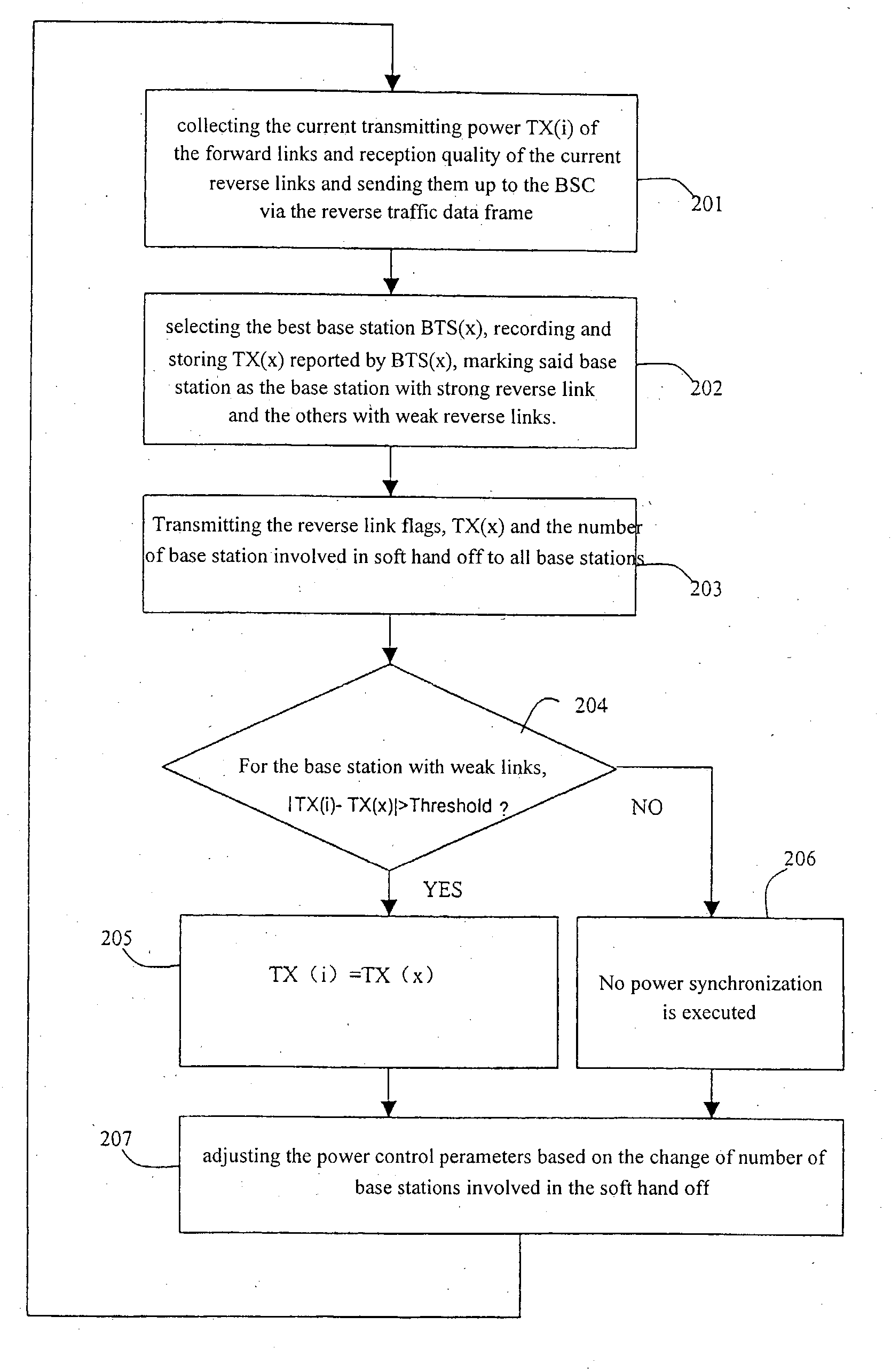
[0101] In FIG. 1, the BSC 108 is connected to the Public Switched Telephone Network (PSTN) 110, the base stations (BS) 105 and 106 are connected to the BSC 108. During a typical soft handoff with two base stations involved, the mobile station (MS) 109 communicates with BS1 and BS2 through forward / reverse links 101 / 103 and 102 / 104, respectively. The relationship of power control in forward and reverse links has been described as in Section "Background Technology". In CDMA2000-1x systems, FFLPC has been introduced for RC3.about.RC5. The forward link power of all base stations involved in soft handoff is independent of each other, i.e. they can be controlled by their own FFLPC. The system performance during soft handoff will degrade a great deal if no specific measure is taken in soft handoff. To this end, two methods are proposed in the invention as the specific measures. FIG. 2 illustrates the flowchart of the first synchronization method (Method 0) proposed in the invention. In Step...

the structure of the environmentally friendly knitted fabric provided by the present invention; figure 2 Flow chart of the yarn wrapping machine for environmentally friendly knitted fabrics and storage devices; image 3 Is the parameter map of the yarn covering machine
Login to View More

PUM

No PUM Login to View More

Abstract

The present invention relates to a method and an apparatus for synchronization control of forward link transmitting power during soft handoff, comprising: collecting the current transmitting power TX(i) of the forward links and the current reception quality of the reverse links; selecting the best base station BTS(x), recording and storing TX(x) reported by BTS(x), marking the BTS(x) as the base station with strong reverse link and the others as base stations with weak reverse link; sending the reverse link flags, TX(x) and the number of base stations involved in soft handoff to all base stations; determining whether a base station is the base station with weak link according to the flag from the base station controller; calculating the deviation between the current transmitting power TX(i) and the TX(x) if the base station is with weak link; adjusting the power control parameters and repeating the above steps; the parameters of the reception quality in reverse links are sampled for every frame in the invention, which not only improves the real time performance of synchronization, but also achieves power synchronization of all base stations and improves the system operation efficiency.

Description

[0001] The present invention relates to a method and an apparatus for synchronization control in wireless communication systems, in particular, relates to a method and an apparatus for synchronization control of forward link transmitting power during soft handoff in CDMA systems.BACKGROUND TECHNOLOGY[0002] The practical applications of CDMA systems show that the system capacity is not only limited by the reverse link capacity but also by the forward link capacity, which raises higher requirements of forward link power control (FLPC). It is the object of FLPC to assign reasonable power to forward traffic channels, and to minimize the interference with other users in the same cell and with the users in adjacent cells on the condition of ensuring the communication quality. Namely, the forward channel transmitting power should be as lower as possible on the condition that minimal required signal-to-noise ratio for demodulation in mobile stations is met. The adjustment of forward power c...

Claims

the structure of the environmentally friendly knitted fabric provided by the present invention; figure 2 Flow chart of the yarn wrapping machine for environmentally friendly knitted fabrics and storage devices; image 3 Is the parameter map of the yarn covering machine
Login to View More

Application Information

Patent Timeline
no application Login to View More
IPC IPC(8): H04W36/18
CPCH04W36/18
Inventor PENG, WEIZHONGWANG, YUELI, PINGQIAO, JIA
Owner ZTE CORP