
Virtual private network (VPN)-aware customer premises equipment (CPE) edge router
a customer premises equipment and virtual private network technology, applied in the field of public communication network prevention of denial of service attacks, can solve the problems of high performance (i.e., expensive) processor components, limited scalability of intserv admission control utilizing rsvp, and disrupting service for all flows for all customers
- Summary
- Abstract
- Description
- Claims
- Application Information
AI Technical Summary
Benefits of technology
Problems solved by technology
Method used
Image

Examples
Embodiment Construction
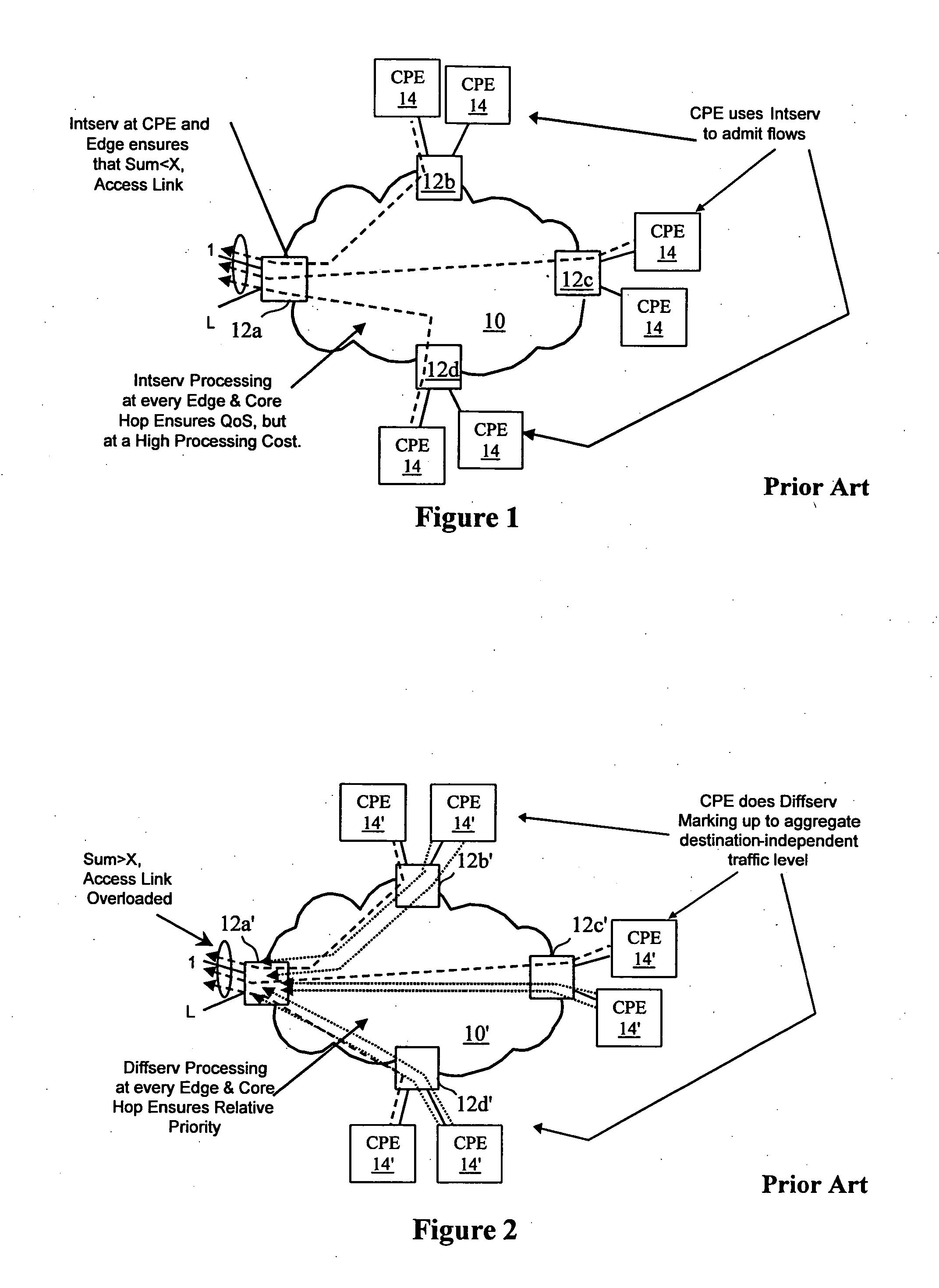
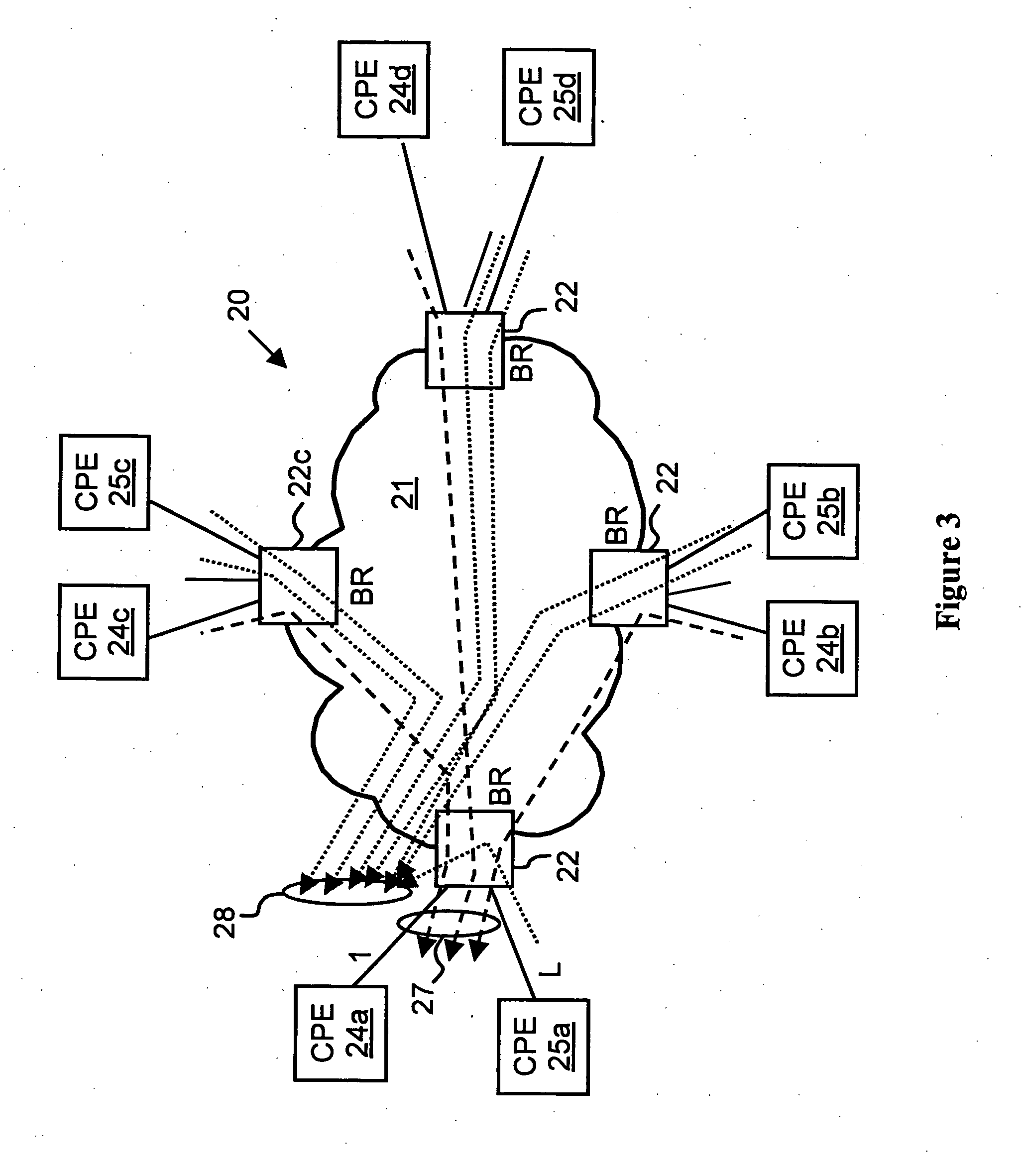
[0036] With reference again to the figures and, in particular, with reference to FIG. 3, there is depicted a high level block diagram of an exemplary network architecture 20 that, in accordance with the present invention, provides a scalable method of providing QoS to selected traffic while protecting a Virtual Private Network (VPN) customer's access and trunk network links against DoS attacks. Similar to the prior art network illustrated in FIG. 2, network architecture 20 of FIG. 3 includes a Diffserv network 21 having N service provider boundary routers (BRs) 22 that each have L access links. What is different in network architecture 20 is that Diffserv network 21 supports a plurality of VPN instances, of which two are shown in the figure as identified by the access links of boundary routers 22 coupled to CPE edge routers (ERs) for a first network service customer 24 and an ER for a second network service customer 25 at each of four sites, respectively identified by letters a thro...
PUM
 Login to View More
 Abstract
Description
Claims
Application Information
 Login to View More