Check patentability & draft patents in minutes with Patsnap Eureka AI!

Apparatus and method for automatic gain control during scanning

Inactive Publication Date: 2005-02-10
KOLSTAD JESSE J
View PDF12 Cites 0 Cited by
  • Summary
  • Abstract
  • Description
  • Claims
  • Application Information

AI Technical Summary

Benefits of technology

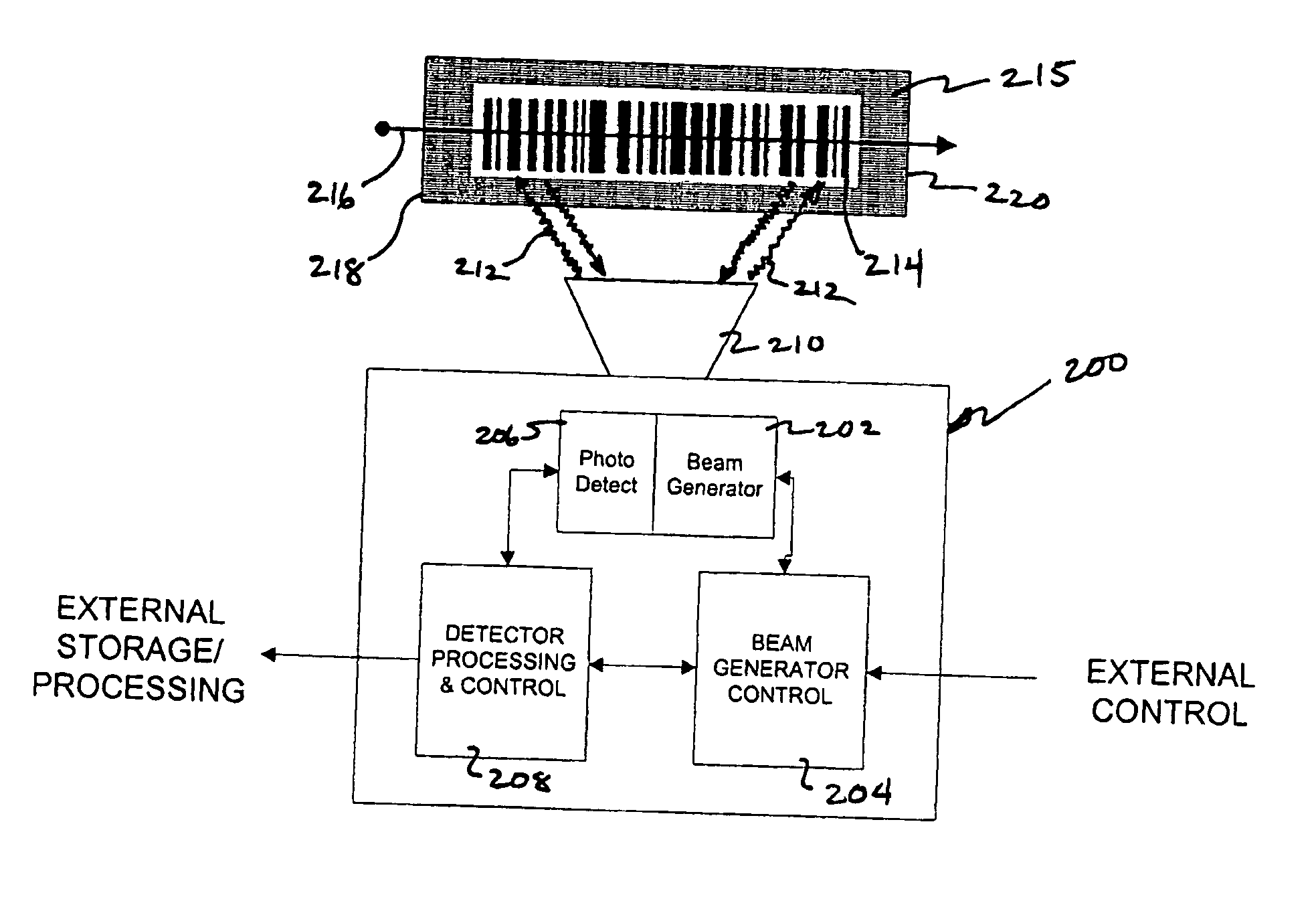
The disclosure describes an apparatus and method for automatic gain control during scanning. The apparatus comprises an optical detector to receive an optical signal reflected from a symbol positioned within a scan window by an optical beam scanned from a leading edge of the scan window to a trailing edge of the scan window; and a processor coupled to the optical detector to adjust the gain of the optical detector during the beam scan. The process comprises receiving an optical signal using an optical detector, wherein the optical signal comp

Problems solved by technology

As a result, the amount of optical power received at the scanner drops off significantly at the edges of the symbol, making it difficult to adequately scan, capture and decode the information contained near the edges of the symbol.
The problem is particularly acute when the scanner must operate in very close quarters and must therefore be placed very close to the symbol.
Thus, in scanners having a short focal length and operating near the symbol it is particularly challenging to properly read the edges of the symbol. FIG. 1B illustrates the effect of the above phenomenon on the optical response of the scanner.
In other words, there is no way of adjusting the gain during a scan.
This approach therefore cannot be used to address the problem of compensating for reduced optical response at the edges of a scanned symbol.
In addition, even if a standard AGC could be adapted to compensate for gain changes during a scan, they would be much too slow.
First, increasing the power of the laser near the edges of the symbol has serious safety implications because the increased laser power can pose a danger to the eyes of the scanner operator or other bystanders, and when the beam nears the edge of the symbol more of the optical power is likely to be reflected into someone's eyes.
Second, using the laser at a higher power output and continually cycling the laser between low and high power states will decrease the lifetime of the laser and the scanner, ultimately driving up costs to the end user.
Finally, the higher power output of the laser means additional power consumption and additional heat dissipation problems.
Power consumption and heat dissipation both can lead to additional expense in making and using the scanner, as well as inconvenience to the user who, in the case of a hand-held scanner, must carry the additional weigh of heat sinks, etc, used to dissipate the heat created by the additional power consumption of the laser.

Method used

the structure of the environmentally friendly knitted fabric provided by the present invention; figure 2 Flow chart of the yarn wrapping machine for environmentally friendly knitted fabrics and storage devices; image 3 Is the parameter map of the yarn covering machine
View more

Image

Smart Image Click on the blue labels to locate them in the text.
Viewing Examples
Smart Image
  • Apparatus and method for automatic gain control during scanning
  • Apparatus and method for automatic gain control during scanning
  • Apparatus and method for automatic gain control during scanning

Examples

Experimental program
Comparison scheme
Effect test

Embodiment Construction

Embodiments of an apparatus and method for automatic gain control during scanning are described herein. In the following description, numerous specific details are described to provide an understanding of embodiments of the invention. One skilled in the relevant art will recognize, however, that the invention can be practiced without one or more of the specific details, or with other methods, components, materials, etc. In other instances, well-known structures, materials, or operations are not shown or described in detail to avoid obscuring aspects of the invention.

Reference throughout this specification to “one embodiment” or “an embodiment” means that a particular feature, structure, or characteristic described in connection with the embodiment is included in at least one embodiment of the present invention. Thus, appearances of the phrases “in one embodiment” or “in an embodiment” in this specification do not necessarily all refer to the same embodiment. Furthermore, the part...

the structure of the environmentally friendly knitted fabric provided by the present invention; figure 2 Flow chart of the yarn wrapping machine for environmentally friendly knitted fabrics and storage devices; image 3 Is the parameter map of the yarn covering machine
Login to View More

PUM

No PUM Login to View More

Abstract

The disclosure describes an apparatus and method for automatic gain control during scanning. The apparatus comprises an optical detector to receive an optical signal reflected from a symbol positioned within a scan window by an optical beam scanned from a leading edge of the scan window to a trailing edge of the scan window; and a processor coupled to the optical detector to adjust the gain of the optical detector during the beam scan. The process comprises receiving an optical signal using an optical detector, wherein the optical signal comprises optical energy reflected from a symbol positioned in a scan window as an optical beam scans from a leading edge of the scan window to a trailing edge of the scan window, and adjusting the gain of the optical detector during receipt of the optical signal. A calibration process is disclosed comprising calibrating the optical detector to obtain a plurality of gain corrections, each gain correction corresponding to a different position between a leading edge and a trailing edge of a scan window, and storing the plurality of gain

Description

TECHNICAL FIELD The present invention relates generally to scanners, and in particular, but not exclusively, to automatic gain adjustment during scanning. BACKGROUND Bar code scanners typically function by generating a thin beam of light and scanning the beam across a symbol to be read. The symbol typically comprises a plurality of alternating light (usually white) and dark (usually black) areas; the best-known symbols are bar codes, where the light and dark areas are formed by a white background with alternating black bars superimposed thereon. As the spot created by the projection of the beam onto the symbol travels across the symbol, it crosses the alternating light and dark areas and a portion of the light hitting the symbol is reflected back into the scanner. More light is reflected from the light areas than from the dark areas, so the optical energy reflected back into the scanner will consist of a signal containing a series of peaks corresponding to the light areas and vall...

Claims

the structure of the environmentally friendly knitted fabric provided by the present invention; figure 2 Flow chart of the yarn wrapping machine for environmentally friendly knitted fabrics and storage devices; image 3 Is the parameter map of the yarn covering machine
Login to View More

Application Information

Patent Timeline
no application Login to View More
IPC IPC(8): G06K7/10
CPCG06K7/10851G06K7/10
Inventor KOLSTAD, JESSE J.
Owner KOLSTAD JESSE J
Features
  • R&D
  • Intellectual Property
  • Life Sciences
  • Materials
  • Tech Scout
Why Patsnap Eureka
  • Unparalleled Data Quality
  • Higher Quality Content
  • 60% Fewer Hallucinations
Social media
Patsnap Eureka Blog
Learn More