

Intra-ventricular pressure sensing catheter
a catheter and pressure technology, applied in the field of catheters, can solve the problems of increasing pressure on the brain, enlarge the ventricle, and difficulty in measuring the pressure within the patient's ventricl
Inactive Publication Date: 2005-02-24
CODMAN & SHURTLEFF INC
View PDF28 Cites 68 Cited by
- Summary
- Abstract
- Description
- Claims
- Application Information
AI Technical Summary
Benefits of technology
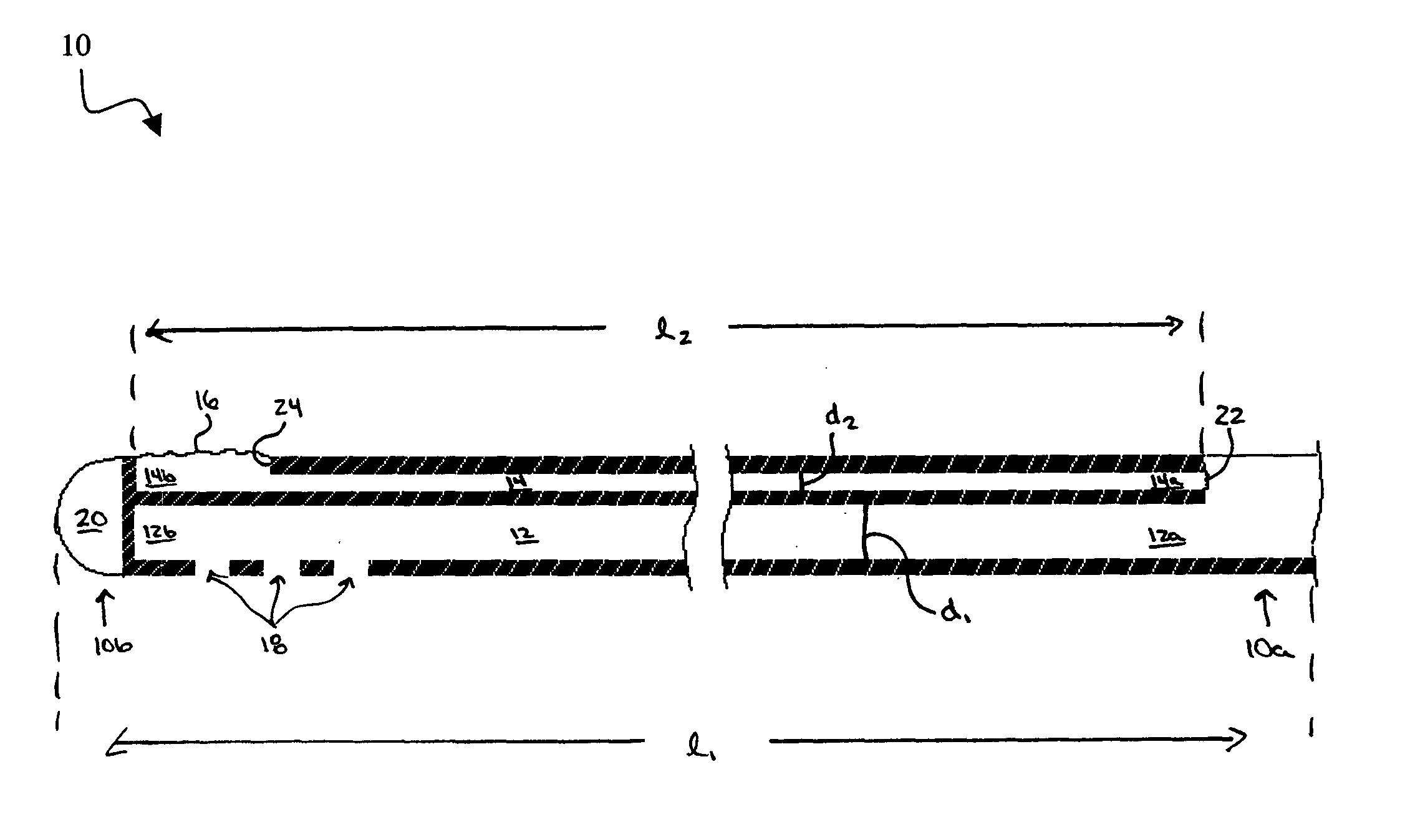
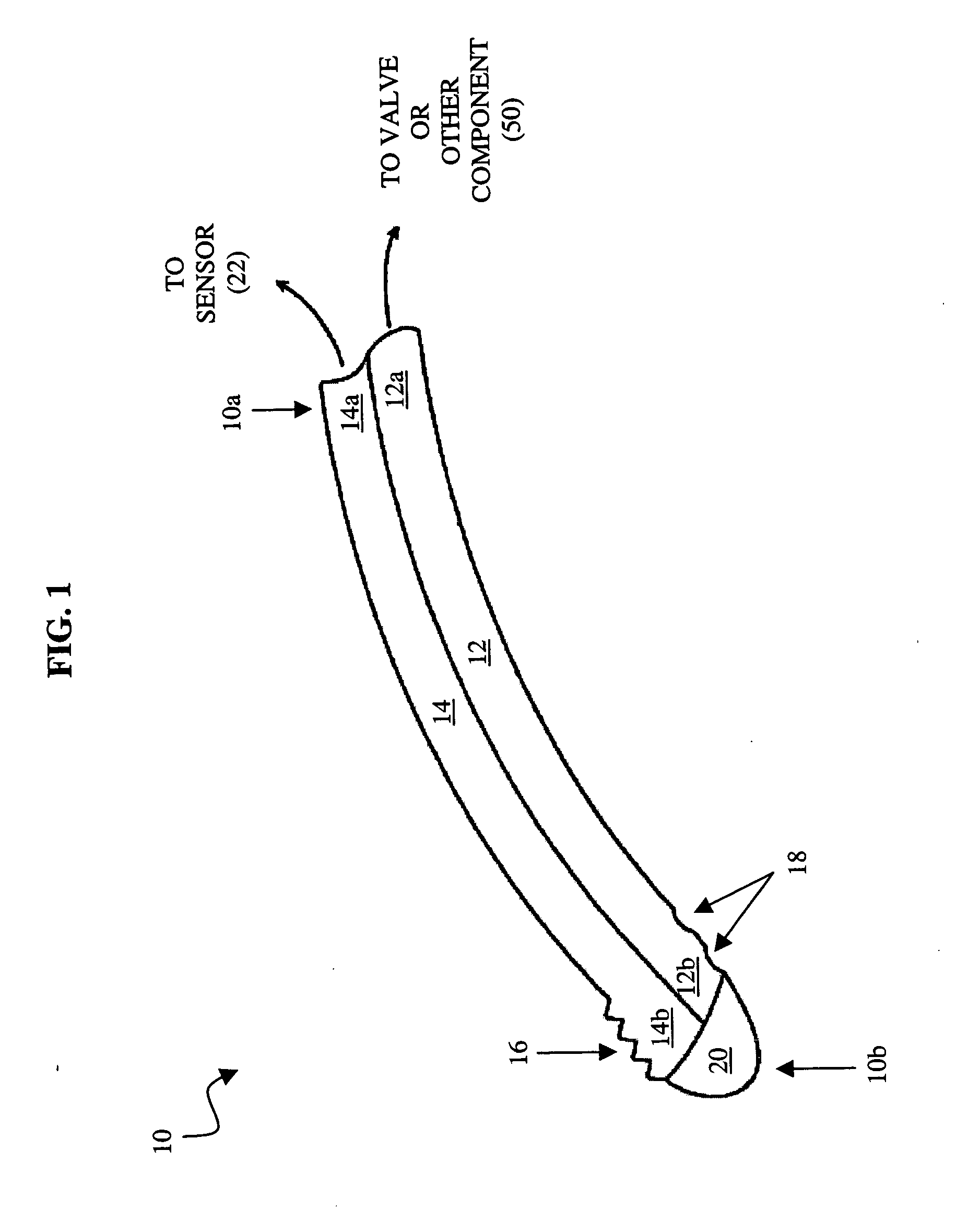
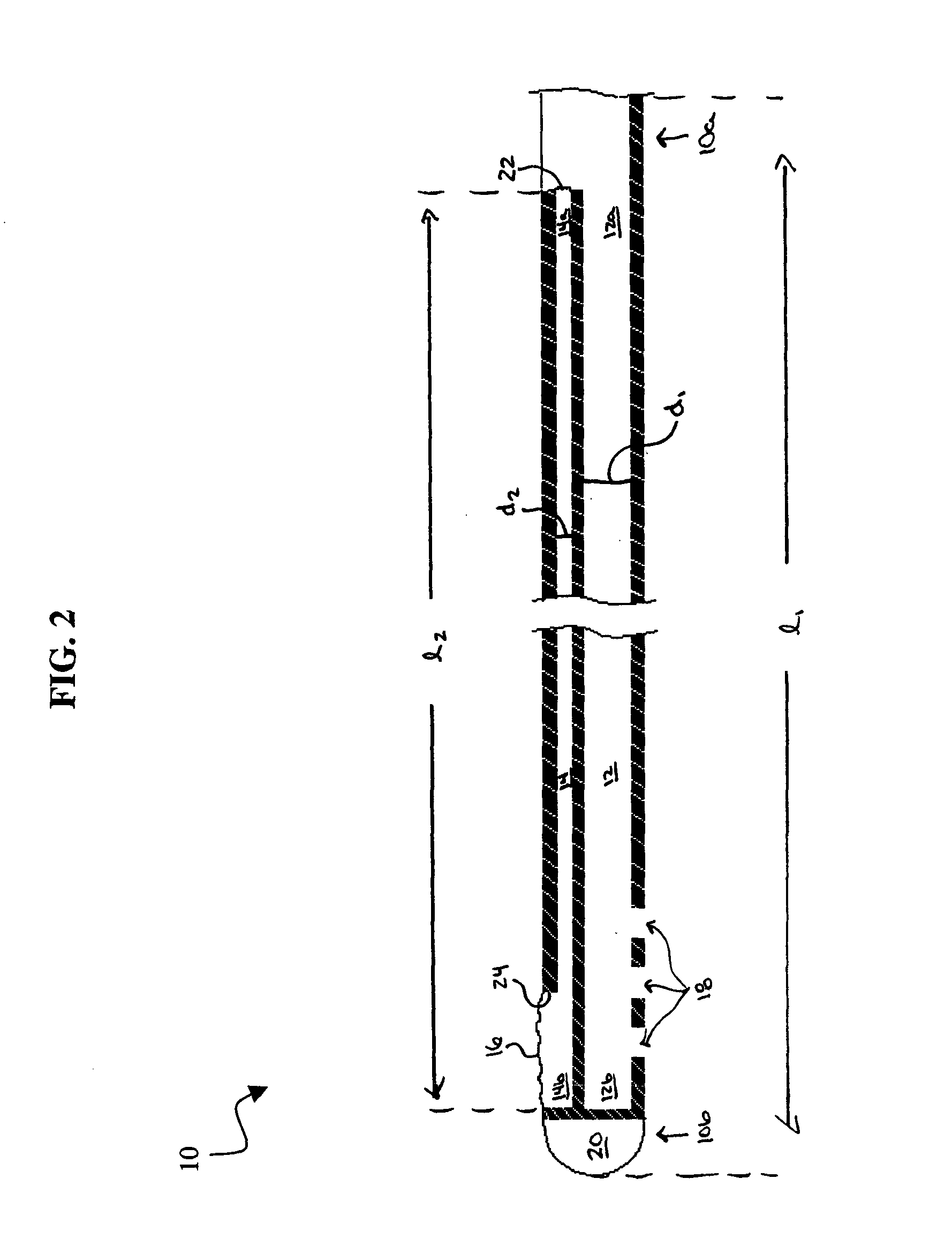
In other aspects of the present invention, a method for manufacturing an intra-ventricular pressure sensor device is provided. The method includes the step of forming a catheter having a first lumen adapted to receive fluid flow therethrough, and a second lumen extending between a proximal, pressure sensor and a distal end in communication with an opening formed in a sidewall of the catheter. The second lumen is then filled with fluid, and a solvent-based solution is sprayed over the opening formed in the sidewall of the catheter to form a flexible membrane that is effective to seal the fluid within the second lumen in the catheter. The solvent-based solution should be effective to adhere to the catheter. Preferably, all voids in the second lumen are removed from the second lumen after the second lumen is filled with fluid, and prior to spraying the solution onto the catheter.
Problems solved by technology
Blockage of the flow of CSF consequently creates an imbalance between the amount of CSF produced by the choroid plexus and the rate at which CSF is absorbed into the bloodstream, thereby increasing pressure on the brain, which causes the ventricles to enlarge.
One common problem encountered with the use of ventricular catheters is the difficulty in measuring the pressure within the patient's ventricle.
Such pressure sensors however, require a high degree of miniaturization and are therefore sensitive to environmental degradation.
While this technique is advantageous in that it allows the use of a relatively large sensor, catheter blockage can impede the pressure sensed by the sensor, thus preventing an accurate measurement of intra-ventricular pressure from being obtained.
Method used
the structure of the environmentally friendly knitted fabric provided by the present invention; figure 2 Flow chart of the yarn wrapping machine for environmentally friendly knitted fabrics and storage devices; image 3 Is the parameter map of the yarn covering machine
View moreImage
Smart Image Click on the blue labels to locate them in the text.
Smart ImageViewing Examples

Examples
Experimental program
Comparison scheme
Effect test
example 1
A silicone catheter having a first lumen and a second lumen that is filled with silicone fluid has the following properties: μ=10−3 l=0.1 m a=1.10−3 m d=0.5.10−3 m E=5000 psi
Thus, 512·10-3·(0.1)2·(10-3)234·106·(0.5·10-3)2[(1·10-3)2-(0.5·10-3)2]=8.10-4<0.01
Accordingly, a catheter 10 having the above dimensions would satisfy the requirement for low system compliance, allowing the use of such a construct for the measurement of intra-ventricular pressure without loss of signal fidelity.
A person skilled in the art will appreciate that a variety of factors should be considered in optimizing the system to provide an accurate pressure reading.
the structure of the environmentally friendly knitted fabric provided by the present invention; figure 2 Flow chart of the yarn wrapping machine for environmentally friendly knitted fabrics and storage devices; image 3 Is the parameter map of the yarn covering machine
Login to View More PUM
 Login to View More
 Abstract
An intra-ventricular pressure sensor device is provided that includes a catheter having a first lumen for receiving fluid flow therethrough, and a second, separate, fluid-filled, fluid-impermeable lumen extending between a pressure-sensitive component that is adapted to be exposed to an external pressure source, and a pressure sensor that is effective to measure pressure of the external pressure source in response to displacement of the pressure-sensitive component. The intra-ventricular pressure sensor device is particularly advantageous in that it allows a direct measurement of a patient's ventricular pressure to be obtained.
Description
FIELD OF THE INVENTION The present invention relates to a catheter device having a pressure sensor disposed therein. BACKGROUND OF THE INVENTION Hydrocephalus is a neurological condition that is caused by the abnormal accumulation of cerebrospinal fluid (CSF) within the ventricles, or cavities, of the brain. CSF is a clear, colorless fluid that is primarily produced by the choroid plexus and surrounds the brain and spinal cord. CSF constantly circulates through the ventricular system of the brain and is ultimately absorbed into the bloodstream. CSF aids in the protection of the brain and spinal cord. Because CSF keeps the brain and spinal cord buoyant, it acts as a protective cushion or “shock absorber” to prevent injuries to the central nervous system. Hydrocephalus, which affects children and adults, arises when the normal drainage of CSF in the brain is blocked in some way. Such blockage can be caused by a number of factors, including, for example, genetic predisposition, intr...
Claims
the structure of the environmentally friendly knitted fabric provided by the present invention; figure 2 Flow chart of the yarn wrapping machine for environmentally friendly knitted fabrics and storage devices; image 3 Is the parameter map of the yarn covering machine
Login to View More Application Information
Patent Timeline
 Login to View More
 IPC IPC(8): A61B5/03A61B5/00A61M25/00
CPCA61B5/031A61M2025/0003A61M27/006
InventorROSENBERG, MEIR
OwnerCODMAN & SHURTLEFF INC