
Corrosion-resistant member and process of producing the same
a technology of corrosion resistance and corrosion resistance, which is applied in the direction of metallic material coating process, natural mineral layered products, electrical equipment, etc., can solve the problems of large apparatus scale, low large particle generation, so as to improve the corrosion resistance of the same, the effect of good bonding of particles and less particle generation
- Summary
- Abstract
- Description
- Claims
- Application Information
AI Technical Summary
Benefits of technology
Problems solved by technology
Method used
Image

Examples
first embodiment
[0025] The first embodiment of the present invention is to provide a corrosion-resistant member comprising a base material having formed thereon a sprayed coating, the sprayed coating being formed on the site of the base material to exposed to corrosive gases or plasma and comprising Si, O, N, Group 2a element, and at least one element selected from the group consisting of Al, B, Zr and Ti.
[0026] The Group 2a element used herein means Group 2a element in the Periodic Table, and specifically means Be, Mg, Ca, Sr and Ba. The sprayed coating constituting the corrosion-resistant member of the present invention comprises glass as the main component. Therefore, the sprayed coating has low reactivity with corrosive gases or its plasma. Even if the sprayed coating is reacted with fluorine in the corrosive gas, the resulting product is a high boiling compound which is difficult to be etched by plasma. Thus, the sprayed coating has the effect to suppress etching with plasma or corrosive gase...
second embodiment
[0036] The second embodiment of the present invention is to provide a corrosion-resistant member comprising a base material having formed thereon a sprayed coating, the sprayed coating being formed on the site of the base material to exposed to corrosive gases or plasma and comprising Si, O, N, Group 3a element, and at least one element selected from the group consisting of B, Zr and Ti.
[0037] The Group 3a element used herein means Group 3a element in the Periodic Table, and specifically means Sc, Y and lanthanoid element. The material containing Group 3a element, Zr and Ti has low reactivity with corrosive gases or its plasma. Even if the sprayed coating is reacted with fluorine in the corrosive gas, the resulting product is a high boiling compound. Thus, the sprayed coating has the effect to suppress etching with plasma or corrosive gases.
[0038] Regarding the concentration of each component in the corrosion-resistant member in the second embodiment, when Zr and / or Ti are used, i...
third embodiment
[0044] The production process of the corrosion-resistant member according to the first and second embodiments is described below as the third embodiment.
[0045] The corrosion-resistant member can be produced by forming a corrosion-resistant sprayed coating on a base material by spraying.
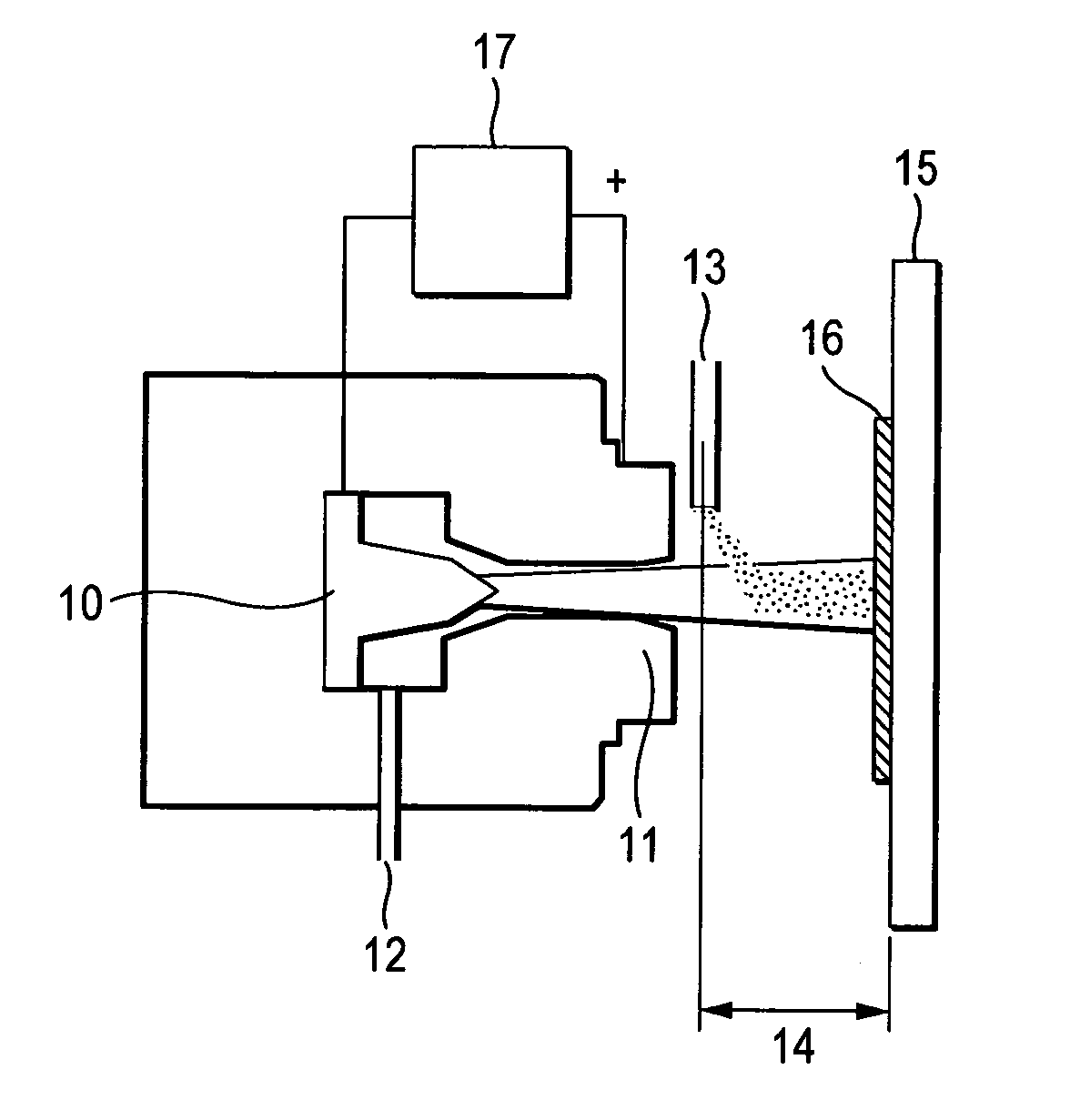
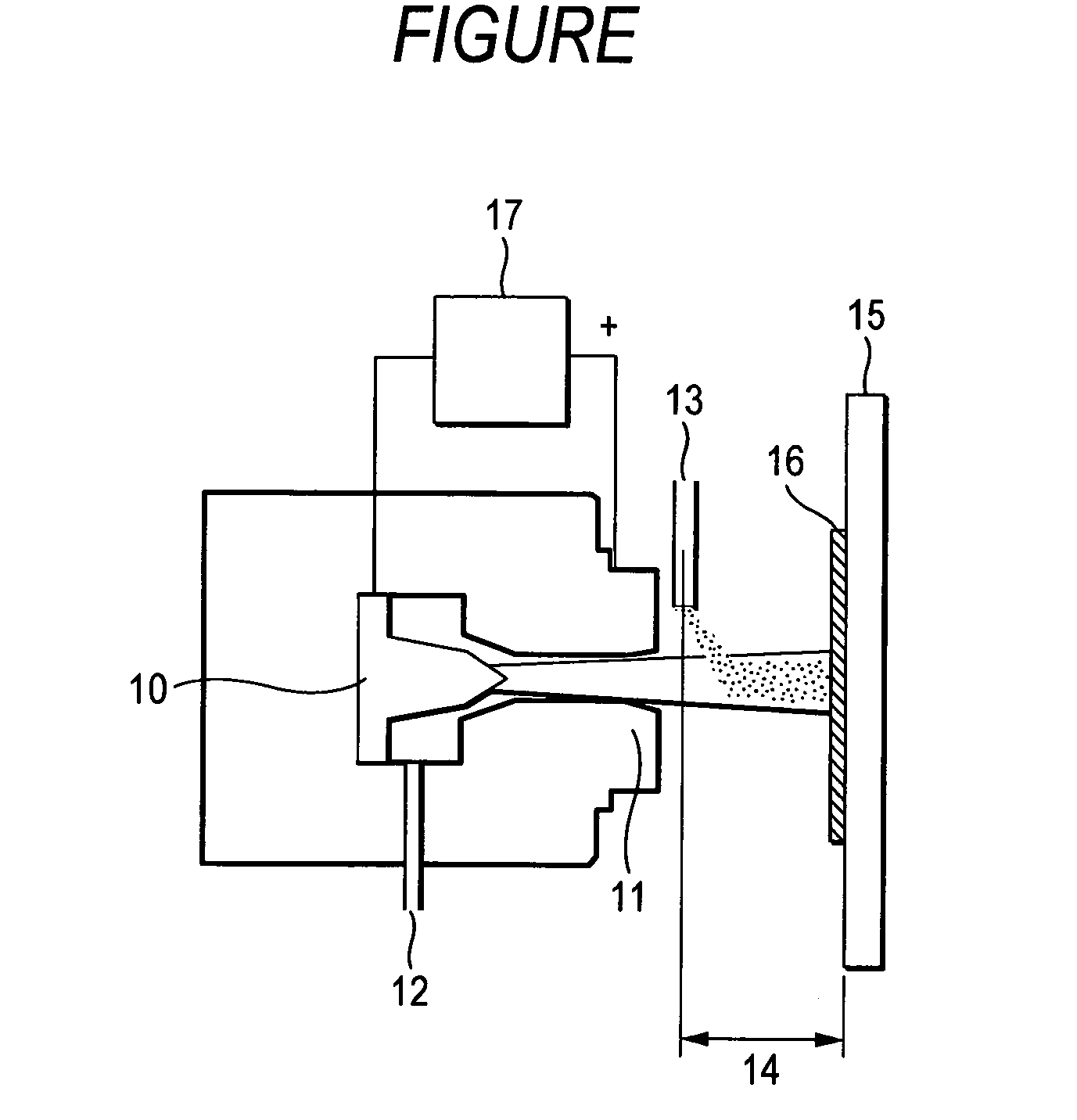
[0046] The spraying method used is preferably a plasma spray. The FIGURE shows a general plasma spraying device. The plasma spraying device functions as follows. Plasma gas 12 flown between an anode 11 and a cathode 12 causes arc discharge to form a plasma jet. The plasma jet is used as a heat source to melt a spraying powder 13. The molten spraying powder strikes a base material 15 and deposits thereon.
[0047] The plasma spraying device can use an inert gas such as N2 or Ar, reducing gas such as H2, or a mixed gas of those, as a plasma gas. Where a nitrogen-containing substance is sprayed, if a plasma gas contains oxygen, decomposition occurs during spraying, and nitrogen disappears from the spraye...
PUM
| Property | Measurement | Unit |
|---|---|---|
| power | aaaaa | aaaaa |
| distance | aaaaa | aaaaa |
| particle diameter | aaaaa | aaaaa |
Abstract
Description
Claims
Application Information
 Login to View More