Y/C separation with 3D comb filter

Inactive Publication Date: 2006-06-15
VXIS TECH CORP
View PDF12 Cites 9 Cited by
  • Summary
  • Abstract
  • Description
  • Claims
  • Application Information

AI Technical Summary

Benefits of technology

[0005] The present invention uses a 2D comb filter to output a 2D chrominance signal by comparing the current scan-line signals with the signals before and after the current scan-line signals. Then a 3D chrominance signal is acquired by directly subtracting two adjacent 2D image signals and then dividing by 2 to get an approximate 3D chrominance signal of the two 2D images. A ratio mixing is performed on the 2D chrominance signal and the 3D chrominance signal to output a near-actual chrominance signal. A chrominance variation value can be acquired by comparing the chrominance signals of the two adjacent images. Hence the present invention can control the mixture ratio value of the CPfade factor of the first dimension and the third dimension chrominance signals in accordance with the chrominance variation, so that the second dimension chrominance signals can be accurately adjusted, which is applied particularly to high frequency image signals. Therefore the present invention can improve the missing color image output problem without setting an extra mixture ratio value.

Problems solved by technology

However, a 2D comb filter may generate errors or tend to be complex in line layout.
Moreover, when a 2D comb filter processes high frequency video signals, since the luminance of the previous scan line and the current scan line changes very rapidly, an erroneous judgment may occur, so as to cause a missing color problem.

Method used

the structure of the environmentally friendly knitted fabric provided by the present invention; figure 2 Flow chart of the yarn wrapping machine for environmentally friendly knitted fabrics and storage devices; image 3 Is the parameter map of the yarn covering machine
View more

Image

Smart Image Click on the blue labels to locate them in the text.
Viewing Examples
Smart Image
  • Y/C separation with 3D comb filter
  • Y/C separation with 3D comb filter
  • Y/C separation with 3D comb filter

Examples

Experimental program
Comparison scheme
Effect test

Embodiment Construction

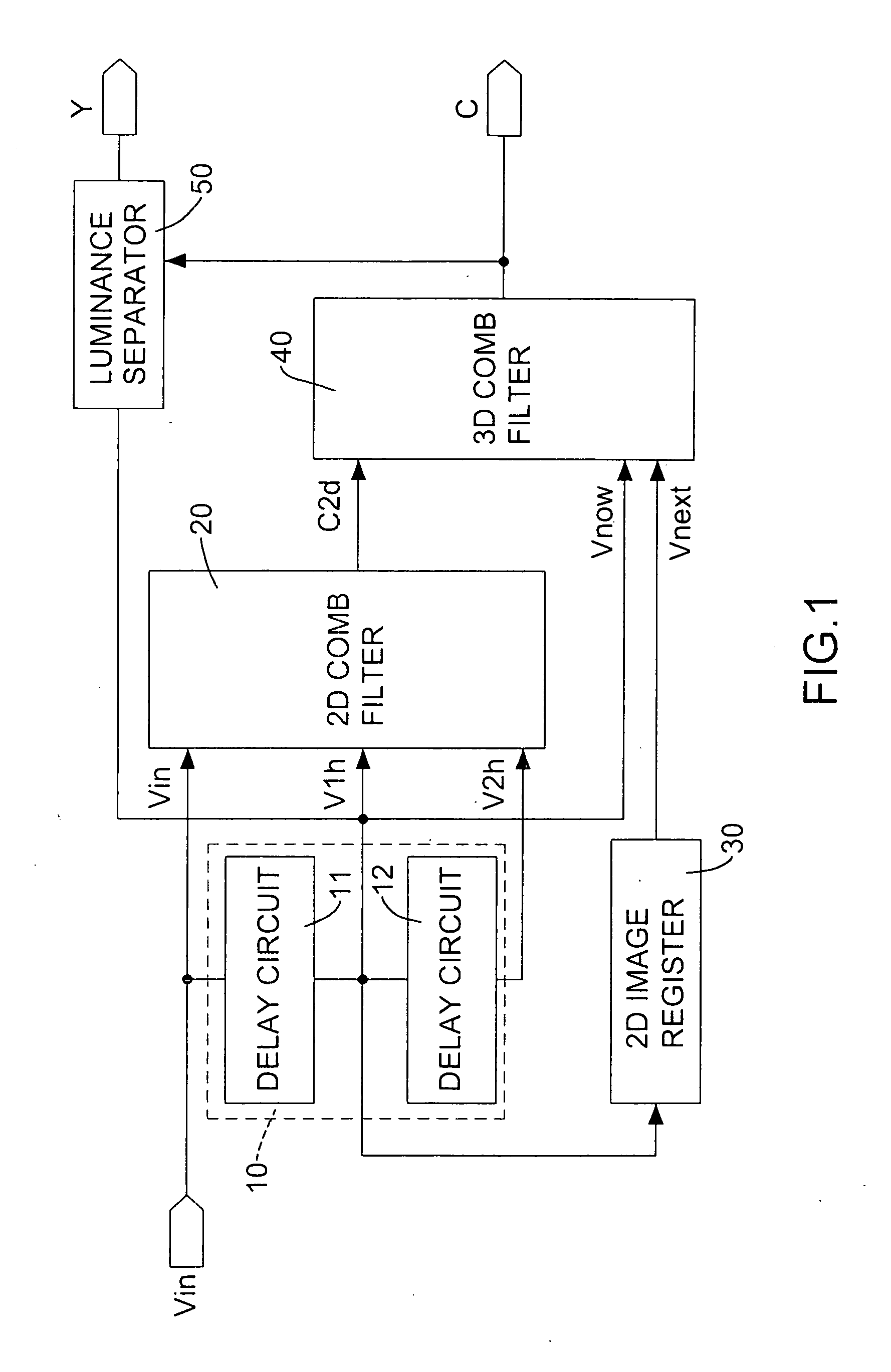
[0011] A Y / C separation circuit of a three-dimension (hereafter abbreviated as 3D) image signal of the present invention is provided. With reference to FIG. 1, a functional block diagram of the present invention includes a delay unit 10, a 2D comb filter 20, a 2D image register 30, a 3D comb filter 40 and a luminance separator 50.

[0012] The delay unit 10 includes two delay circuits 11 and 12. The two delay circuits 11, 12 are series connected to an image signal input terminal Vin for simultaneous outputting of a current image scan signal Vin and two scan signals V1h and V2h, which occur before and after the current scan signal Vin, respectively, so as to have three scan signals. Between the two delay circuits 11, 12 is the image scan signal V1h, which will undergo chrominance separation.

[0013] Every input terminal of the 2D comb filter 20 is connected respectively to the image signal input terminal and output terminals of the delay unit 10 to receive the three adjacent scan signal...

the structure of the environmentally friendly knitted fabric provided by the present invention; figure 2 Flow chart of the yarn wrapping machine for environmentally friendly knitted fabrics and storage devices; image 3 Is the parameter map of the yarn covering machine
Login to View More

PUM

No PUM Login to View More

Abstract

The present invention uses a 2D comb filter 20 to output a 2D chrominance signal C2d by comparing the current scan-line signals with the signals before and after the current scan-line signals. A 3D chrominance signal C3d is then acquired by directly subtracting two adjacent 2D image signals and then dividing by 2 to get an approximate chrominance signal C3d of the two 2D images. Ratio mixing is performed on the 2D chrominance signal C2d and the 3D chrominance signal C3d to output a near-actual chrominance signal. A chrominance variation value can be acquired by comparing the chrominance signals of the two adjacent images. Finally, an actual luminance signal of the current scan-line is separated by deducting the near-actual chrominance signal from the signals of the current scan-line to restore the luminance signal.

Description

BACKGROUND OF THE INVENTION [0001] 1. Field of the Invention [0002] The invention relates in general to a Y / C separation with 3D comb filter, and more particularly to a 3D image separation technique to separate Y / C signals of video signals to make chrominance signals of high frequency image signals close to actual chrominance to avoid a missing color problem. [0003] 2. Description of the Related Art [0004] A conventional 2D comb filter separates chrominance (color) from luminance (brightness) information in a video signal for independent processing to improve picture resolution and minimize distortion. A 2D comb filter only performs operations on demodulated signals and adjacent horizontal scan-line signals. However, a 2D comb filter may generate errors or tend to be complex in line layout. Moreover, when a 2D comb filter processes high frequency video signals, since the luminance of the previous scan line and the current scan line changes very rapidly, an erroneous judgment may occ...

Claims

the structure of the environmentally friendly knitted fabric provided by the present invention; figure 2 Flow chart of the yarn wrapping machine for environmentally friendly knitted fabrics and storage devices; image 3 Is the parameter map of the yarn covering machine
Login to View More

Application Information

Patent Timeline
no application Login to View More
IPC IPC(8): H04N9/77
CPCH04N9/78
InventorHUANG, YUAN-HAOHO, JEN-YAO
OwnerVXIS TECH CORP