
Method and apparatus for verifying memory testing software
- Summary
- Abstract
- Description
- Claims
- Application Information
AI Technical Summary
Benefits of technology
Problems solved by technology
Method used
Image

Examples
Embodiment Construction
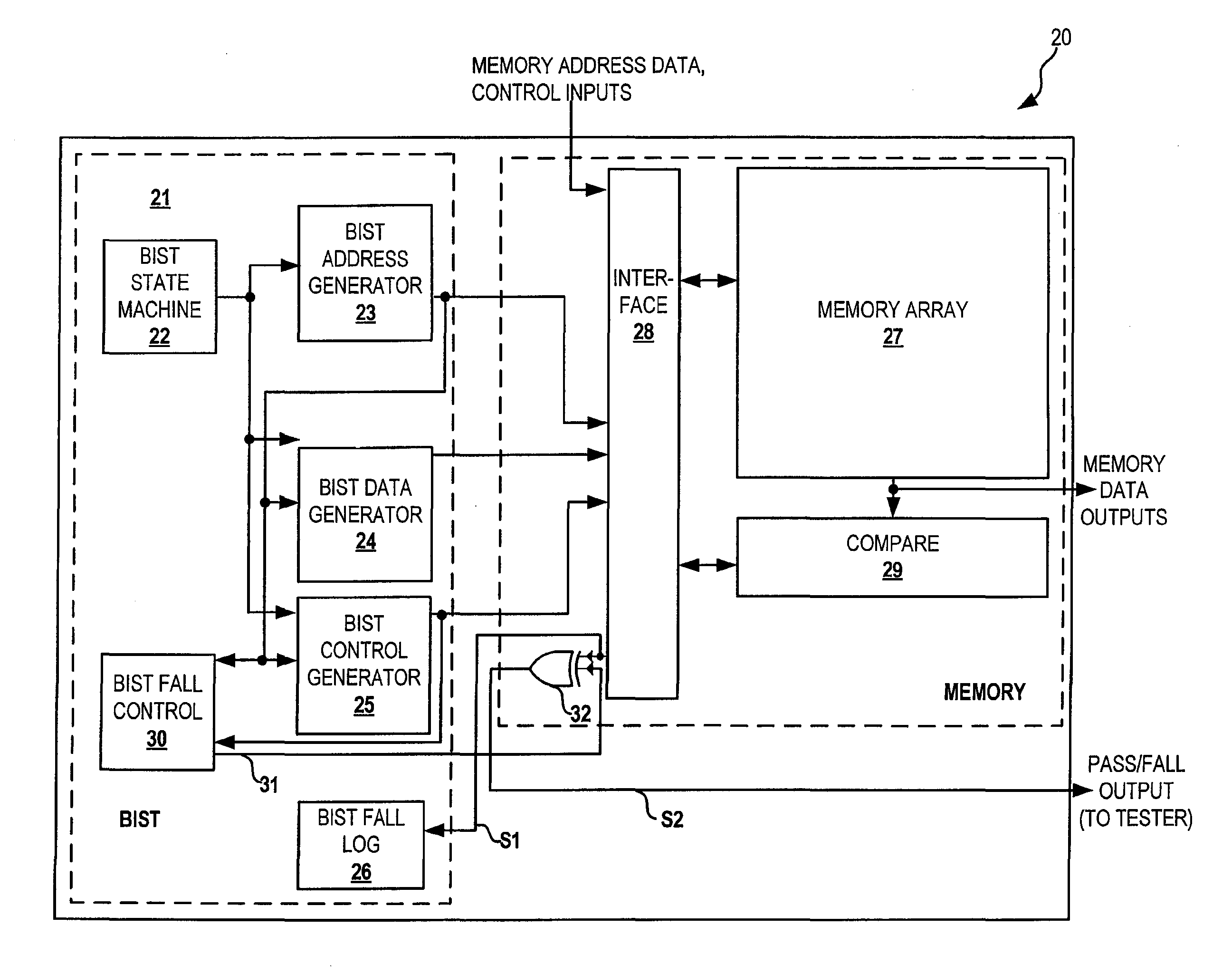
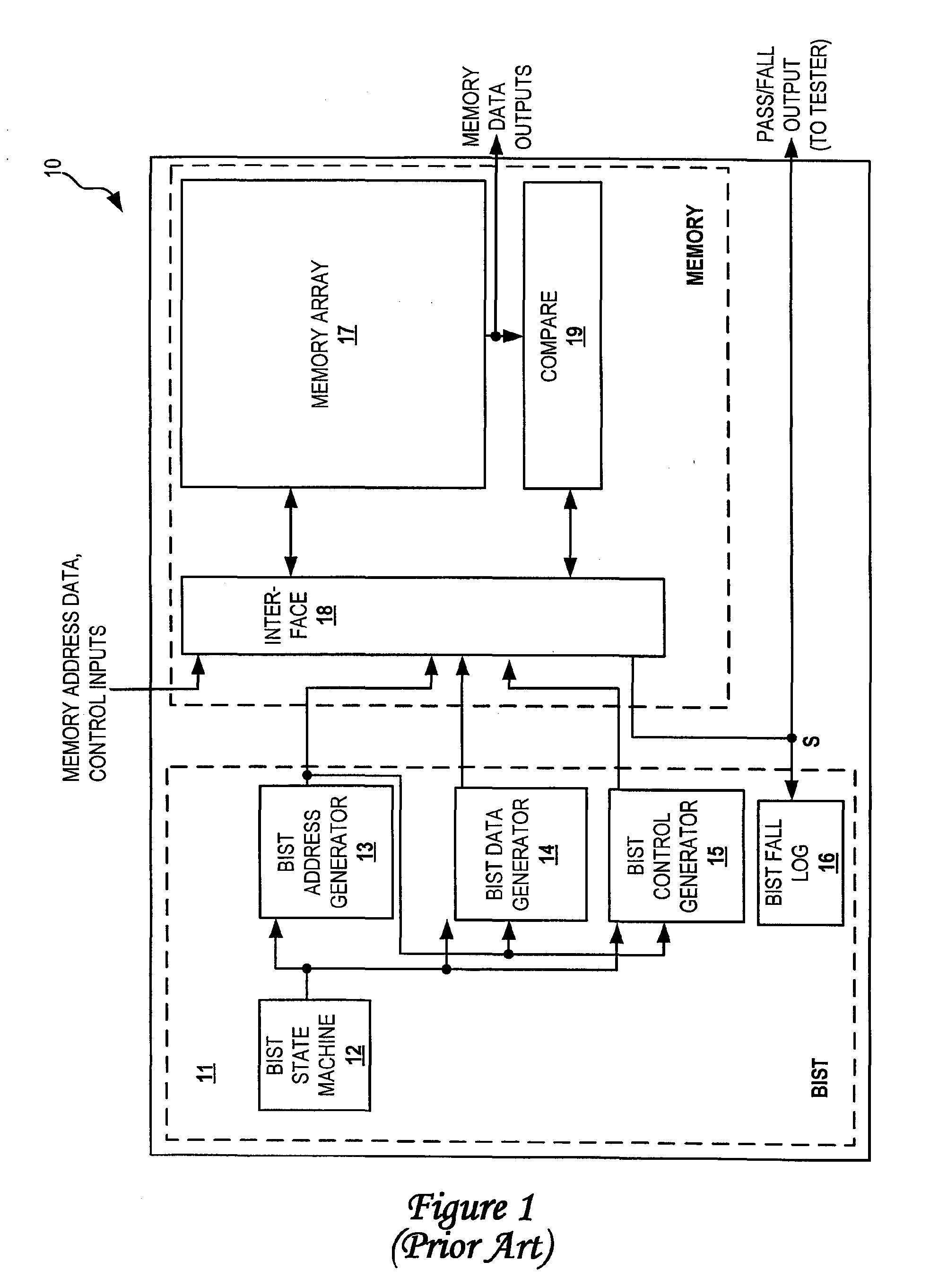
[0016] Referring now to the drawings and in particular to FIG. 1, there is illustrated a block diagram of a built-in self-test (BIST) configuration within a memory device, according to the prior art. As shown, a BIST 11 is coupled to a memory array 17 via an interface 18 within a memory device 10. BIST 11 includes a BIST state machine 12 for controlling a BIST address generator 13, a BIST data generator 14 and a BIST control generator 15. BIST 11 tests memory array 17 by performing a series of read and write operations on memory array 17 in sequences that are well-known to those skilled in the art. After comparing the expected data from BIST 11 to the actual data coming from memory array 17 from a read operation, a compare module 19 generates a pass / fail signal S to indicate whether or not there is a match. Pass / fail signal S is recorded in a BIST fail log 16. At the end of a BIST sequence, BIST fail log 16 can be used to determine if a memory fail occurred at any time during the BI...
PUM
 Login to View More
 Abstract
Description
Claims
Application Information
 Login to View More