
Continuous biomolecule separation in a nanofilter
- Summary
- Abstract
- Description
- Claims
- Application Information
AI Technical Summary
Benefits of technology
Problems solved by technology
Method used
Image

Examples
example 1
Fabrication of an Embodiment of the Microseparator
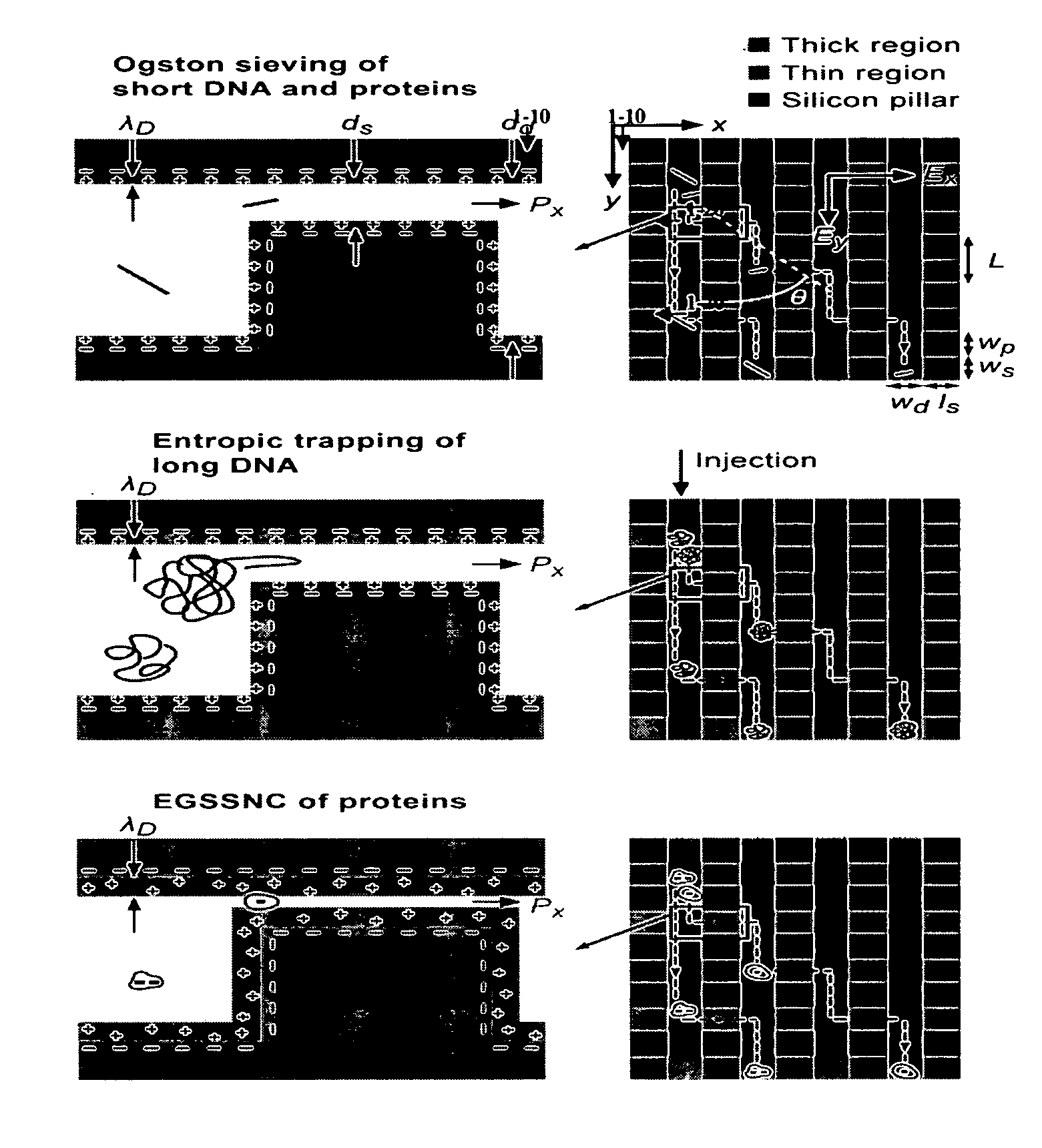
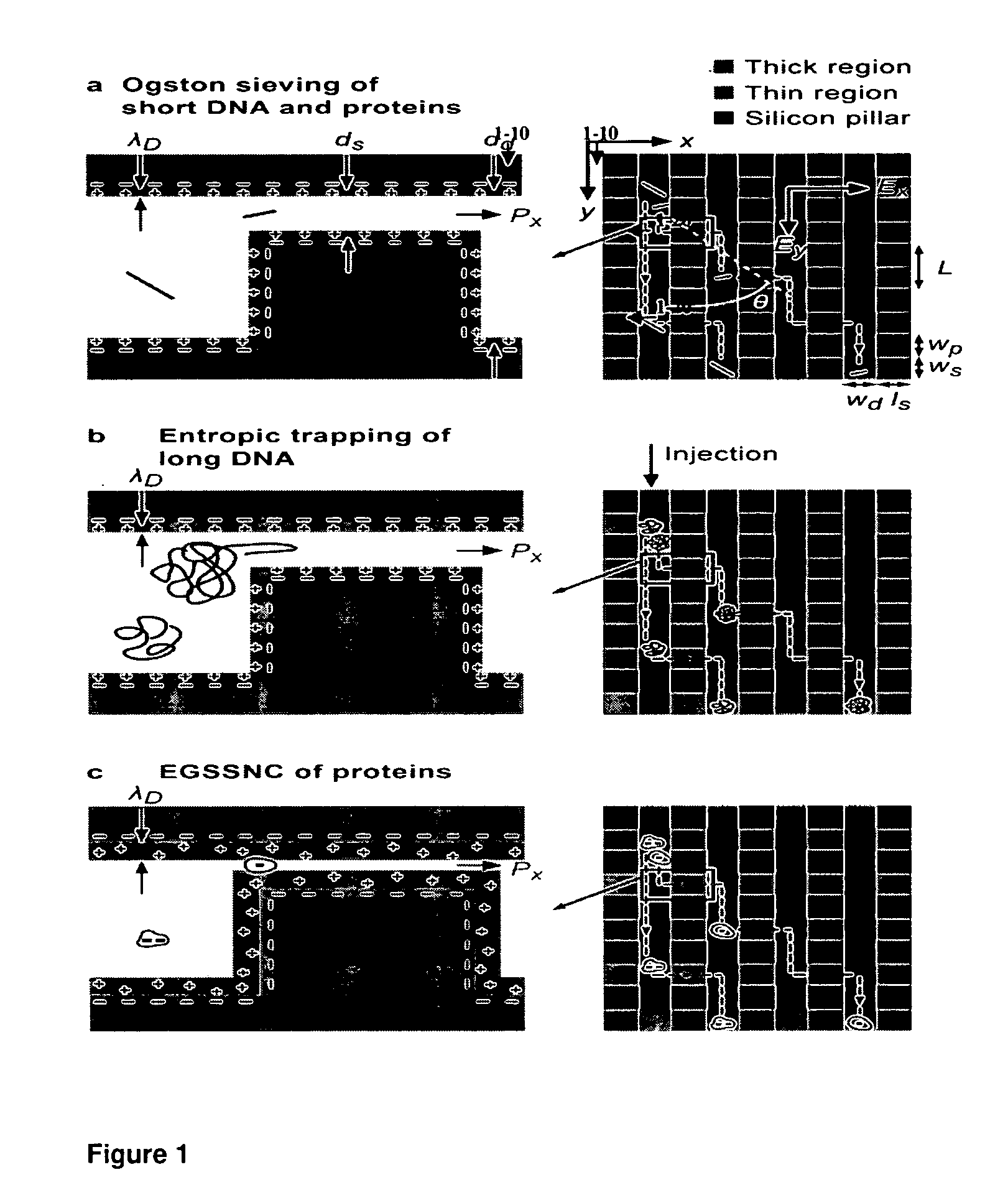
[0161] To construct a device, which can continuously fractionate small biomolecules such as proteins based on their sizes, a nanofilter array chip was fabricated. The microchip comprising nanofilters, representing an embodiment of this inventuion, was constructed using conventional photolithography and reactive ion etching (RIE) techniques, with nanofilter gap thickness (ds) as thin as 20 nm. The microchip was constructed to comprise thick channels (1-10) with width Ld separated by rows of nanofilters (1-20) with width of Ws and length Ls. Rectangle-shaped silicon pillars (1-30) were designed with width of Wp to serve as supporting structures. The rows of nanofilters and silicon pillars may optionally have a lateral shift (FIG. 1A).
[0162] The separation mechanism of the sorter relies on different sieving characteristics along two orthogonal directions within the sorter, which are set perpendicular and parallel to the nanofilter row...
example 2
Operation of the Mieroseparator in Continuous-Field Mode
[0170] Molecules that can be separated in such a chip include, but are not limited to, proteins and DNA, RNA, carbohydrate (sugar), nanoparticles, and small organelles.
[0171] Optimal sieving with a nanofilter is expected when the molecule size is comparable with the nanofilter thin gap size. However, the gap size of the nanofilter does not have to be smaller than the size of the molecule. Indeed, the separation of SDS-proteins (typically ˜10 nm in physical dimensions) using nanofilters as large as 60 nm is feasible. If one wishes to separate different (larger or smaller) biomoelcules in this chip, nanofilter gap size can be adapted to the molecules to be separated.
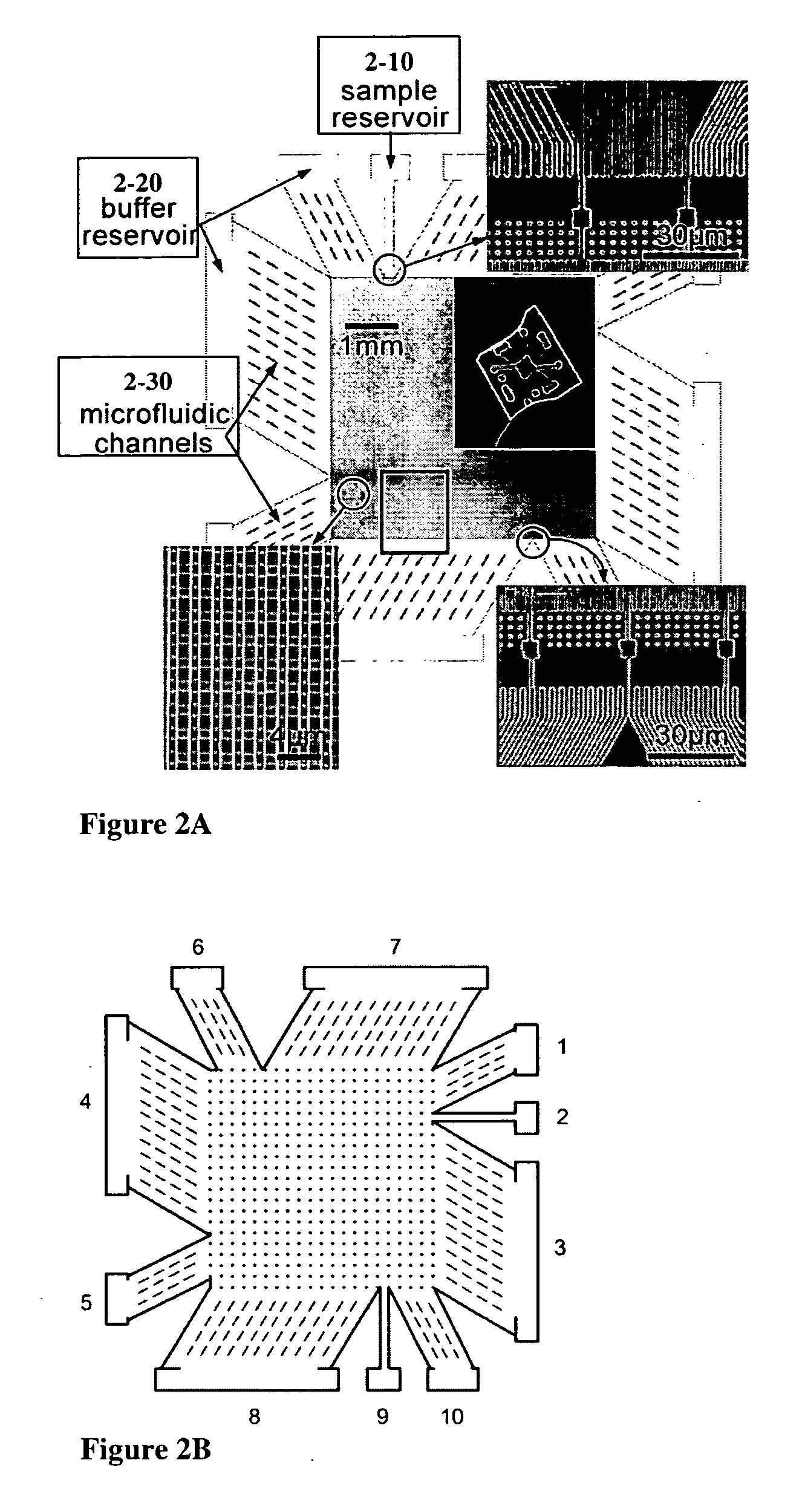
[0172] To demonstrate continuous-flow separation of small biomolecules with the invention of the nanofilter array chip SDS-protein complexes and small double-stranded DNA molecules were separated using a microchip, as depicted in FIG. 2, in continuous field separat...
example 3
Operation of the Microseparator in Pulse-Field Separation Mode
[0174] In another embodiment of the microseparator, separation can also be achieved using alternating electric fields of different strengths and / or durations in the pulse-field separation mode (FIG. 4). In the embodiment presented here, the voltage was applied at different reservoirs, where the horizontal electric field (Eh) alternated with the vertical electric field (Ev), and increasing the duration of the vertical force field enhanced the separation. Thus more size-differential jumpings over the nanofilters were experienced in the case of longer duration of the vertical electric field.
[0175] While many different artificial molecular sieving matrixes are known in the art for size-fractionation of biomolecules based on different mechanisms, to date, microfabricated artificial sieving systems have been limited for separation of large biomolecules such as viral DNA, mainly because it is generally challenging to fabricate...
PUM
 Login to View More
 Abstract
Description
Claims
Application Information
 Login to View More