Unlock instant, AI-driven research and patent intelligence for your innovation.

Bi-planar network architecture

Inactive Publication Date: 2007-08-16
TREND MICRO INC
View PDF20 Cites 4 Cited by
  • Summary
  • Abstract
  • Description
  • Claims
  • Application Information

AI Technical Summary

Benefits of technology

[0029]Other features and advantages of various aspects and embodiments of the present invention will become apparent from the following description and from the claims.

Problems solved by technology

Although these control functions often work relatively well for their individual intended purposes, their introduction (whether in the form of point solution appliances or bolt-ons to switches and routers) has led to high-cost, difficult-to-manage network environments.
The problems addressed, however inadequately, by such added control functions are only growing in scope and complexity.
These threats can lead to catastrophic business downtime and even legal liability for invasion of privacy.
Combining these multiple kinds of traffic into a single IP network is leading to application performance issues that the connectivity plane (e.g., switches and routers) was not designed to address.
For example, conventional connectivity networks were not designed to provide the quality of service (QoS), authentication, encryption, and threat management needed for these new business-critical functions.
As an example, conventional connectivity networks typically lack the ability to maintain the high QoS required by voice traffic in the face of bursts of data traffic on the same network.
Furthermore, the cost of network downtime has skyrocketed.
When businesses relied on their IP networks only for data traffic, and when such data traffic was required for only a small portion of the business' activities, the cost of having an email server down for an hour was relatively low.
Now that voice, data, video, application and other traffic are combined onto the same network, and now that an increasingly large percentage of business functions rely on such traffic, the cost of network downtime is signifcantly higher.
In essence, when the network stops, the business stops, leading to lost productivity, lost revenue, and customer dissatisfaction.
From a technical perspective, CIOs know that the current connectivity network cannot resolve security and application performance issues.
In turn, from a financial perspective, CFOs are concerned that it will be too expensive to solve these problems by performing a “forklift upgrade”—replacing the entire connectivity plane with new hardware.
Finally, from an overall business perspective, CEOs cannot tolerate network security downtime risk, and are demanding predictable, stable application performance.
A bare IP network typically does not perform any kind of “access control”—controlling which users and devices can access the network.
As a result, the perimeter has blurred, thereby limiting the utility of firewalls and other systems which are premised on a clear inside-outside distinction.
Today's networks are constantly under attack, both by directed and non-directed attacks.
Furthermore, the attacks continually evolve, often making yesterday's defenses obsolete.
The typical cost of a successful attack is higher today than in the past because of the increased value of information stored on modern networks.
The same use of the network to connect a larger number and wider variety of devices that leads to problems for traditional access control mechanisms has also spurred the use of the network to store increasingly high-value information.
Anyone who has attempted to store copies of the same data on a desktop computer, laptop computer, PDA, and cell phone, and to synchronize that data across all of the devices, knows that storing data at the edge of the network can be inefficient.
Furthermore, a bare IP network does not perform any kind of “application control”.
But they do so at the risk of exposing telephony, an application of extremely high availability expectation, to the perils of the IP environment.
The challenge is to imbue telephony with the benefits of IP networks without sacrificing quality of service.
Unproductive network traffic has also increased due to the emergence of bandwidth-consuming peer-to-peer applications, such as BitTorrent, Kazaa, and Gnutella.
Furthermore, as new devices connect to the network, bandwidth increases accordingly, as well as the probability of a malfunctioning device flooding the network with garbage traffic.
Conventional connectivity networks, which do not distinguish between packets delivered by or transmitted to different applications, are unequipped to address these problems.

Method used

the structure of the environmentally friendly knitted fabric provided by the present invention; figure 2 Flow chart of the yarn wrapping machine for environmentally friendly knitted fabrics and storage devices; image 3 Is the parameter map of the yarn covering machine
View more

Image

Smart Image Click on the blue labels to locate them in the text.
Viewing Examples
Smart Image
  • Bi-planar network architecture
  • Bi-planar network architecture
  • Bi-planar network architecture

Examples

Experimental program
Comparison scheme
Effect test

Embodiment Construction

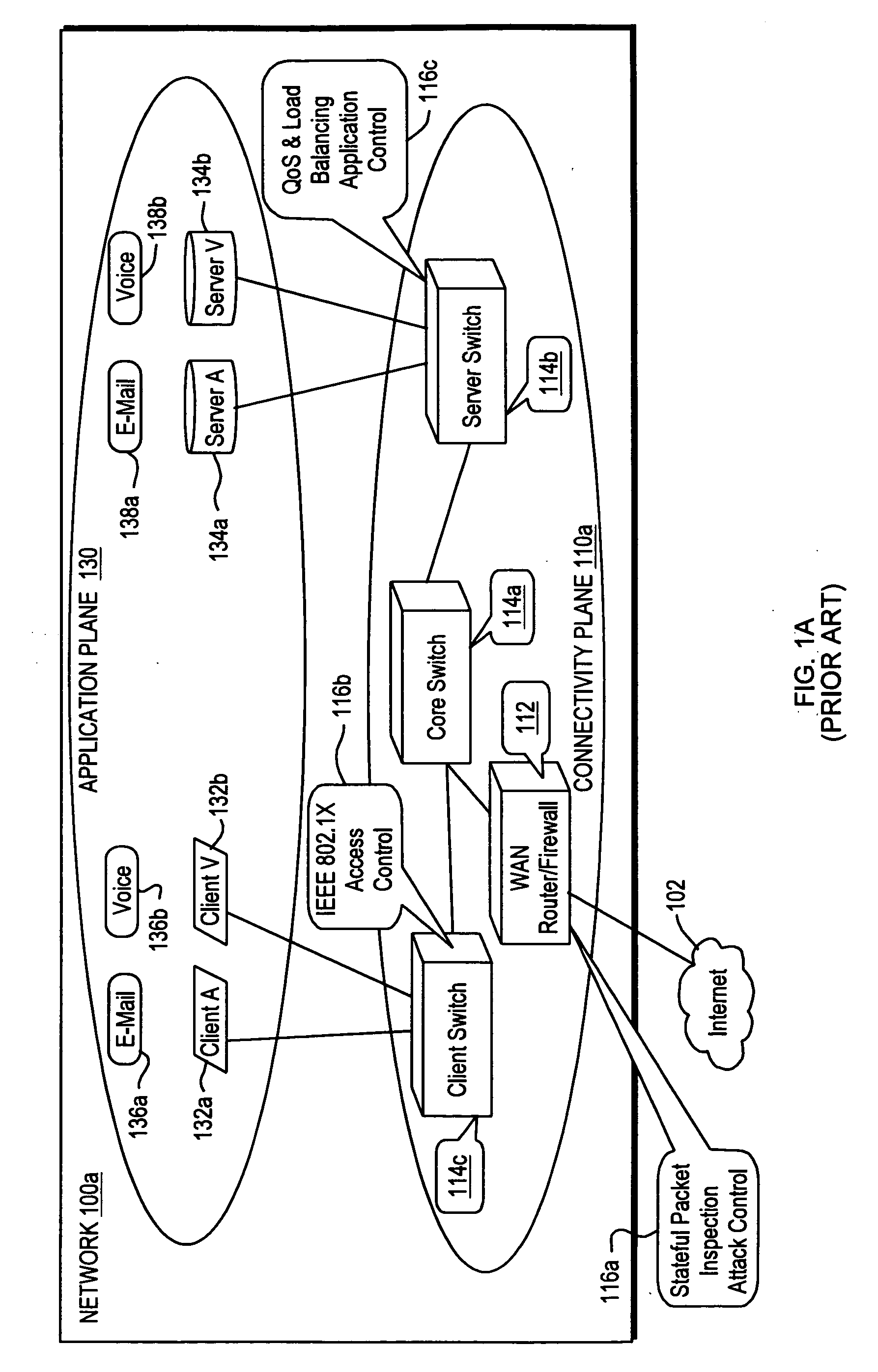
[0038]Referring to FIG. 1A, a high-level functional diagram is shown of a prior art electronic communication network 100a. The network 100a includes a connectivity plane 110 and an application plane 130. The connectivity plane 110 and application plane 130 may be of various types well-known to those having ordinary skill in the art. The connectivity plane 110 may, for example, include conventional routers 112 and switches 114 (such as layer 2 and / or 3 switches). The application plane 130 may include, for example, web, email, and voice applications.

[0039]More specifically, in the example illustrated in FIG. 1A, the application plane 130 includes two clients 132a-b and two servers 134a-b. Client 132a is an email client which handles email data 136a, while Client 132b is a voice application which handles voice data 136b. Similarly, Server 134a is an email server which serves email data138a, while Server 134b is a voice server which serves voice data 138b.

[0040]The connectivity plane 1...

the structure of the environmentally friendly knitted fabric provided by the present invention; figure 2 Flow chart of the yarn wrapping machine for environmentally friendly knitted fabrics and storage devices; image 3 Is the parameter map of the yarn covering machine
Login to View More

PUM

No PUM Login to View More

Abstract

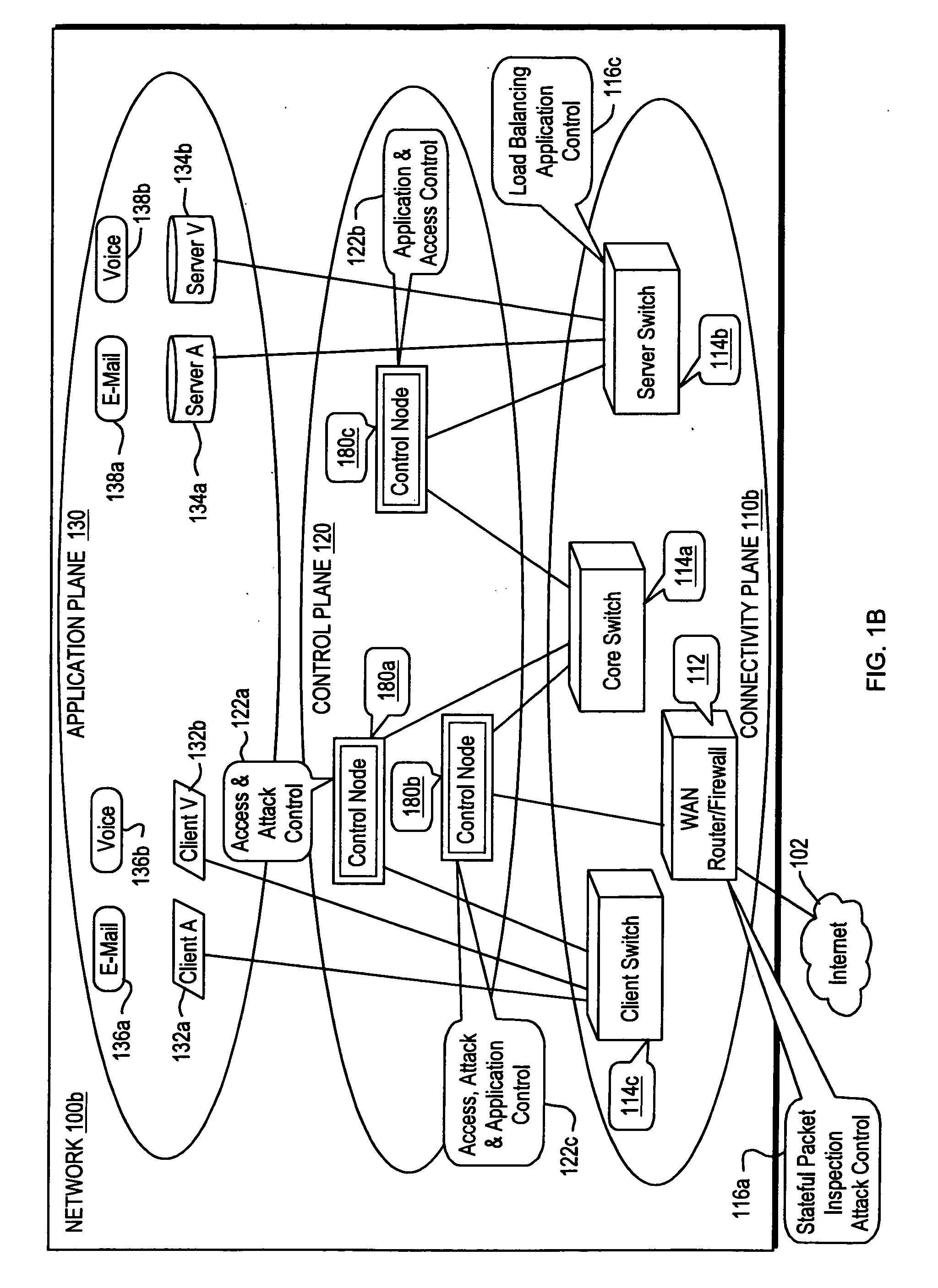
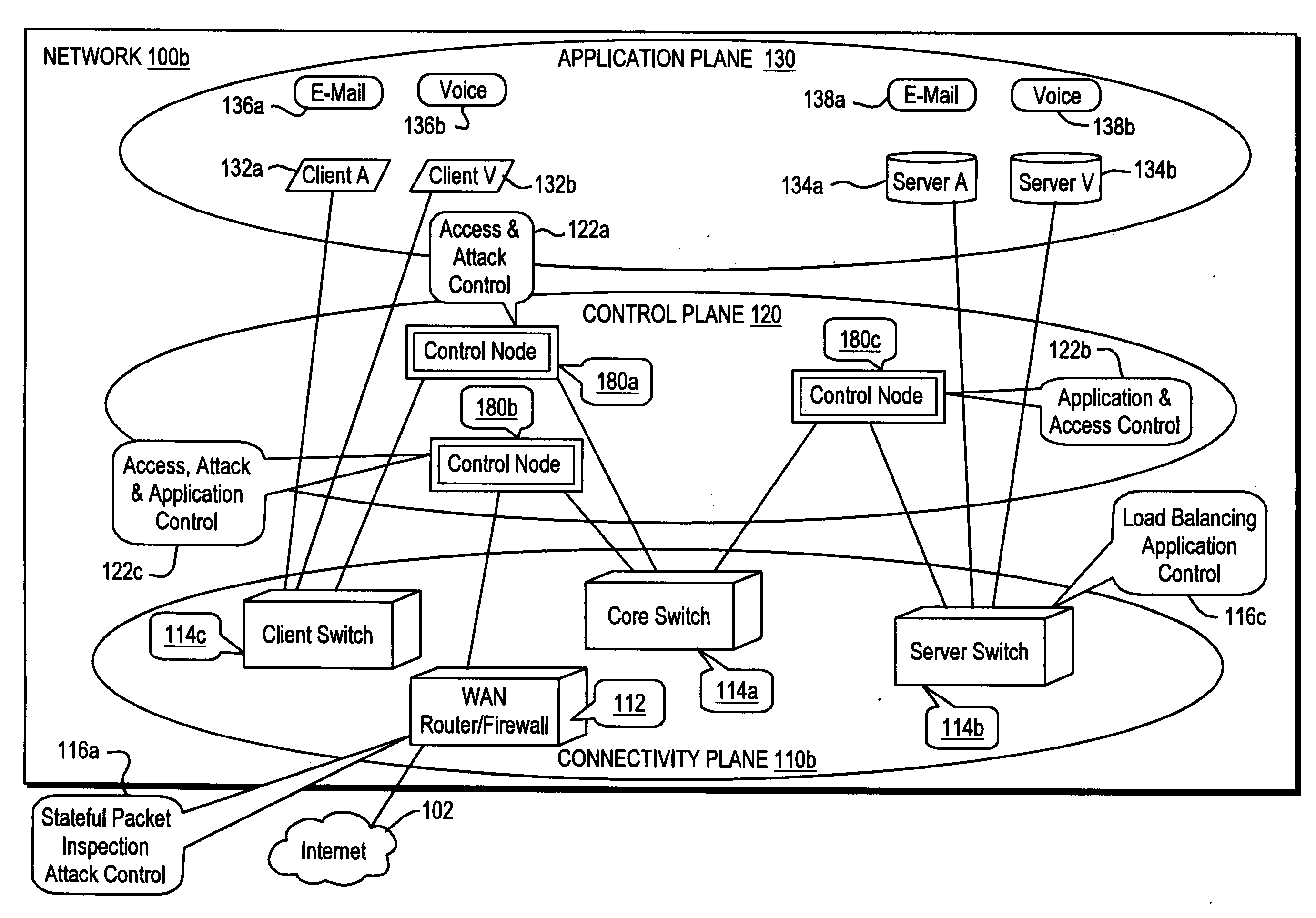
An electronic communication network includes a connectivity plane and a control plane. The control plane includes at least one control node for inspecting packets received by the control plane. The control plane is configured to perform network traffic control functions on the packets received by the at least one control node before transmitting the packets to any other node in the network. The network traffic control functions include one or more of access control, attack control, and application control.

Description

CROSS REFERENCE TO RELATED APPLICATIONS[0001]This application claims priority from U.S. Prov. Pat. App. Ser. No. 60 / 772,152, filed on Feb. 10, 2006, entitled “Bi-Planar Network Architecture,” and from U.S. Prov. Pat. App. Ser. No. 60 / 773,437, filed on Feb. 15, 2006, entitled “Bi-Planar Network Architecture,” both of which are hereby incorporated by reference.BACKGROUND[0002]1. Field of the Invention[0003]The present invention relates to electronic communication networks and, more particularly, to techniques for performing access control, attack control, and application control in packet-switched networks.[0004]2. Related Art[0005]Electronic communication networks based on the Internet Protocol (IP) have become ubiquitous. Although the primary focus of the information technology (IT) industry over the last two decades has been to achieve “anytime, anywhere” IP network connectivity, that problem has, to a large extent, been solved. Individuals can now use a wide variety of devices con...

Claims

the structure of the environmentally friendly knitted fabric provided by the present invention; figure 2 Flow chart of the yarn wrapping machine for environmentally friendly knitted fabrics and storage devices; image 3 Is the parameter map of the yarn covering machine
Login to View More

Application Information

Patent Timeline
no application Login to View More
IPC IPC(8): H04L12/66
CPCH04L12/24H04L41/00H04L63/0209H04L63/20H04L63/14H04L63/1408H04L63/10
Inventor WILLEBEEK-LEMAIR, MARCSMITH
Owner TREND MICRO INC
Features
  • R&D
  • Intellectual Property
  • Life Sciences
  • Materials
  • Tech Scout
Why Patsnap Eureka
  • Unparalleled Data Quality
  • Higher Quality Content
  • 60% Fewer Hallucinations
Social media
Patsnap Eureka Blog
Learn More