
Hierarchical virtual private LAN service protection scheme
a virtual private lan and protection scheme technology, applied in the field of communication networks, can solve the problems of long period of traffic outage, inability to initiate failure protection, inherently slow, etc., and achieve the effect of reducing packet flooding and recovering quickly from failur
- Summary
- Abstract
- Description
- Claims
- Application Information
AI Technical Summary
Benefits of technology
Problems solved by technology
Method used
Image

Examples
Embodiment Construction
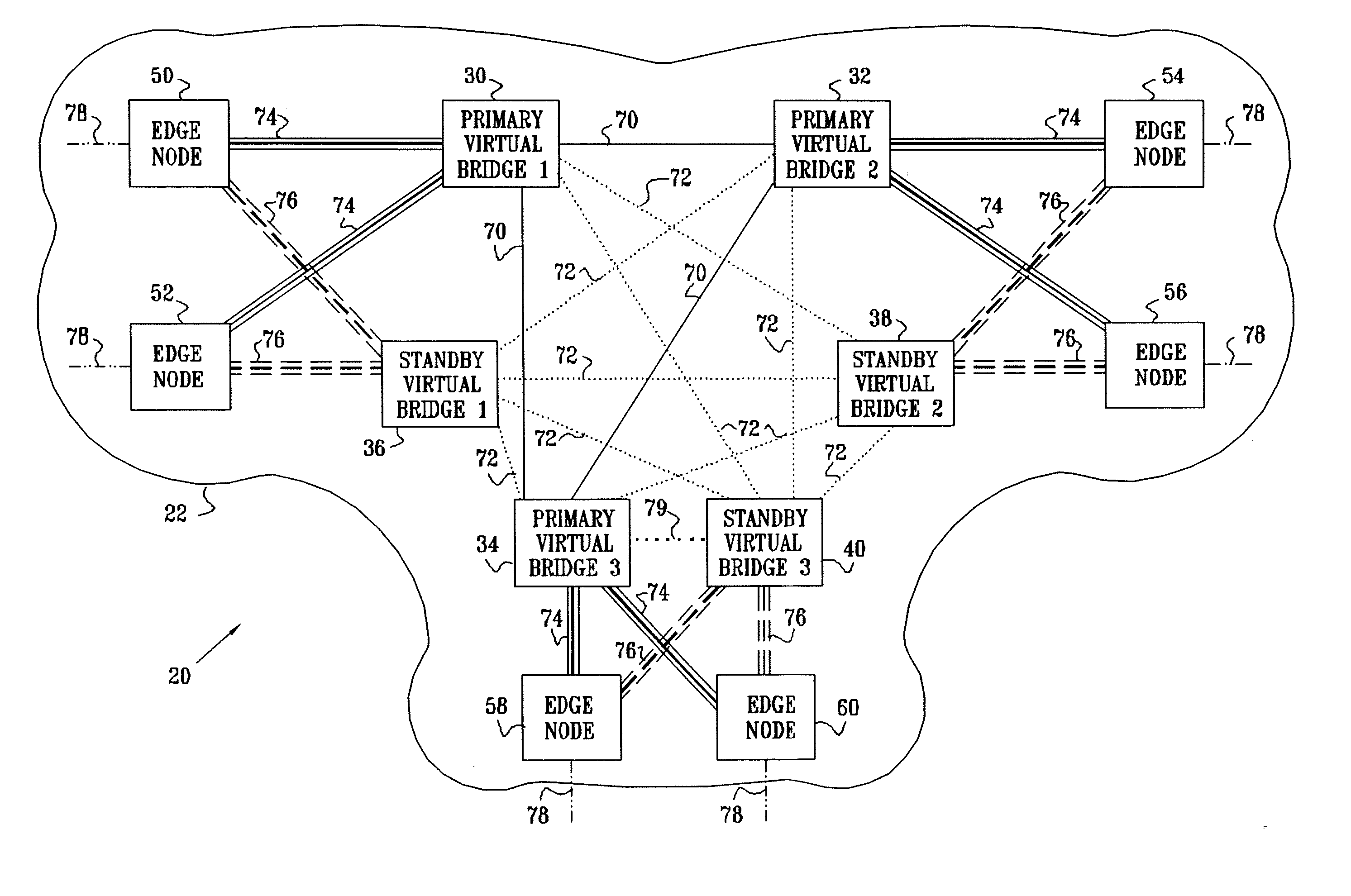
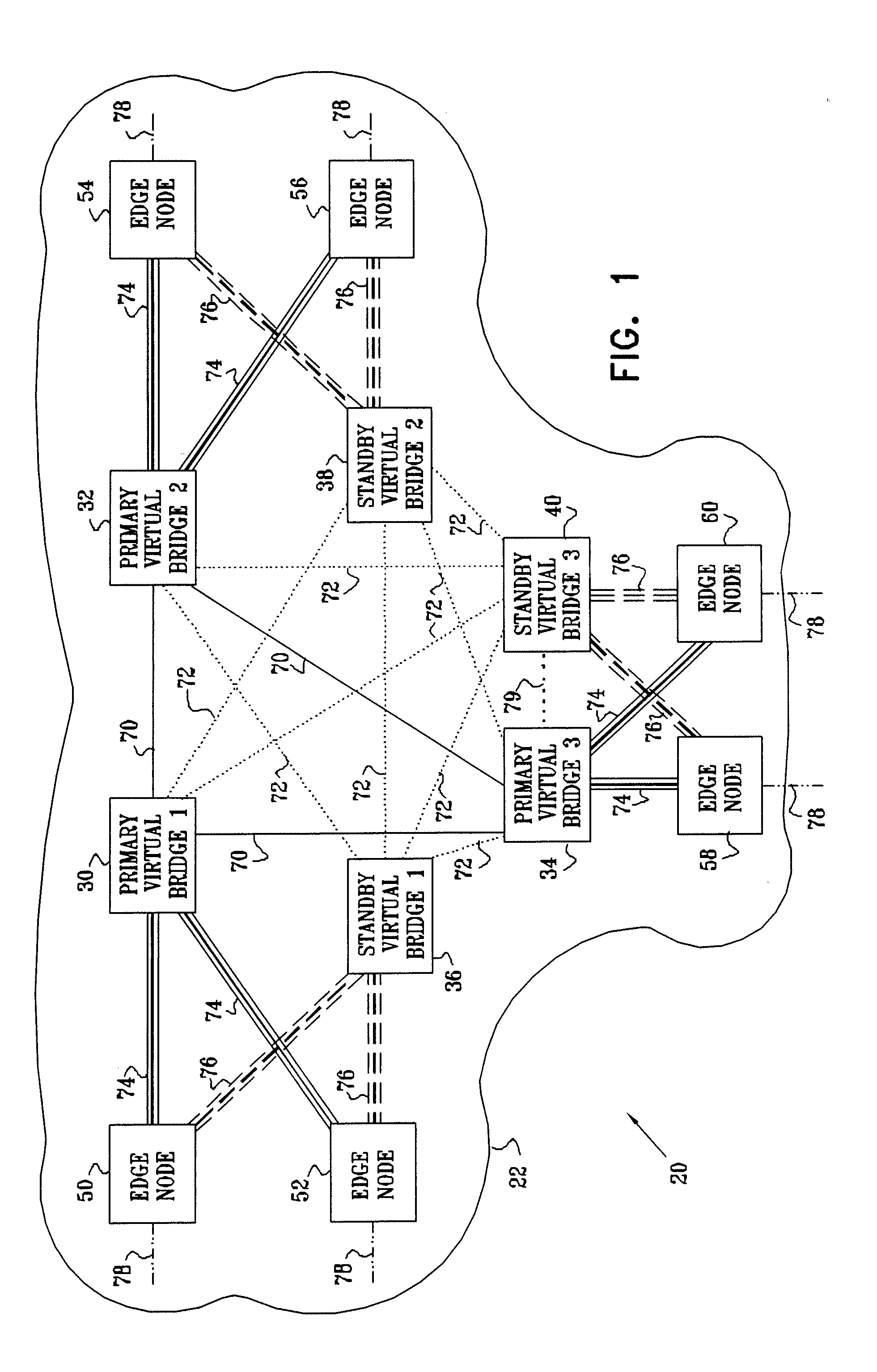
[0043]FIG. 1 is a block diagram that schematically illustrates a VPN 20 with a hierarchical VPLS topology, implementing a protection scheme in accordance with a preferred embodiment of the present invention. VPN 20 is built around a virtual private LAN service (VPLS), operating within a network 22, typically an IP or MPLS network. The VPLS is based on virtual bridges 30, 32, 34, 36, 38, and 40, or VPLS-capable PEs, which are connected by PWs 70, 72, 74 and 76 through network 22. Although for clarity of illustration, network 22 includes only a small number of PEs and represents only a single VPLS instance, the principles embodied in this network may be extended in a straightforward manner to larger networks and to multiple VPLS instances.
[0044] Three primary virtual bridges 30, 32 and 34, referred to as primary core nodes, are connected with each other in a full mesh with PW connections 70. Typically, the PW connections comprise MPLS tunnels, but they may alternatively comprise virt...
PUM
 Login to View More
 Abstract
Description
Claims
Application Information
 Login to View More