
Transceiver
a transceiver and transceiver technology, applied in waveguides, waveguide types, instruments, etc., can solve the problems of difficult to process sub-millimeter signals using components developed for microwave circuitry or components, difficult to develop circuit components and circuit structures to process such signals that exhibit both electrical and optical behavior, and difficult to process signals with wavelengths of 1 millimeter or less
- Summary
- Abstract
- Description
- Claims
- Application Information
AI Technical Summary
Benefits of technology
Problems solved by technology
Method used
Image

Examples
Embodiment Construction
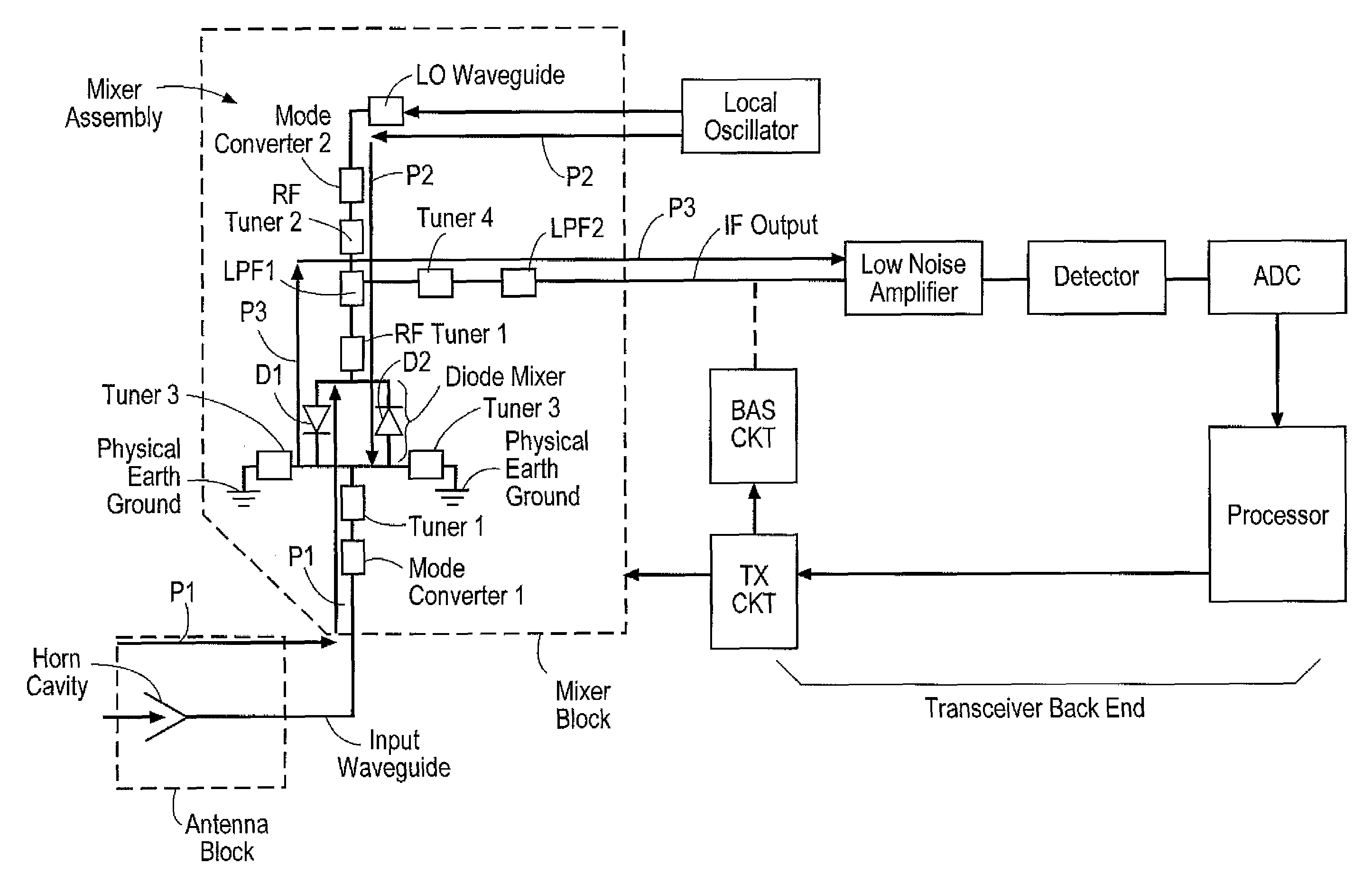
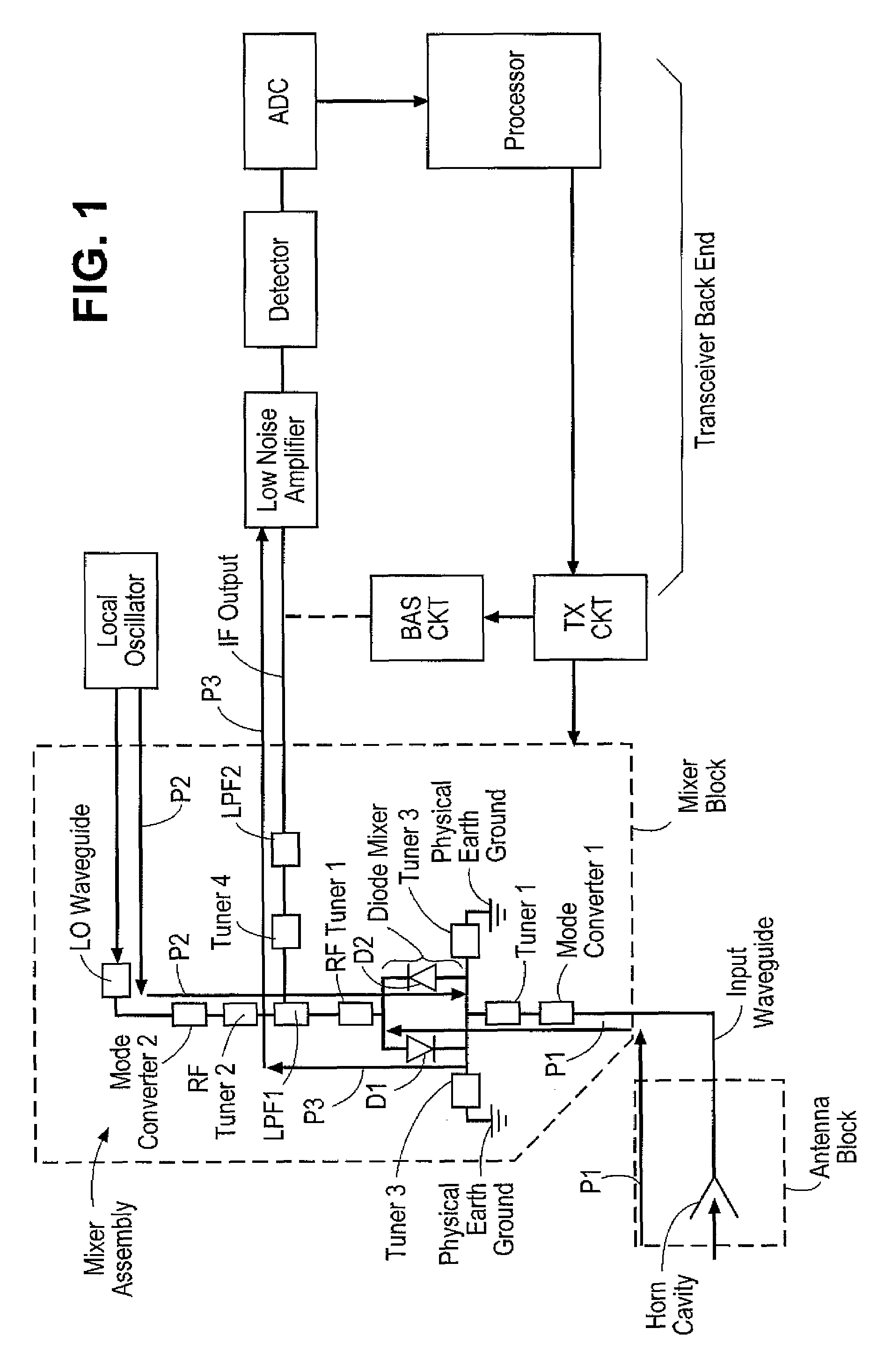
[0040]The present invention provides a transceiver having at least two controllable modes of operation where such transceiver is capable of processing signals of processing signals of different frequency ranges. Examples of types of processing are: receiving signals, transmitting signals, amplifying signals, mixing one signal with another or mixing one group of signals with another group of signals, filtering signals and detecting signals. The present invention encompasses other types of well known processing techniques of signals such A / D conversion and digital signal processing of signals. In general, processing encompasses the manipulation of signals for one or more purposes. A signal's amplitude, frequency, phase and other characteristic can be manipulated when such a signal is being processed. The transceiver of the present invention is capable of processing sub-millimeter signals as well as processing of signals having wavelengths of one millimeter or more. The transceiver of ...
PUM
 Login to View More
 Abstract
Description
Claims
Application Information
 Login to View More