
Techniques to moderate interrupt transfer
a technology of interrupt transfer and transfer, applied in the direction of instruments, electric digital data processing, etc., can solve the problems of system becoming more and more busy servicing interrupts, the overhead of processing these interrupts degrading the overall system performance, and the system itself becoming temporarily unusabl
- Summary
- Abstract
- Description
- Claims
- Application Information
AI Technical Summary
Benefits of technology
Problems solved by technology
Method used
Image

Examples
Embodiment Construction
[0008]Reference throughout this specification to “one embodiment” or “an embodiment” means that a particular feature, structure, or characteristic described in connection with the embodiment is included in at least one embodiment of the present invention. Thus, the appearances of the phrase “in one embodiment” or “an embodiment” in various places throughout this specification are not necessarily all referring to the same embodiment. Furthermore, the particular features, structures, or characteristics may be combined in one or more embodiments.
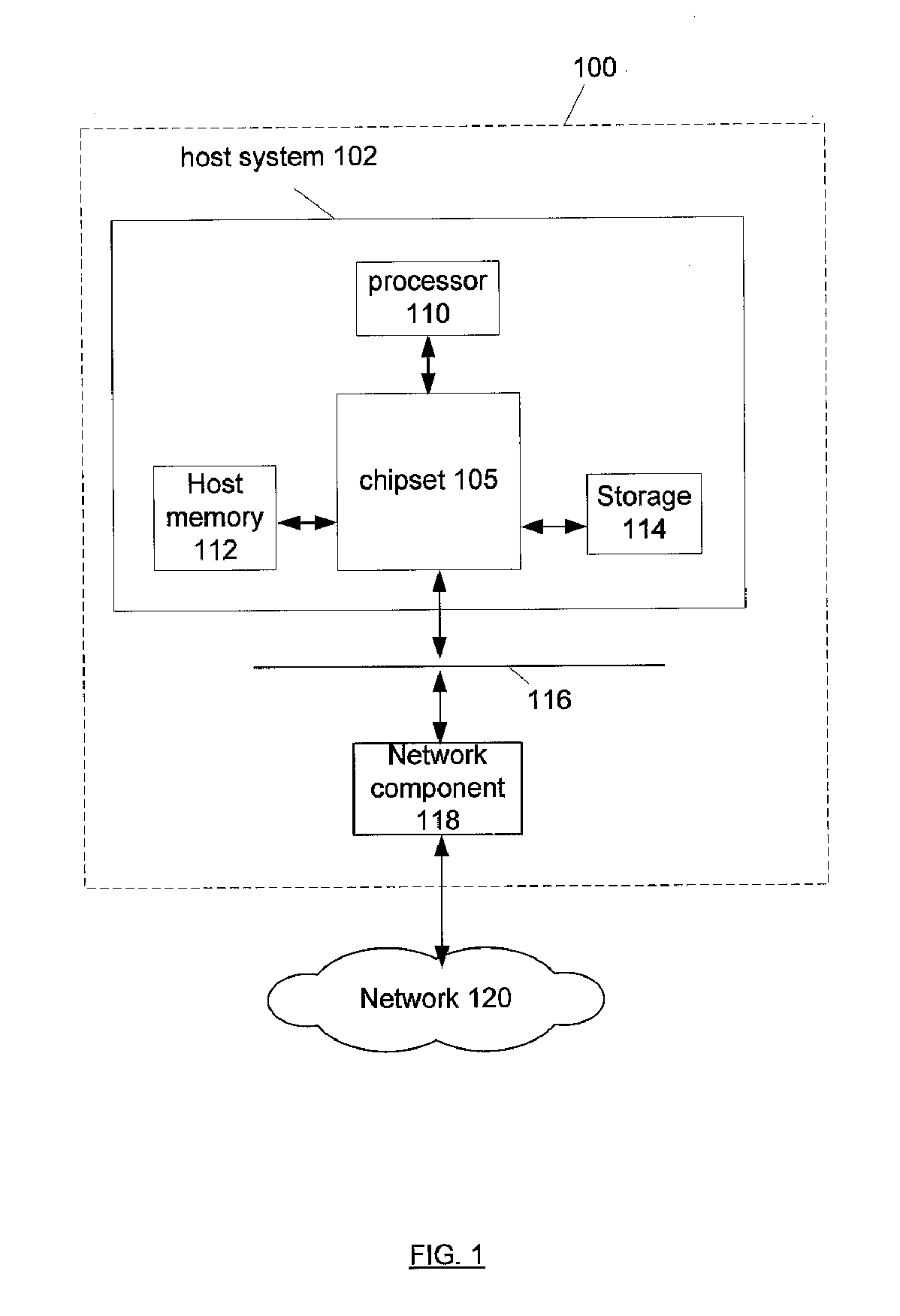
[0009]FIG. 1 depicts in computer system 100 a suitable system in which some embodiments of the present invention may be used. Computer system 100 may include host system 102, bus 116, and network component 118.
[0010]Host system 102 may include chipset 105, one or more of processor 110, host memory 112, and storage 114. Chipset 105 may provide intercommunication among processor 110, host memory 112, storage 114, bus 116, as well as a graphics ad...
PUM
 Login to View More
 Abstract
Description
Claims
Application Information
 Login to View More