Image processing apparatus and method

US20080084425A1Active Publication Date: 2008-04-10CANON KK
14 Cites 2 Cited by

Patent Information

Authority / Receiving Office
US · United States
Current Assignee / Owner
Publication Date
2008-04-10

Smart Images

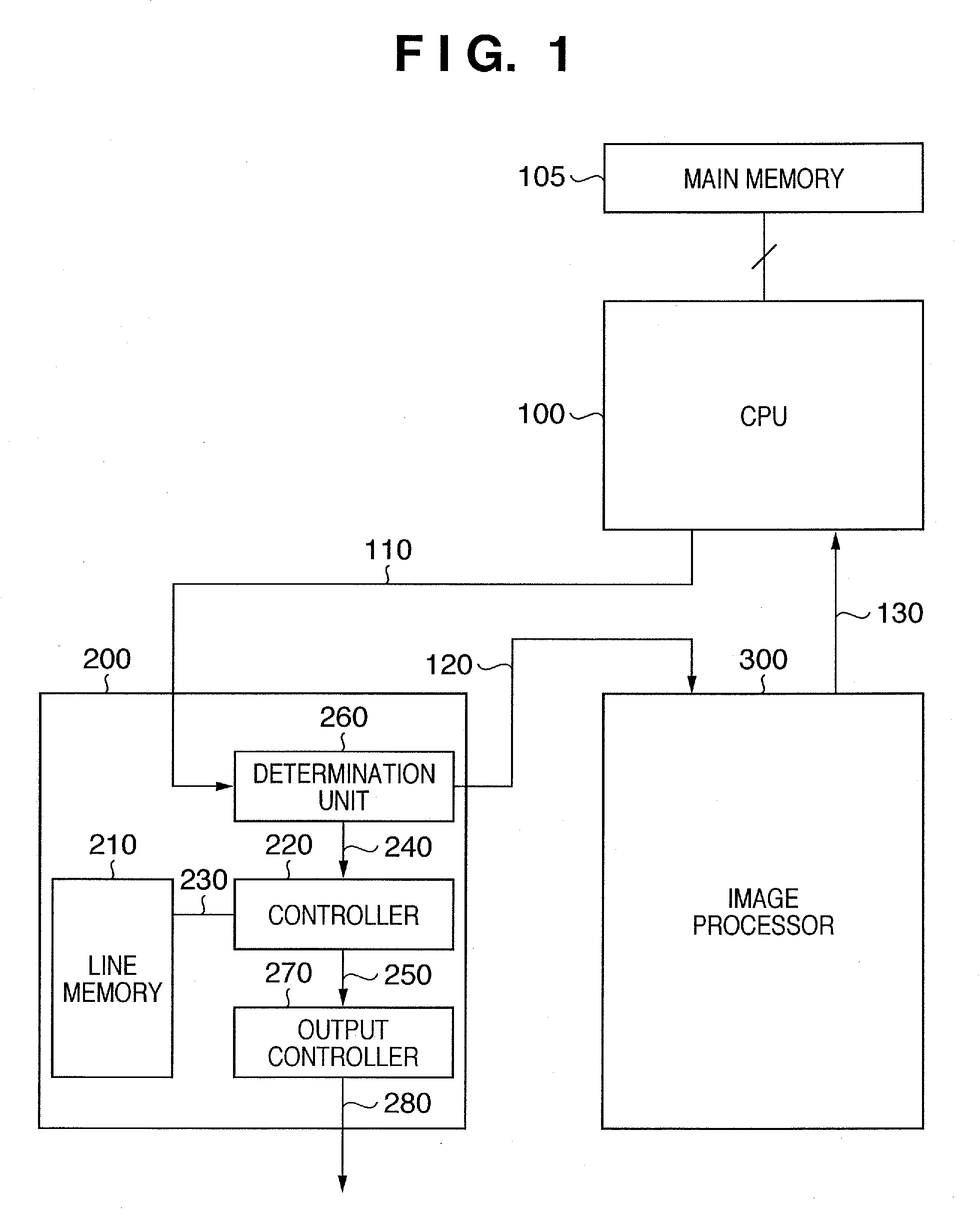
  • Figure 1
    Figure 1
  • Figure 2
    Figure 2
  • Figure 3
    Figure 3
Patent Text Reader

Abstract

Disclosed is an image processing apparatus for inputting a plurality of rectangular images each composed of n×n pixels and outputting line-by-line image data in which one line is composed of n×n×m pixels. A line buffer stores n lines of image data, each line is composed n×n×m pixels. The apparatus generate a write address for writing a rectangular image to the line buffer memory and a read-out address for reading line-by-line image data out of the line buffer memory, and changes over a method of generating the write address between a first write-address generating method and a second write-address generating method whenever m rectangular images are written to the line buffer, and changes over the read-out address between a first read-out-address generating method and a second read-out-address generating method whenever n lines of image data are read out of the line buffer.
Need to check novelty before this filing date? Find Prior Art

Description

BACKGROUND OF THE INVENTION

[0001] 1. Field of the Invention

[0002] The present invention relates to an image processing apparatus and method for inputting a plurality of rectangular images and converting the images to dot sequential raster image data.

[0003] 2. Description of the Related Art

[0004] Consider a case where image data in page units composed of a plurality of rectangular images is output upon being converted to raster image data in line units using a buffer memory for image data. In this case, it is necessary that image data in page units input in units of rectangular images be converted to image data in line units. The most common method of performing this conversion involves making the conversion by a double-buffer scheme using a buffer memory whose capacity is double the amount of data equivalent to the following: (number of lines of image data contained in the rectangular image)×(number of pixels of one line).

[0005] Another method involves making the conversion from a rectan...

Examples

Embodiment Construction

[0057]Embodiments of the present invention will now be described in detail with reference to the accompanying drawings. It should be noted that the embodiments below are not intended to limit the present invention set forth in the claims and that not all of the combinations and features described in the embodiments are necessarily essential as means for attaining the objects of the invention.

[0058]First, the concept of addressing according to this embodiment will be described with reference to FIGS. 10 to 14.

[0059]FIG. 10 is a diagram useful in describing the order of addresses when image data of an initial array of rectangular images (eight rectangular images) is written to a line buffer. As in the description of the prior art rendered above, here also a case where one line has 32 pixels and one rectangular image is composed of 4×4 pixels will be described. The parenthetic numerals (1) to (8) in the drawings represent the order in which the rectangular images are written.

[0060]Here...