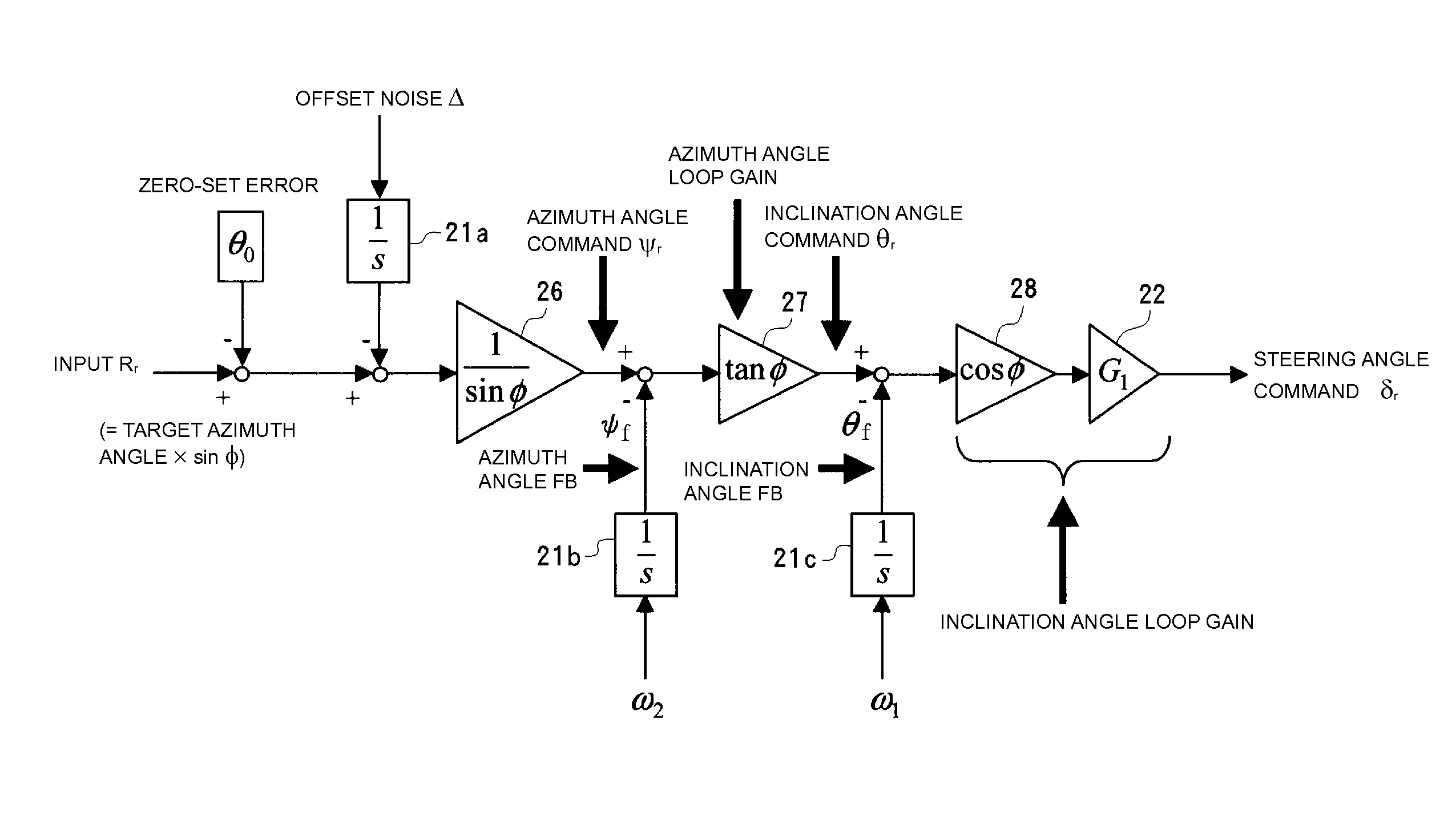
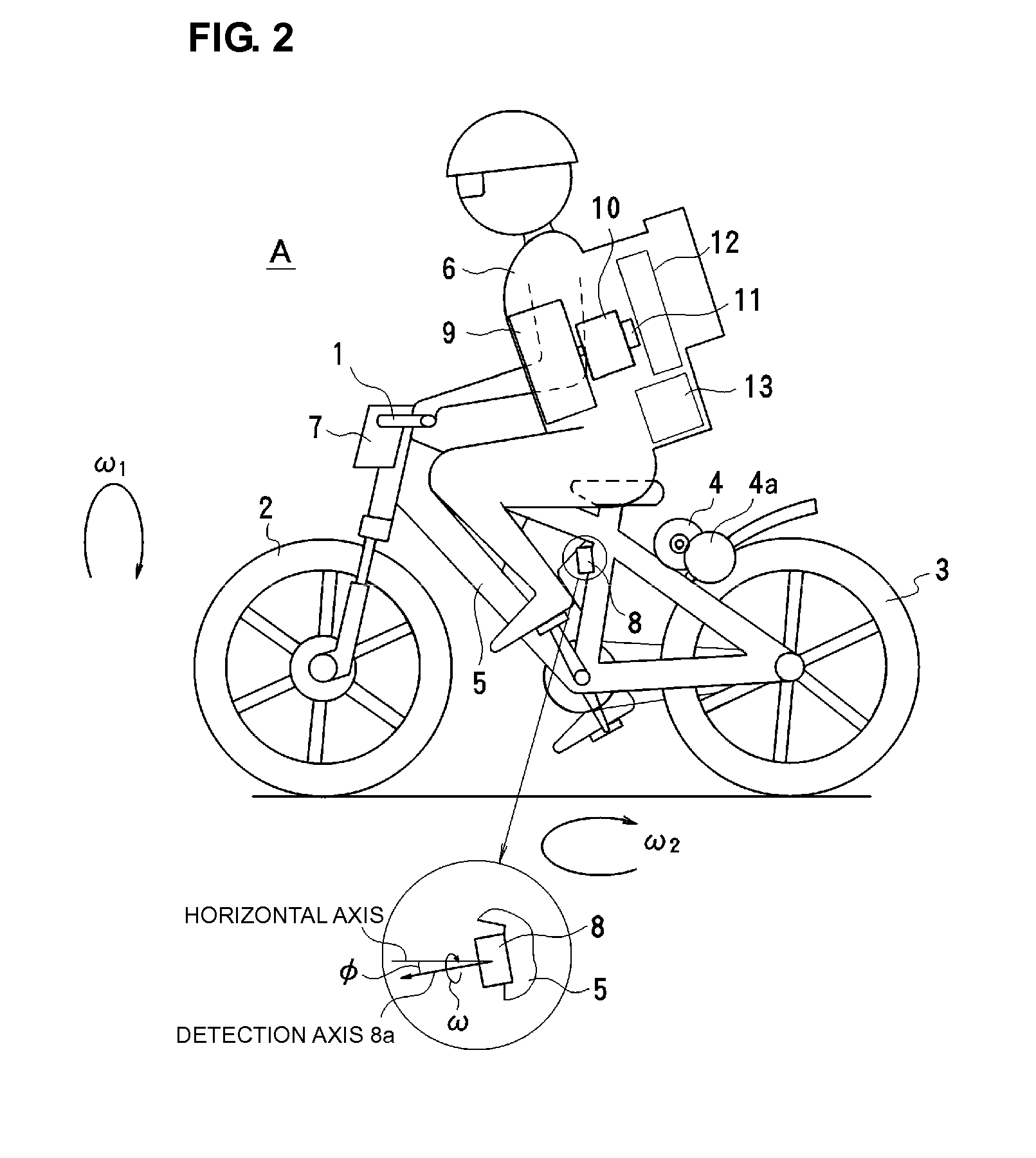
[0013]A traditional angular sensor detects only an angular velocity ω1 in the lateral direction of inclination of the vehicle body, so the sensor is mounted such that its detection axis faces in the forward direction of the vehicle body (
horizontal axis in the direction of travel of the vehicle body). In contrast, in preferred embodiments of the present invention, the angular velocity sensor is mounted on the vehicle body such that its detection axis is downwardly inclined relative to the forward direction of the vehicle body, so the angular velocity ω including the angular velocity ω1 component in the lateral direction of inclination of the vehicle body and the angular velocity ω2 component in the azimuthal direction is thereby detected. By integration of the angular velocity ω to obtain a first angle
signal, generation of a
steering angle command
signal δr using the deviation between the first angle signal and an externally provided second angle signal, input of the
steering angle command signal δr r into the
actuator, similar advantages to those obtained when an
azimuth angle loop is set outside an inclination angle loop are obtainable. The zero-set error merely provides an initial value of the azimuth angle command with a deviation, and, for the offset
noise, the integral thereof merely affects the azimuth angle command. That is, the zero-set error and the offset noise are incorporated into the azimuth angle command, and the inclination angle in the lateral direction of inclination is automatically controlled in the
internal loop (inclination angle loop). Accordingly, the two-wheel vehicle can be prevented from overturning. Here, the inclination angle is an angle in the lateral direction of inclination of the vehicle body, and the steering angle is an angle that represents the direction of the front wheel. In addition, the azimuth angle is an angle that represents the direction of travel of the vehicle body, and the mounting angle is a downward tilting angle of the detection axis of the angular velocity sensor relative to the forward
horizontal axis. Because the detection axis of the angular velocity sensor extends in the longitudinal direction, setting the detection axis using an angle of upward tilt to the backward
horizontal axis is equal to the above.
[0016]According to a preferred embodiment of the present invention, the second angle signal can be provided by a target azimuth angle×sin φ. That is, because the second angle signal being a command signal includes only an azimuth angle component, the direction of travel of the vehicle body can be directed in a target direction (orientation). In other words, the direction of travel is also controllable. In view of the azimuth angle command being affected by the offset and noise, the vehicle can also be accurately controlled to a target position by correction of the position of the vehicle using other position recognition devices.
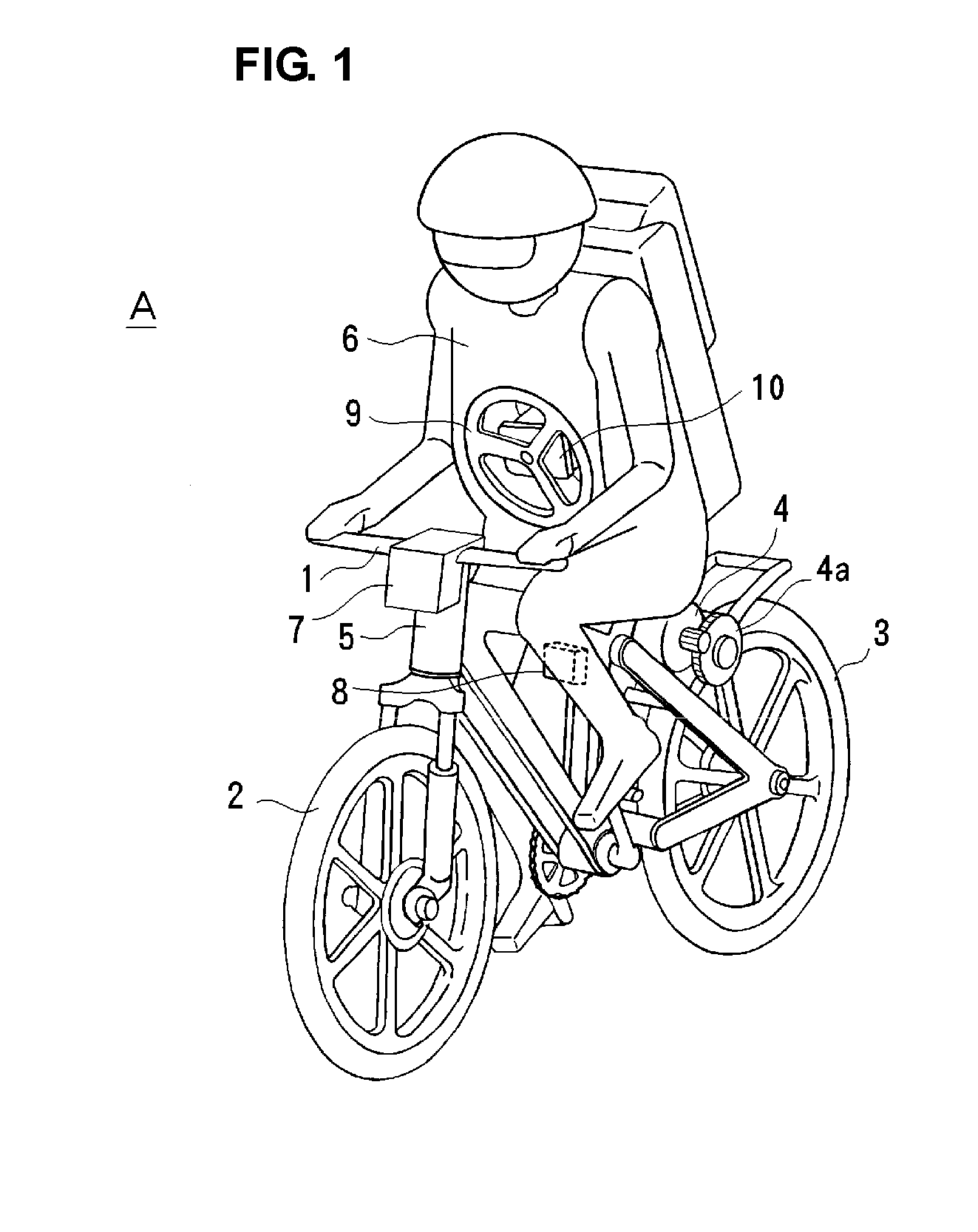
[0017]As described above, according to the overturn prevention control device for a two-wheel vehicle in accordance with preferred embodiments of the present invention, the angular velocity sensor is mounted on the vehicle body such that its detection axis is downwardly inclined relative to the forward direction of the vehicle body. Therefore, similar advantages to those obtained when the azimuth angle loop is set outside the inclination angle loop are obtainable. This causes the zero-set error and the offset noise to be incorporated into the azimuth angle command, and causes the inclination angle in the lateral direction of inclination to be automatically controlled in the
internal loop (inclination angle loop). Accordingly, the two-wheel vehicle can be reliably prevented from overturning.
[0018]Additionally, because the
control unit arranged to output a steering angle command signal includes the integration unit and the simple arithmetic unit having a proportional
gain, the structure is simple and easy to manufacture.


 Login to View More
  Login to View More