Secure print processing system
a printing system and printing technology, applied in the field of printing processing system, can solve the problems of limiting the copying capability, the inability of the pc user to select whether to execute security image processing or not in accordance, and the inability to control the security image printing. the effect of reusability
- Summary
- Abstract
- Description
- Claims
- Application Information
AI Technical Summary
Benefits of technology
Problems solved by technology
Method used
Image



Examples
first embodiment
The First Embodiment
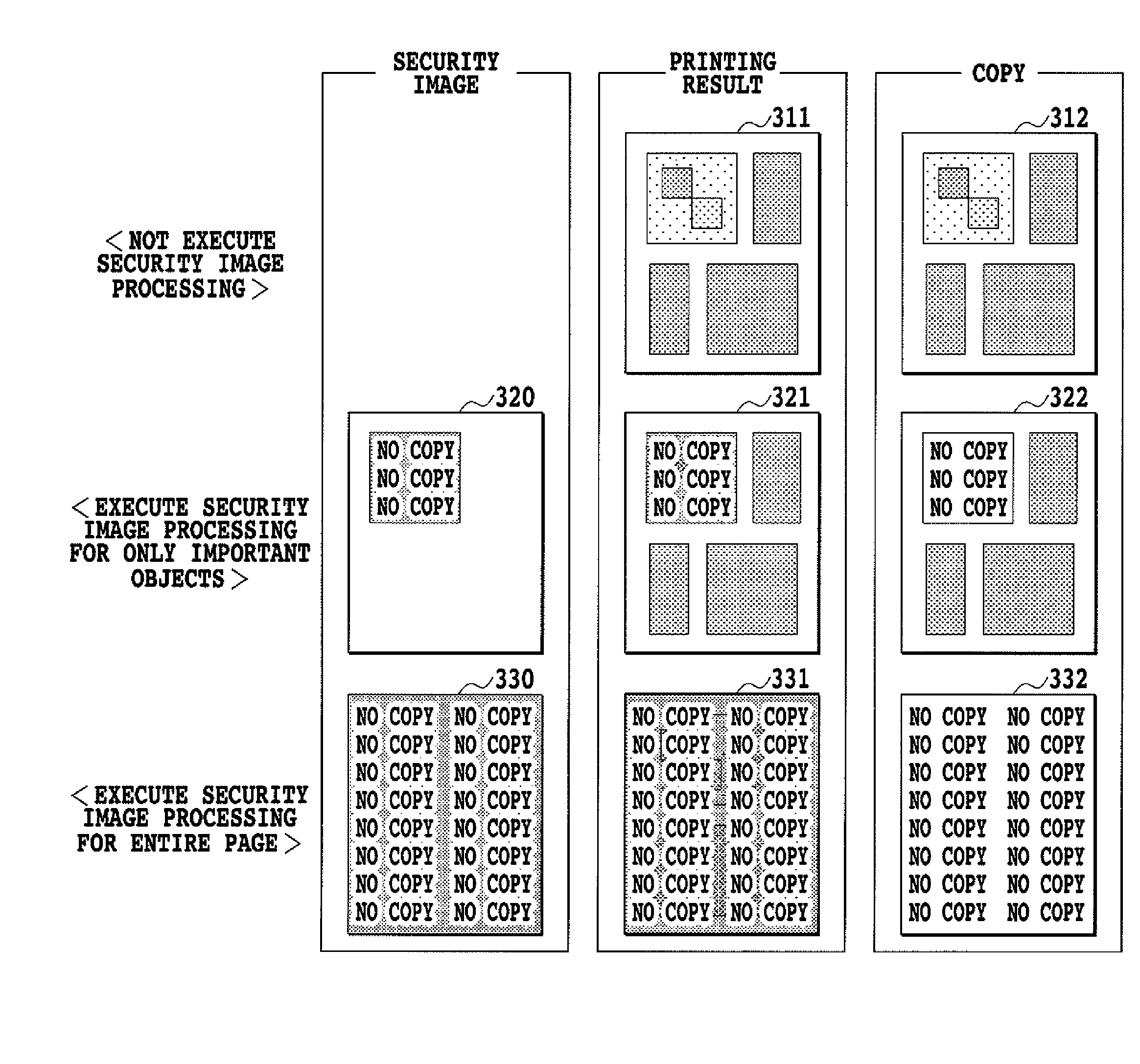
[0040]FIG. 2 is a flowchart showing print processing executed by the printer 100 according to the first embodiment. FIGS. 3A and 3B are schematic views showing security images. The first embodiment will be described with reference to FIGS. 2, 3A and 3B.
[0041]In Step 201, the printer 100 receives PDL data from the PC 191. The printer 100 may also read the PDL data from storage for storing the PDL data. The PDL data is prepared in the form of a language specification where security information for inhibiting copying by a printer user is settable for various drawing objects such as graphics or images. The printer 100 can process the PDL data. As shown in the PDL data 300 of FIG. 3A, object (a) with high importance and objects with low importance are mixed in the PDL data. Information (copy-inhibited information) on whether or not to inhibit copying of a printer user is set for each object by a PC user. Or, copy-inhibited information is set for an entire physical pag...
second embodiment
The Second Embodiment
[0058]FIG. 4 is a flowchart showing PDL data generation processing executed by the PC 191 according to the second embodiment. Unlike the first embodiment, the PDL data is prepared in the form of a language specification where security information for inhibiting copying by a specific user is not settable for various drawing objects such graphics or images.
[0059]In Step 401, the PC 191 determines whether or not a document image data contains an invisible object. The invisible object represents a non-drawn data type object with a completely transparent (alpha value=0) or ROP (raster operation processing) background image when the PDL data is rendered. The ROP processing represents a drawing operation processing executed when two or more drawing objects (raster images) are superimposed. By executing ROP processing, it is possible not only to just overwrite in the form of hierarchical relationship but also to provide results such as a “watermark” or “inversion”.
[0060...
third embodiment
The Third Embodiment
[0081]FIG. 6 is a flowchart showing the print processing executed by the printer 100 according to the third embodiment.
[0082]In Step 601, the printer 100 receives PDL data from the PC 191. As shown in the PDL data 700 of FIG. 7A, the invisible object 701 (a) shown in FIG. 7B generated by the processing in Step 403 in FIG. 4 is superimposed on the object with high importance 702. The invisible object 701 (a) corresponds to security information. The invisible object 701 (a) is prepared in the form of PDL language specification. The invisible object 701 (a) represents a completely transparent, monochromatic black rectangle.
[0083]In Step 602, the printer 100 determines whether or not to execute filling processing for deteriorating visibility of the object with high importance 702. When it is determined that the filling processing is executed, the process proceeds to Step 603. When it is determined that the filling processing is not executed, the process proceeds to S...
PUM
 Login to View More
 Abstract
Description
Claims
Application Information
 Login to View More
 - R&D
- Intellectual Property
- Life Sciences
- Materials
- Tech Scout
- Unparalleled Data Quality
- Higher Quality Content
- 60% Fewer Hallucinations
Browse by: Latest US Patents, China's latest patents, Technical Efficacy Thesaurus, Application Domain, Technology Topic, Popular Technical Reports.
© 2025 PatSnap. All rights reserved.Legal|Privacy policy|Modern Slavery Act Transparency Statement|Sitemap|About US| Contact US: help@patsnap.com