
Membrane supported bioreactor for conversion of syngas components to liquid products
a bioreactor and membrane technology, applied in the field of biochemical conversion of co and mixtures of co2 and h2 to liquid products, can solve the problems of inability of conventional yeasts to ferment csub>5/sub>sugar to ethanol and the total unfermentability of lignin components by such organisms
- Summary
- Abstract
- Description
- Claims
- Application Information
AI Technical Summary
Benefits of technology
Problems solved by technology
Method used
Image

Examples
example 1
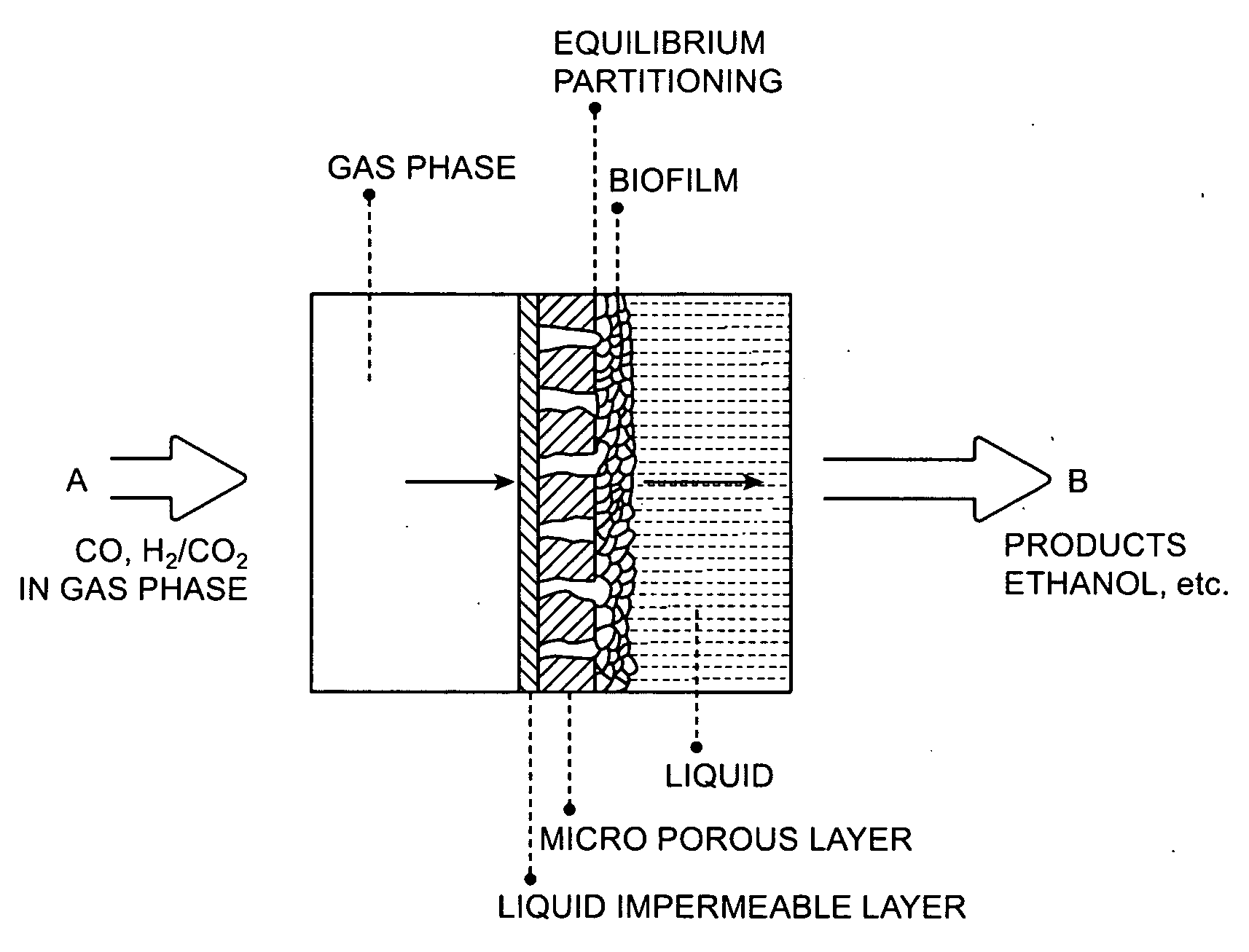
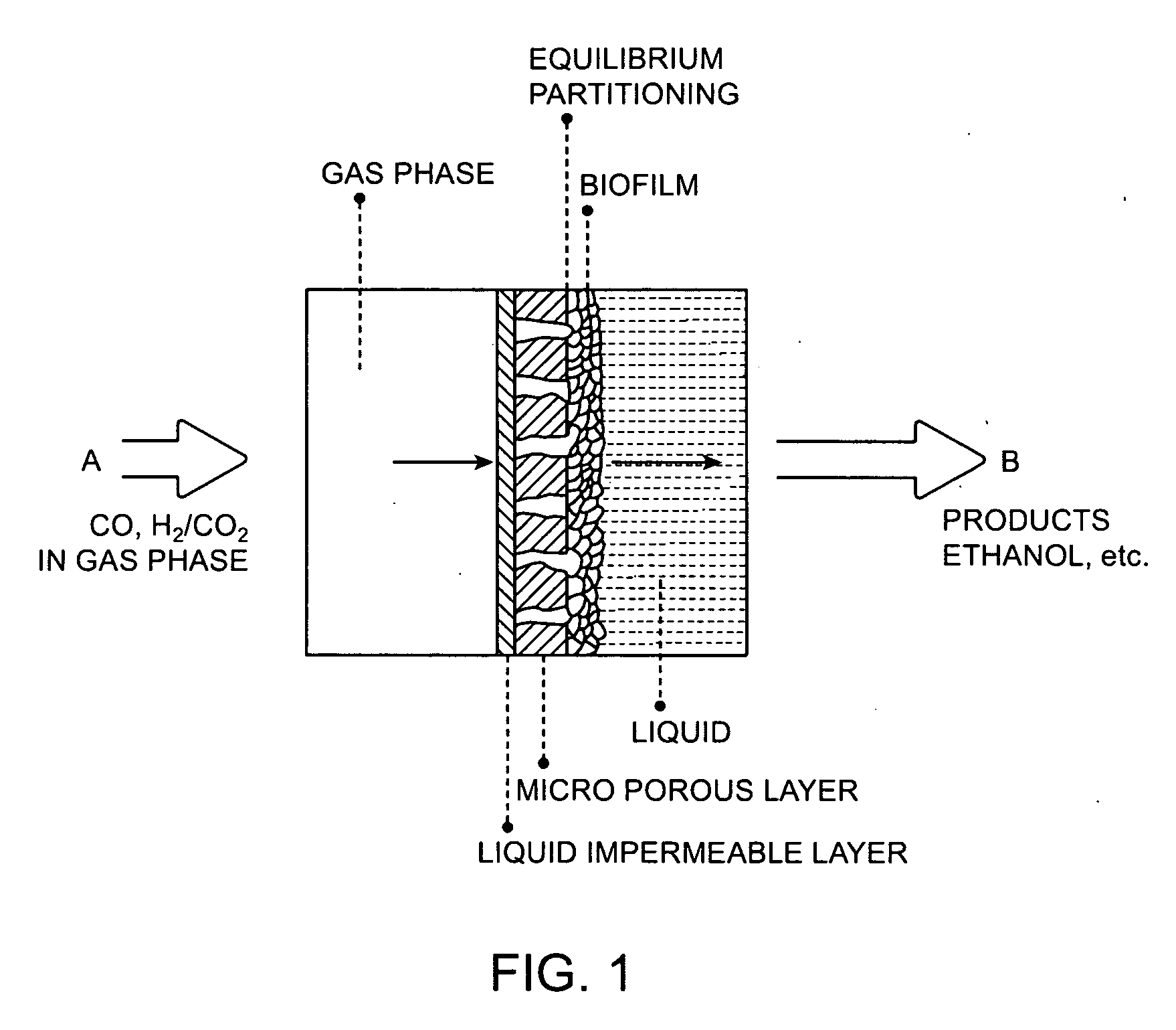
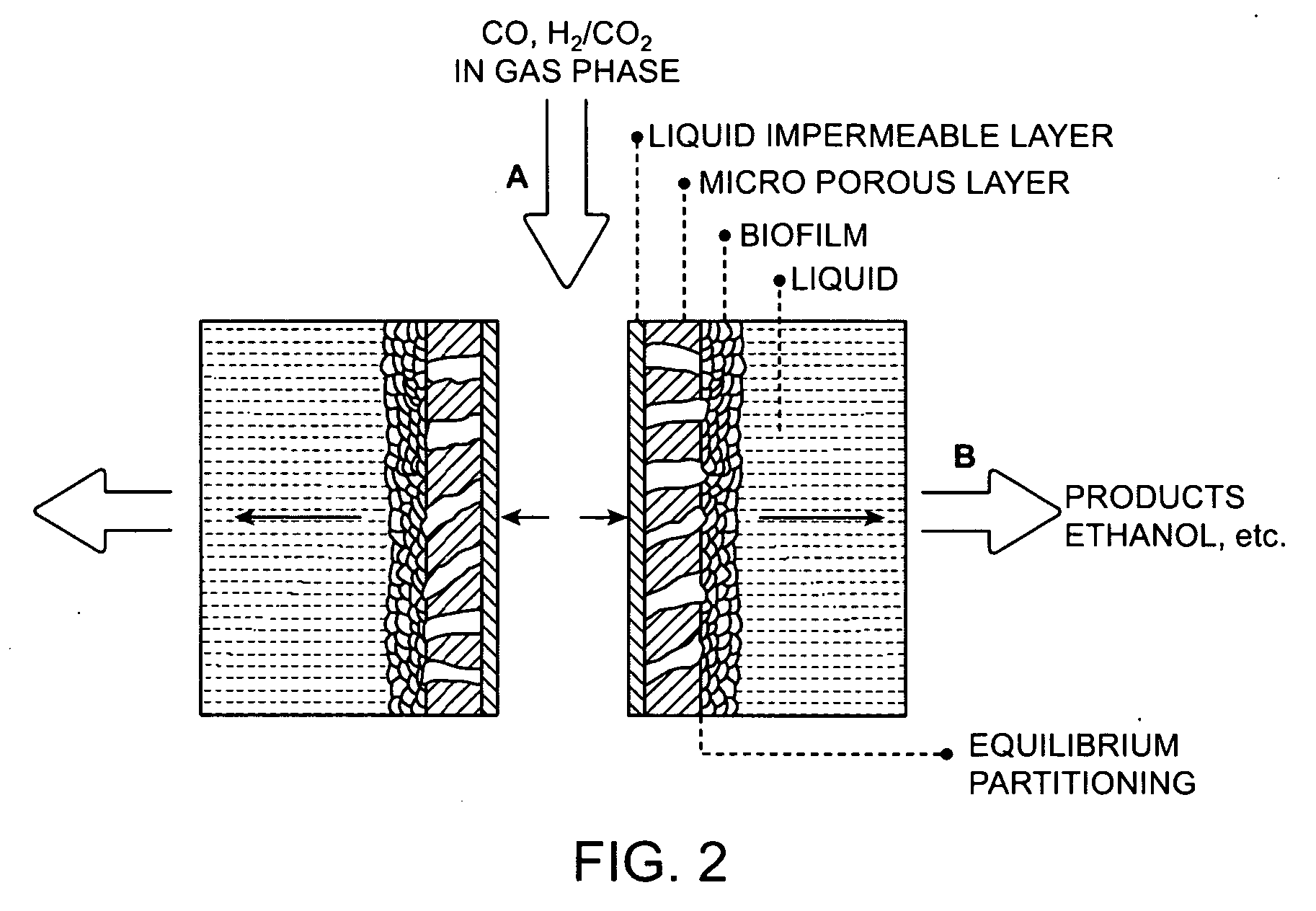
[0062]The membrane permeance of syngas components was measured for Membrane A, a gas transfer membrane module Model MHF0504MBFT from Mitsubishi Rayon Engineering (Tokyo, Japan). The module contains composite hollow fiber membranes with a triple-layer construction, consisting of a thin liquid impermeable layer sandwiched between two porous layers. The fiber outer diameter is approximately 280 μm and inner diameter approximately 200 μm. The nominal membrane surface area in the module was 0.6 m2. A source of syngas, containing 39.0% CO, 33.5% H2, 23.1% CO2 and 4.4% N2, was connected to the lumen inlet of the module, while the lumen outlet was closed with a shut-off valve. The syngas feed pressure was maintained at a desired level, and the feed flow rate was measured with a calibrated flow meter. Syngas components passed through the membrane into the shell side of the module, and the permeate flow rate was measured with a bubble flow meter. Pressures at the lumen inlet, lumen outlet and...
example 2
[0063]A membrane module measuring 4″ diameter and 40″ length and containing a gas transfer membrane described in Example 1 was used as a membrane supported bioreactor for the conversion of carbon monoxide and hydrogen into ethanol. The active membrane surface area of the module was 17.1 m2, based on fiber outer diameter. The packing density of the module, calculated as the volume occupied by the fibers divided by the internal volume of the module, was 16%. The membrane module was housed in constant temperature chamber at 37° C. and connected to a 10-liter BIOSTAT Bplus Fermentor from Sartorius AG (Goettingen, Germany). The fermentor initially contained 8 liters of the fermentation medium, which was agitated at 300 rpm and maintained at 37° C. The fermentor was maintained under anaerobic conditions. The fresh fermentation medium contained the components listed in Tables 2 & 3(a)-(d). Initially, at t=0 hr the fermentor was operated in the batch mode without connecting to the membrane ...
PUM
| Property | Measurement | Unit |
|---|---|---|
| pressure | aaaaa | aaaaa |
| impermeable | aaaaa | aaaaa |
| lumen volume | aaaaa | aaaaa |
Abstract
Description
Claims
Application Information
 Login to View More