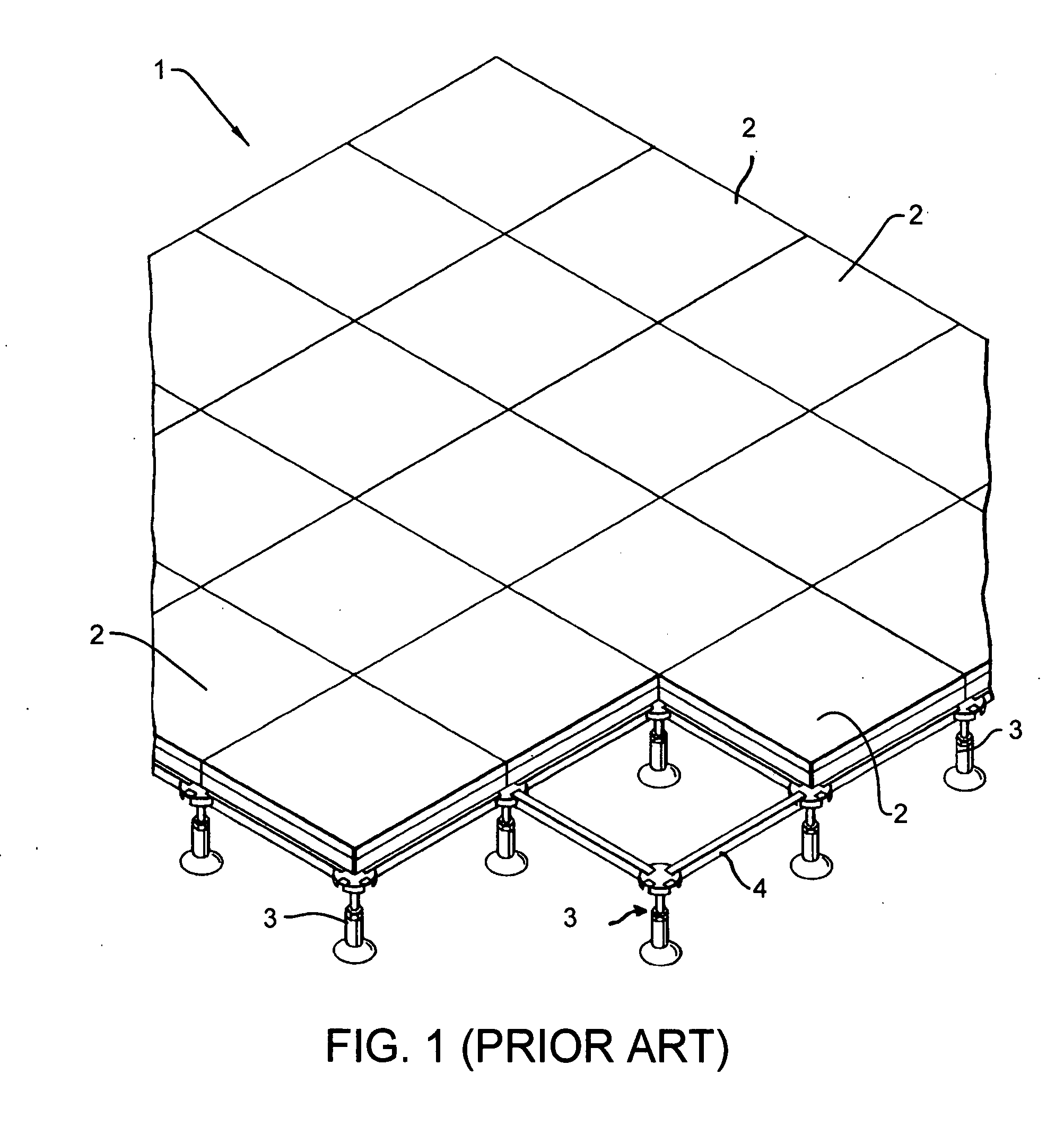
In known floor systems employing composite steel and concrete floor tiles, which tiles in plan view are typically relatively large squares having side dimensions of about 24 inches, the tiles due to their construction and size are necessarily both bulky and heavy so that transport of such tiles over long distances is undesirably costly.
Further, filling the metal pans with wet concrete and achieving a proper structural
interconnection of the hardened concrete to the metal pan so as to provide the finished floor tile, when in use, with the necessary strength and durability, has presented an ongoing problem.
While these techniques have proven to improve the strength characteristics, these techniques also increase the complexities associated both with the manufacture of the pan and the forming of the concrete therein.
This, however, creates additional disadvantages due not only to the expense of
gypsum cement, but also due to its characteristics.
Specifically, concrete mix formed using
gypsum cement experiences dimensional
instability in that the concrete dimensionally changes, specifically grows, during
drying or curing.
This hence creates significant dimensional
instability with respect to the finished floor tile, and requires significant
grinding or
surface finishing of the exposed upper surface of the concrete in order to achieve the desired finished dimension of the floor tile.
In addition, since wet concrete mix formed using
gypsum cement requires utilization of a significant quantity of water, this reduces the strength properties of the concrete.
Even so, this technique of forming floor tiles by depositing wet concrete mix into preformed metal pans is undesirable with respect to the time and
space requirements demanded for production of such floor tiles, and hence this technique is limited to situations where these restrictions and the limitations imposed on the volume of production can be tolerated.
As an alternative to the manufacturing technique wherein wet concrete is poured into and cured within a metal pan, and the disadvantages associated with such technique, other floor tiles have been manufactured wherein a preformed block, frequently of wood, is positioned within a metal pan and secured therein, and is typically wholly enclosed within the pan by means of a separate covering or top walls.
Such constructions, however, typically lack the strength and durability achieved utilizing floor tiles formed dominantly of concrete.
While attempts have been made to design and develop floor tiles employing a concrete block positioned within a metal pan by preforming the concrete and then forming the pan therearound, such as by shaping or bending the pan around a preformed block, such technique is also undesirable in terms of its
processing limitations and the difficulty in achieving desired dimensional tolerances.


 Login to View More
  Login to View More