
Method and apparatus for synchronizing messages between multiple terminals
- Summary
- Abstract
- Description
- Claims
- Application Information
AI Technical Summary
Benefits of technology
Problems solved by technology
Method used
Image

Examples
embodiment 1
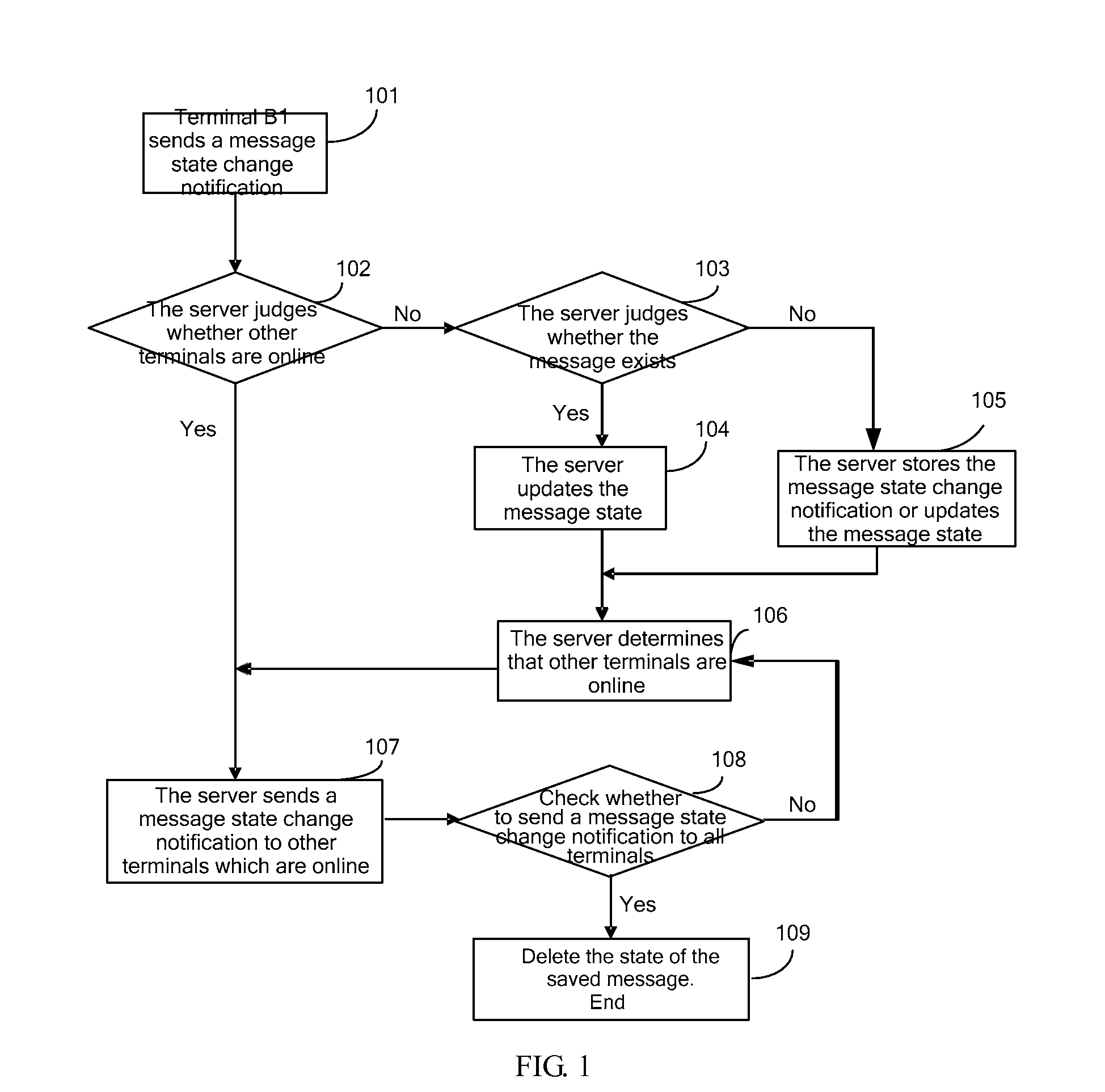
[0028]As shown in FIG. 1, a method for synchronizing message states between multiple terminals is provided according to an embodiment of the present invention, and includes the following blocks.
[0029]Block 101: A terminal B1 of a user changes a message state and sends a message state change notification to a server. The message state change notification carries an identifier of the message (e.g. message ID), message state change description (for example, delete, read and modify), a user identifier of the user, and an identifier of the terminal B1. The terminal may use a SIP message or a MSRP, Message Session Relay Protocol, path to send a MSRP SEND message, or use a SIP subscription notification mechanism to send the state change notification through PUBLISH mode. The state change notification may carry multiple messages or message IDs, and each message state change notification may associate the changed states of one or more messages.
[0030]Moreover, the terminal that changes the me...
embodiment 2
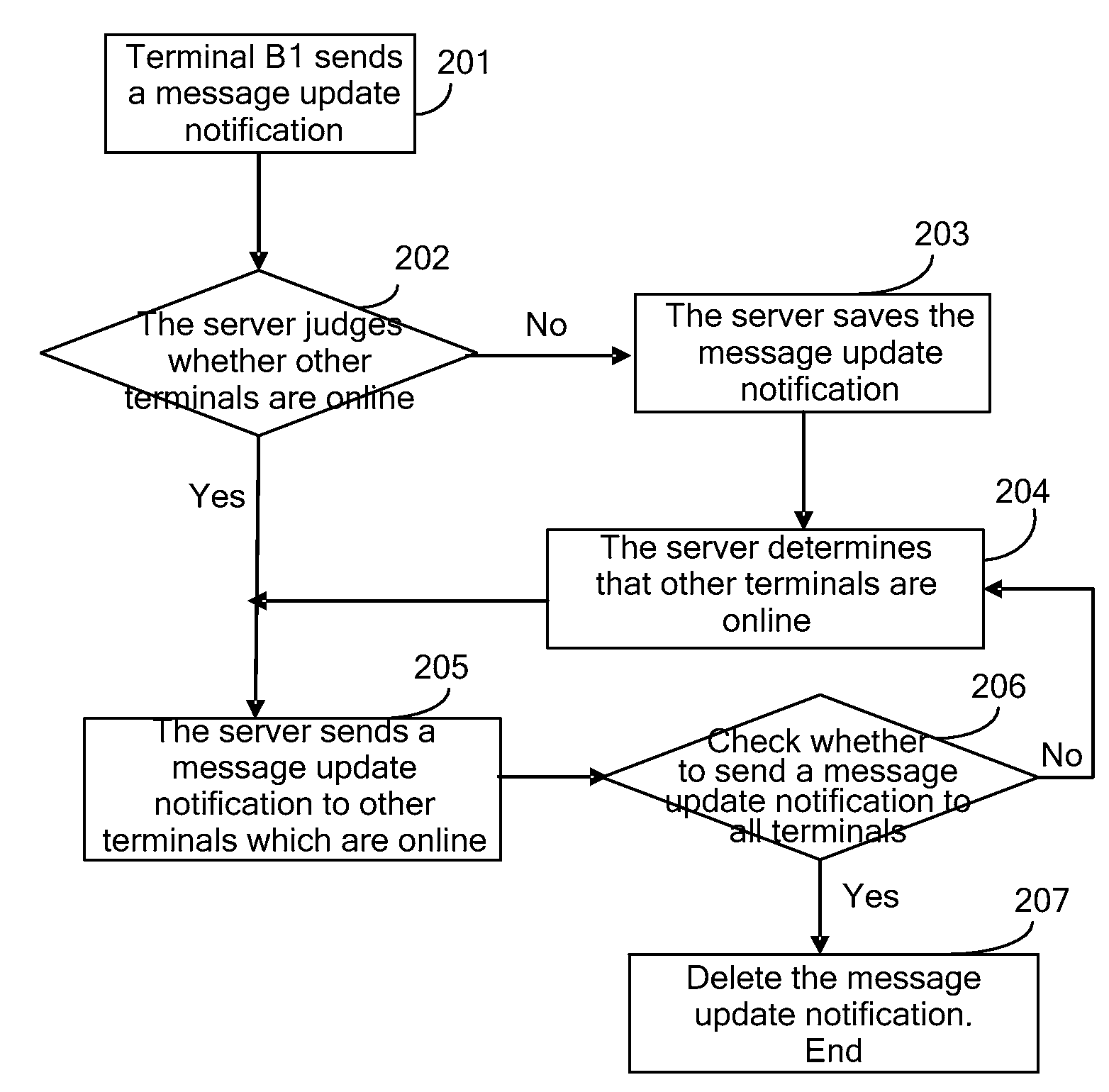
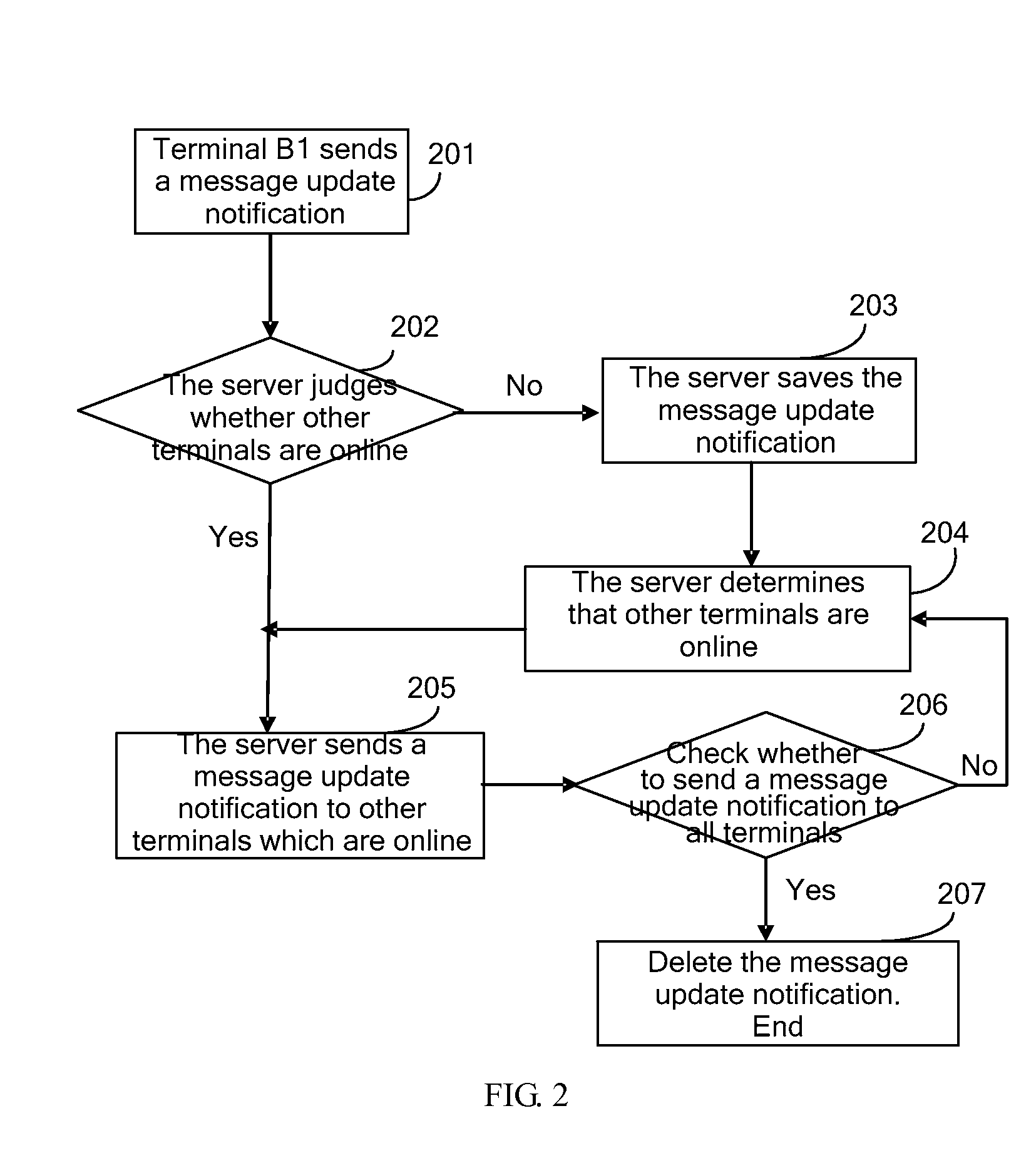
[0042]FIG. 2 shows a method for synchronizing messages between multiple terminals according to another embodiment of the present invention. Compared with the method for synchronizing the message state between multiple terminals, as shown in FIG. 1, the message for synchronizing a message between multiple terminals is different by the following: the server needs to save the message update notification which carries the message, without the need to construct a new message according to the received message update notification or save the new message. The detailed process is as follows.
[0043]Block 201: A terminal B1 of a user creates a new message and sends a message update notification to the server. The message update notification carries the new message. The terminal may use a SIP message or a MSRP path to send an MSRP SEND message, or use the SIP subscription notification mechanism to send the message update notification through PUBLISH mode. The message update notification may carr...
embodiment 3
[0054]FIG. 3 is a flow chart of synchronizing messages or message states between a server and multiple terminals through a SIP message format in another embodiment of the present invention, supposing that all terminals (B1, B2, and B3) of a user are online. Terminals B1, B2, and B3 represent multiple terminals of user B for receiving messages in a message system, which may be a SIP-based Instant Message and Presence Leveraging Extensions (SIMPLE) system, an Instant Message (IM) system, or a Converged IP Messaging (CPM) system. The home server of the terminals may be an IM or CPM server. The messaging server here may be a CPM server, and the CPM server may serve as a participant function server or an offline messaging server. The detailed process is as follows.
[0055]Block 301: When the terminal B1 of the user B creates a new message or changes the state of a message, for example, the terminal B1 creates a new message which amount of data is less than 1300 bytes, reads an existing mes...
PUM
 Login to View More
 Abstract
Description
Claims
Application Information
 Login to View More