[0002]Methods and Systems for Trusted Energy Saving according to embodiments of the present inventions leverage the assignee Cyberview Technology Inc / s Secure Game Download technology disclosed in commonly assigned and co-pending U.S.
patent application Ser. No. 10 / 520,831 filed on Aug. 12, 2005, which US application claims priority to international application PCT / US02 / 29927 and to U.S. provisional patent application Ser. No. 60 / 393,892 filed on Jul. 5, 2002, and allows casino operators to save money and operate in an environmentally conscious manner by limiting the
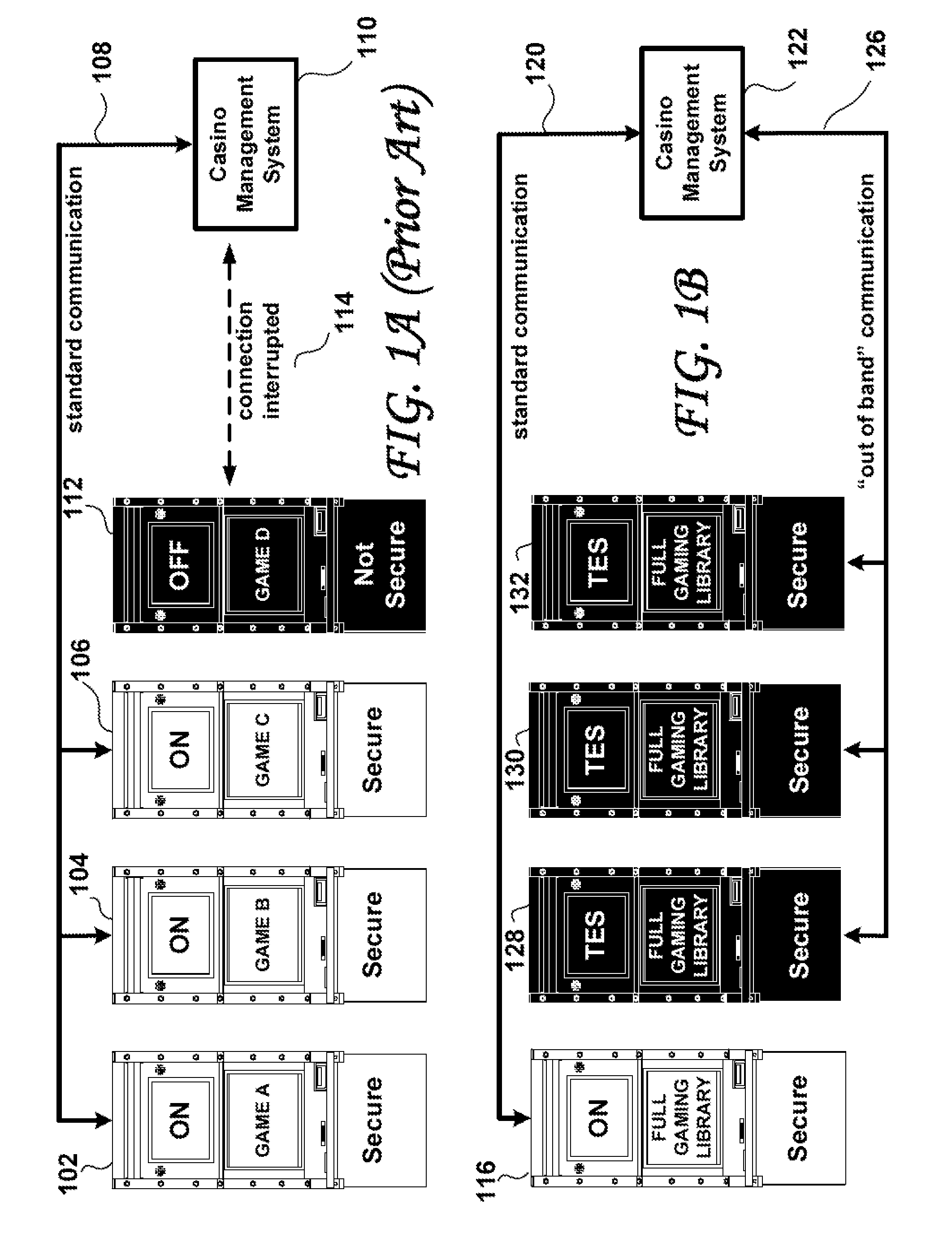
power consumption of gaming machines that are not in use. Legacy gaming machines (i.e., gaming machines not configured according to an embodiment of the present invention) are unable to maintain communication with a casino's management
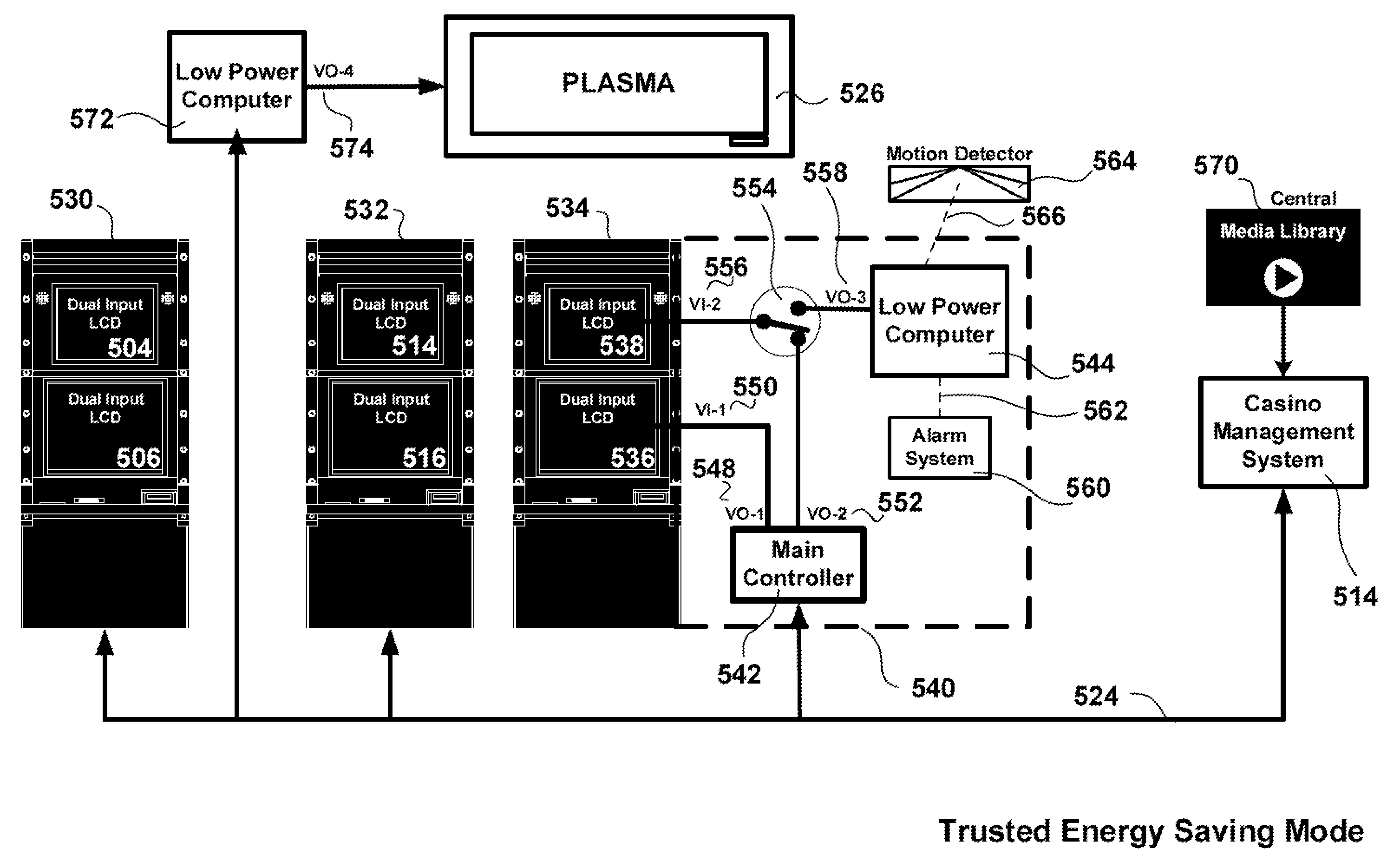
system when powered off (e.g., powered-off or in a low-power standby mode in which
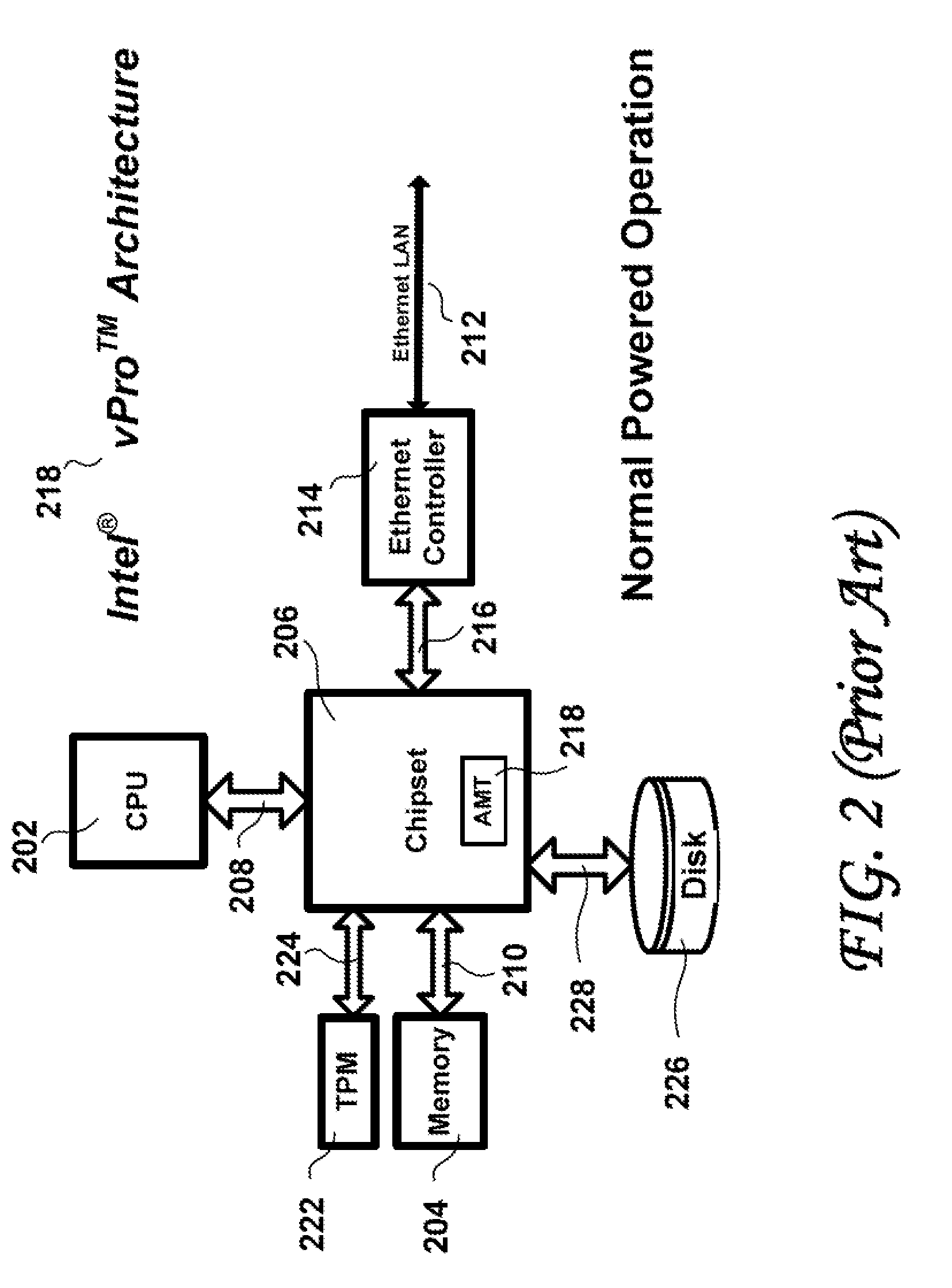
secure communication with the main controller is unavailable) and therefore lack security (as the server can no longer monitor the non-communicating gaming machine which may have been powered-off, carted away, may be communicating with a non-authorized network node, may be or have been subjected to off-line attacks, etc.). In contrast, server-based gaming machines equipped for Trusted Energy Savings according to embodiments of the present invention are able to maintain an Intel Advanced Management Technology (AMT) “out-of-band” communication (or equivalent communication) and retain full
network security while in a powered off mode. As the casino's management
system is continually and securely communicating with the gaming machine even when the gaming machine is in low
power mode (or appears turned-off to outside observers), security is not compromised. Consequently, lengthy security verifications (required by gaming regulations upon every gaming machine start-up) may be waived to enable the gaming machine to perform a rapid start-up and accept a wager from a player without
delay.
[0003]From a marketing perspective, gaming machines equipped for Trusted Energy Savings (abbreviated to TES hereafter) according to embodiments of the present invention do not lose their ability to attract players by appearing to be turned off. Instead, their cabinets may remain illuminated and one of more of their gaming screens may run promotional content that is sourced by a low power media player (that may receive media from the central server, for example).
[0004]Unlike legacy gaming machines, which typically feature a single gaming title per gaming machine (requiring a player to check as many as 3,000 gaming machines on the casino floor to find a specific game), TES-enabled server-based games allow players to access an entire gaming
library of hundreds or even thousands of games on each gaming machine. It is the very nature of server-based games that unexpectedly makes TES possible. Indeed, whereas a casino operator using legacy gaming machines would be reluctant to power off a percentage of his gaming machines and consequently render a corresponding percentage of the gaming titles in his library unavailable to players, a casino operator using server-based gaming machines may power off or down any number of TES-enabled gaming machines and not
restrict the players' ability to access the full panoply of games in the casino's rich game library.
[0005]TES-enabled gaming machines may use a variety of methods to anticipate use in standby or power-down mode. According to one method, each
bank of games on a casino floor (usually 8 gaming machines per
bank) may feature one fully powered up gaming machine at all times. Whenever a player initiates play on a powered up gaming machine, one or more of the other gaming machines in the
bank that are in TES-enabled mode may rapidly wake up so that any new player approaching the game bank may be accommodated. Whenever a player approaches a powered down gaming machine, a specifically identified button (or any of the gaming machine buttons if configured accordingly) may be activated by a player such, this gaming machine and more of the other gaming machines in the bank that are in TES-enabled mode may rapidly wake up. According to another embodiment, the gaming machine may use previous play history to determine future behavior, such that popular gaming machines are more likely to be fully powered up than less popular games. In a third method, motion detectors may be used to anticipate
game play. When the
motion detector(s) detect movement in the vicinity of a bank of gaming machine, one or more gaming machines may rapidly wake-up (i.e., perform a rapid boot up procedure), exiting TES low-power mode, entering a fully powered up state, bypassing the lengthy regulatory
verification and returning to fully operational state.

 Login to View More
  Login to View More