[0008]A personal document archive
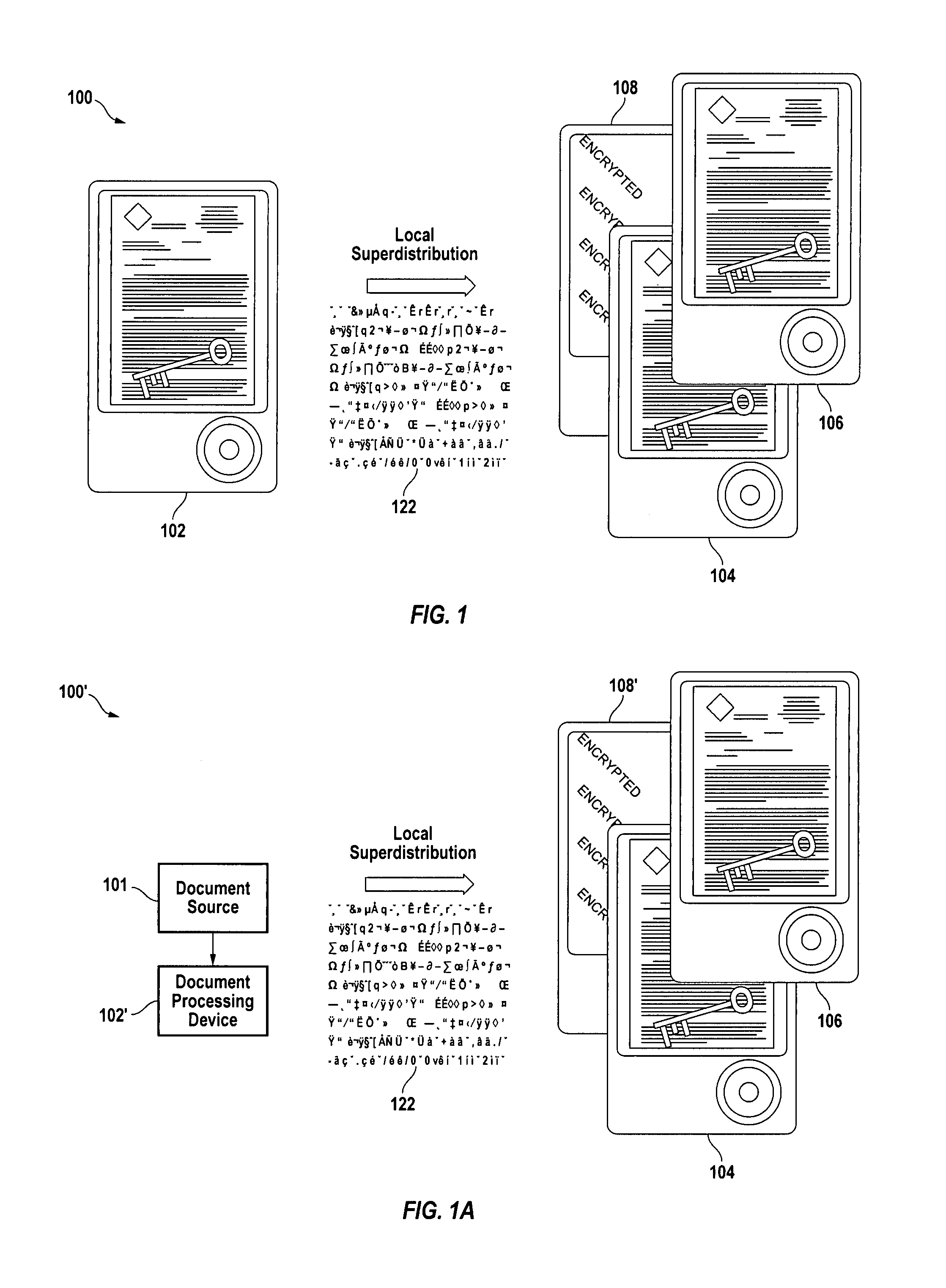
system according to the present invention provides for secure publication of compound documents to a limited audience. The present invention has been reduced to practice by the inventors and is referred to herein generally as Makyoh. Features include version-control, secure storage, permanent handles for publications and versions (URIs), and the ability to build compound documents and organize documents into
directory trees. It also provides features including robust redundant storage, an intuitive “paper-like” publication and access-control model, and the ability to operate in environments with slow, partitioned or no network access.
[0012]To access a particular document or feed, a user must possess that document's or feed'
s key. Each document, as represented by a file or set of files, is associated with a
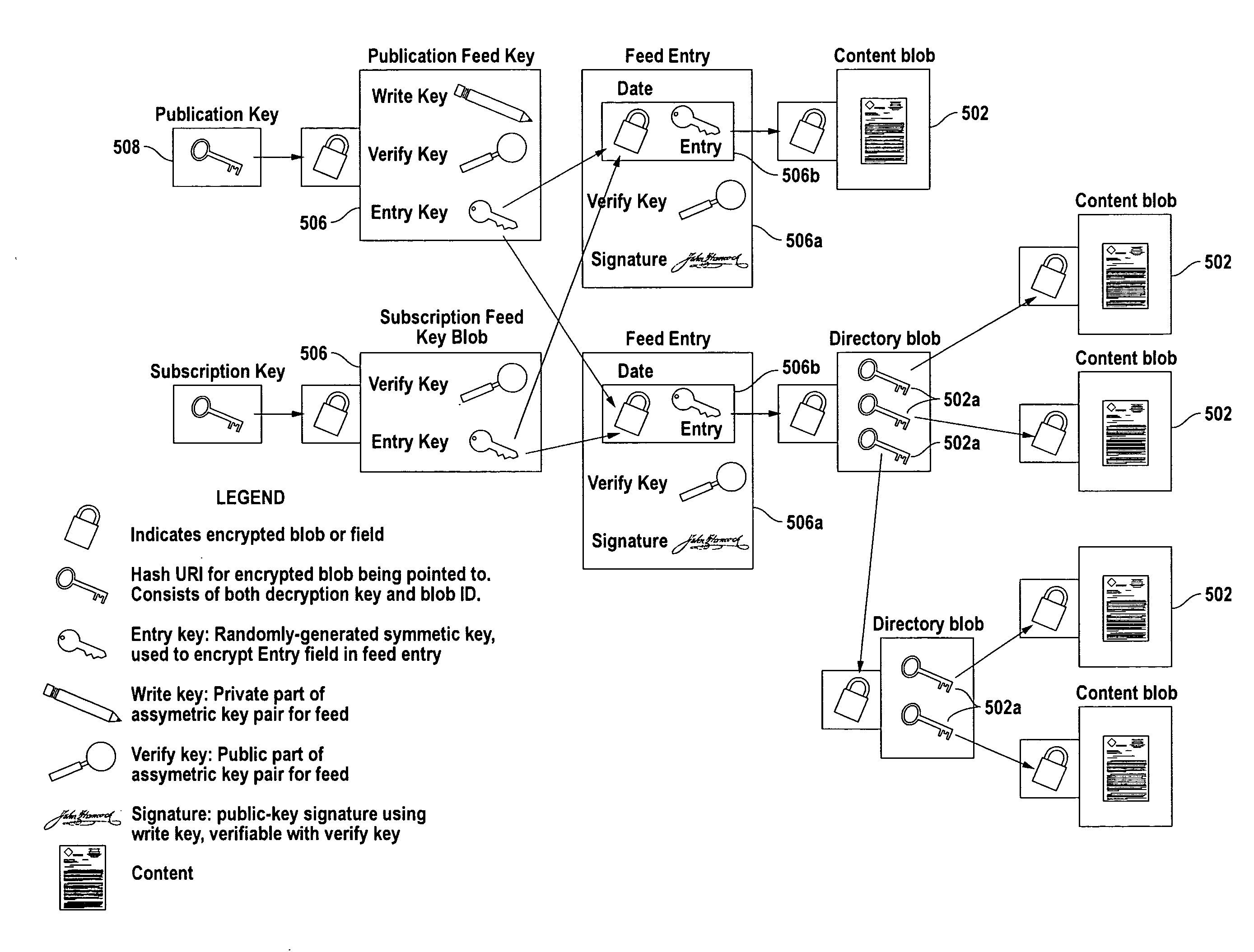
unique key called a “document key.” A document key grants the ability to both identify and decrypt the file or set of files that make up a single, fixed version of the associated document. Each feed (and its entries) is associated with two unique keys, called a “subscription key” and a “publication key.” A subscription key grants the ability to both identify and decrypt the file or set of files that make up entries in the associated feed, but does not grant the ability to add new entries to the feed. A publication key grants the ability to both identify and decrypt the file or set of files that make up entries in the associated feed, and also grants the ability to add new entries to the feed through a process called “publication.” A user can grant access to a document or feed to someone else by giving the appropriate key. The
receiver will then “import” the key into his or her personal Makyoh
server. In an embodiment of the present invention, the key is encrypted using the user's
passphrase and stored in a private
directory on his or her personal Makyoh
server's local disk.
[0013]A personal document archive system according to the present invention provides robust, secure
document storage and sharing without requiring any of the infrastructure required in conventional archiving systems. It is robust without requiring dedicated servers, scheduled
backup or even a reliable network, and it is secure without the need for account
password, firewalls or secure
server rooms. To an
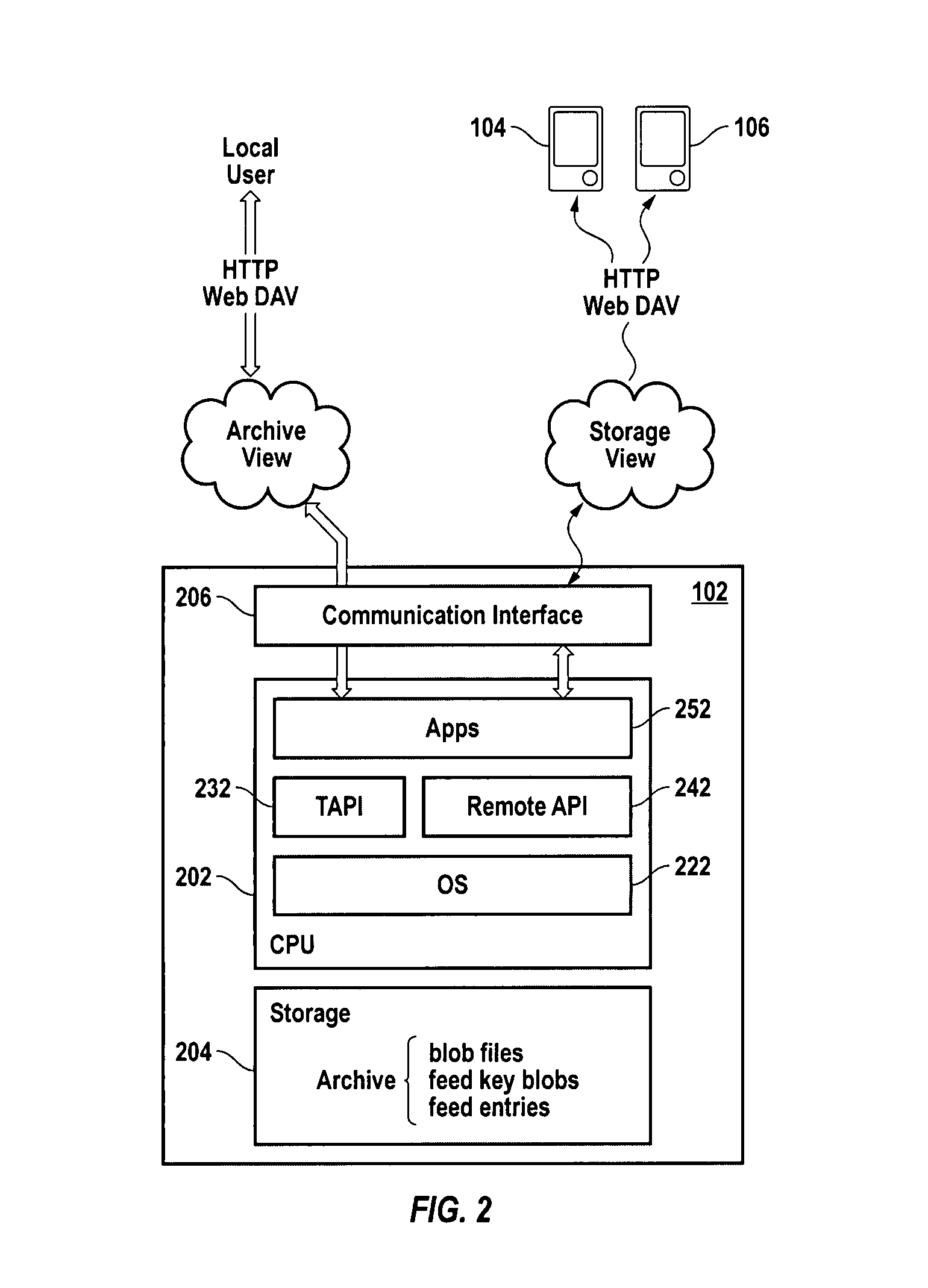
end user (and his applications), the archive appears to be a local disk. Once the user has entered his
passphrase to unlock the system, his entire archive is available in this manner. In a particular embodiment of the present invention, each file and
directory is actually stored on disk in its own encrypted file called a blob (
Binary Large OBject). Each blob has its own unique 128-bit symmetric decryption key. No one can access the contents of an archive without the appropriate key, even if they steal the hard drive. Blob decryption keys can be listed in encrypted directory blobs, but not in all cases. For example, the key for a blob representing a single-file document might only exist as a printed 2D
barcode representing the document key.
[0014]As stated above, conventional centralized and decentralized systems typically differ in how control over a document is divided between the publisher and the reader, with centralized systems leaving more control in the hands of the publisher and decentralized systems giving the reader more control. In accordance with the present invention, control over how resources (e.g., files, directories and feed entries) can be accessed and modified is more evenly balanced between publishers and consumers than is the case in either typical central server systems like the Web or decentralized systems like email. In particular, the present invention ensures the following needs are met for readers, publishers, and re-publishers (e.g., readers who are also publishers; e.g., readers who modify material they have read and then publish the modified material).
[0024]Integrity: ability to ensure that readers can tell whether their mirror of a resource is complete (that is, to tell when they have all the files necessary to read a complete document or feed entry).



 Login to View More
  Login to View More