
Method of manufacturing coil for stators mounted in rotary electric machines
- Summary
- Abstract
- Description
- Claims
- Application Information
AI Technical Summary
Benefits of technology
Problems solved by technology
Method used
Image

Examples
first embodiment
[0056]Referring to FIGS. 1 to 17, hereinafter will be described, in detail, a first embodiment of a method of manufacturing a stator coil related to the present invention.
[0057]First, a configuration of a rotary electric machine 1 is described. The rotary electric machine 1 is integrated with a stator coil that has been obtained by the method of manufacturing a stator coil according to the present embodiment. The rotary electric machine 1 may, for example, be an electric motor, an electric generator or a motor generator, which is loaded on a vehicle.
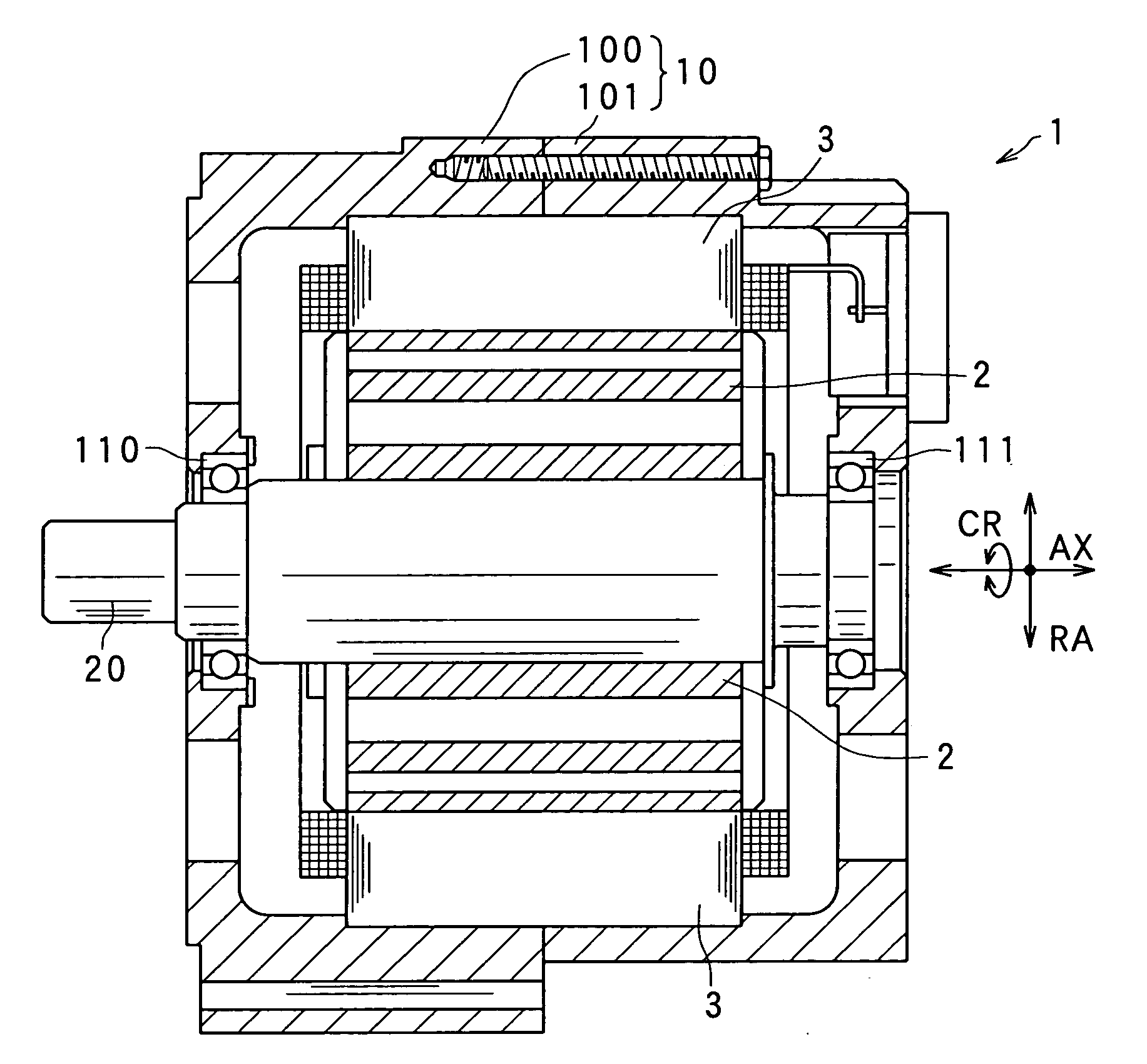
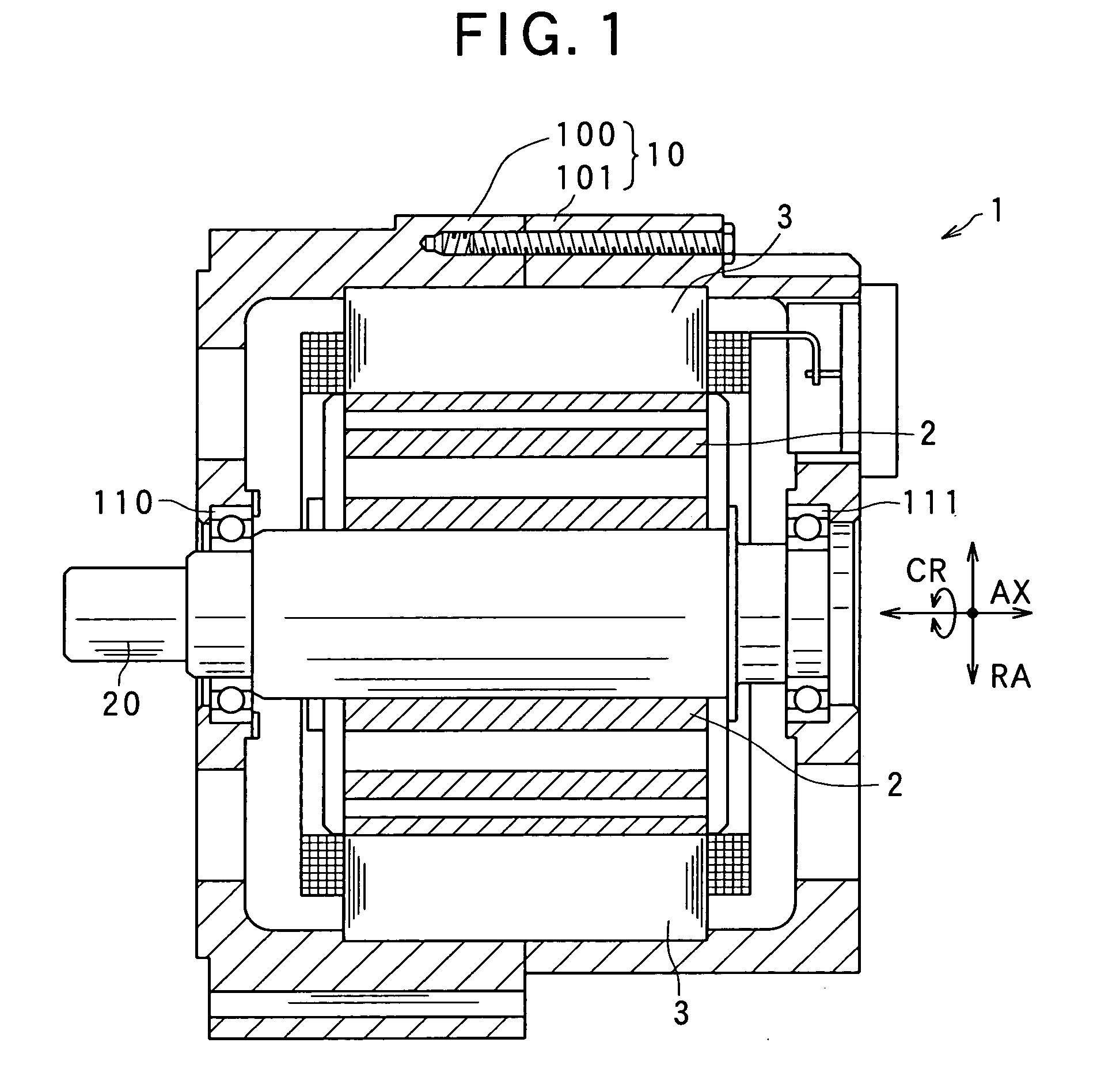
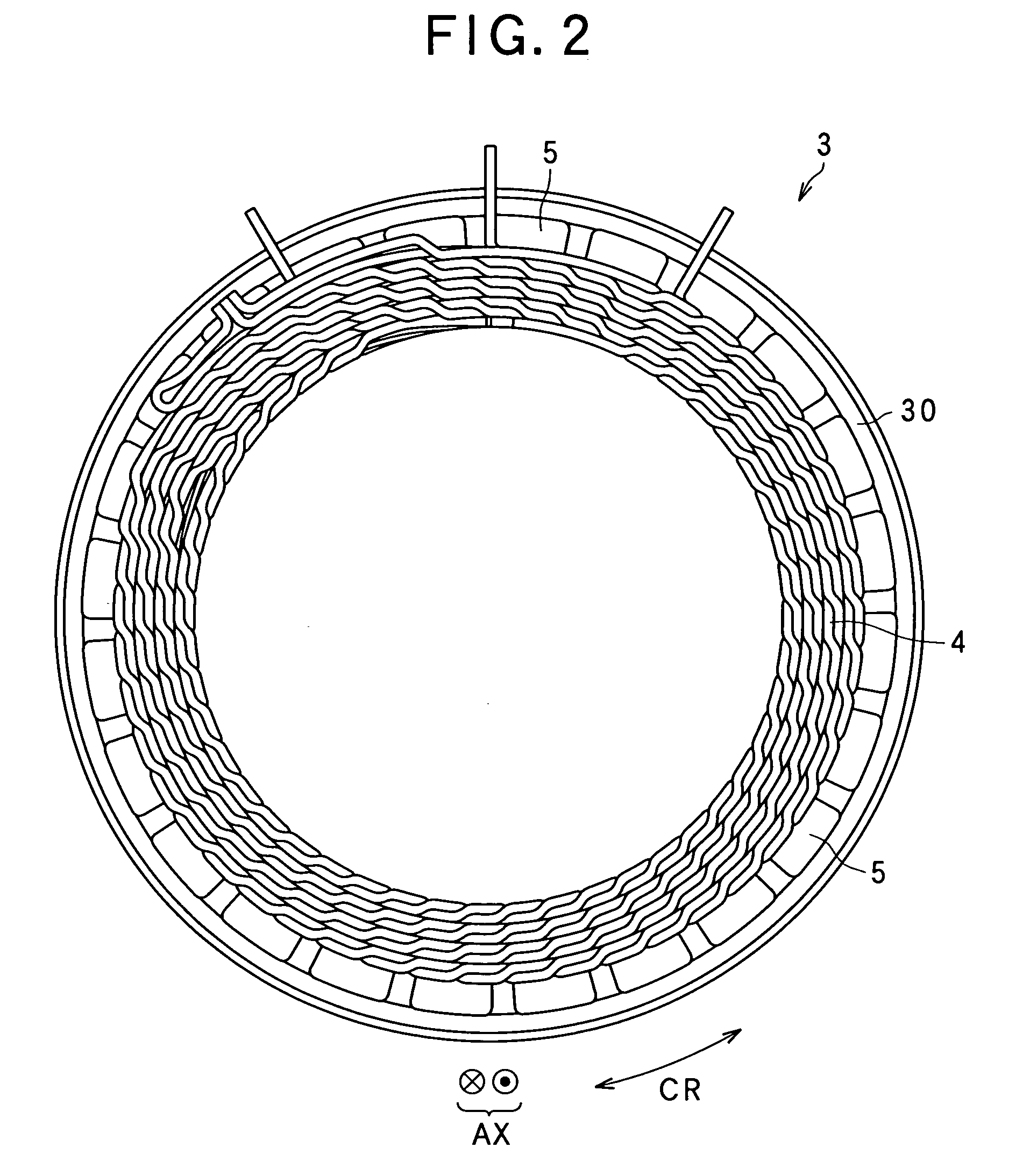
[0058]As shown in FIG. 1, the rotary electric machine 1 includes: a housing 10 consisting of a pair of bottomed housing members 100, 101 each having substantially a cylindrical shape and joined to each other at the opening portions thereof; a rotary shaft 20 rotatably supported by the housing 10 via bearings 110, 111; a rotor 2 secured to the rotary shaft 20; and a stator 3 secured to the housing 10, being located at a position of enclos...
second embodiment
[0101]Referring now to FIG. 18, hereinafter will be described a second embodiment of a method of manufacturing a stator coil related to the present invention. In the present and the subsequent embodiments, the components having functions identical with or similar to those in the first embodiment described above are designated with the same references to omit or simplify the descriptions.
[0102]In the first embodiment described above, no particular processes have been performed from when the integrated body 47 has been fitted to the alignment member 500 to when the integrated body 47 is wound about the core member 600. However, the present invention is not intended to be limited to this, but may be configured differently. Specifically, as a pre-process prior to winding the integrated body 47 about the core member 600, the integrated body 47 may be subjected to round shaping (curve shaping) to cope with the curvature of the winding face 601. FIG. 18 is a side view illustrating a config...
third embodiment
[0107]Referring now to FIG. 19, hereinafter is described a third embodiment of a method of manufacturing a stator coil related to the present invention.
[0108]In the first embodiment described above, a plurality of integrated bodies have been fitted to the alignment member 500 first, and then wound about the core member 600 with a plurality of winding turns. In the third embodiment, however, the integrated body 47 is divided in advance into pieces each of which corresponds to one winding turn. The plurality of pieces of divided integrated body 47 are fitted to the alignment member 500 and then wound about the core member 600. Compared to the first embodiment, this can reduce the number of winding turns imparted to the core member 600. Further, compared to the first embodiment, the pieces of integrated body, each of which has been divided to have a length corresponding to that of each winding turn, can be located in a compact space to thereby additionally exert an advantage of reducin...
PUM
| Property | Measurement | Unit |
|---|---|---|
| Size | aaaaa | aaaaa |
| Speed | aaaaa | aaaaa |
| Electrical conductor | aaaaa | aaaaa |
Abstract
Description
Claims
Application Information
 Login to View More