
Device and method for coding a data signal and device and method for decoding a data signal
a data signal and data signal technology, applied in the field of data signal coding devices, can solve the problems of reducing the amount of data to be transferred, high distortion loss of information transferred, etc., and achieve the effect of improving the quality of the reconstructed data signal
- Summary
- Abstract
- Description
- Claims
- Application Information
AI Technical Summary
Benefits of technology
Problems solved by technology
Method used
Image

Examples
example a
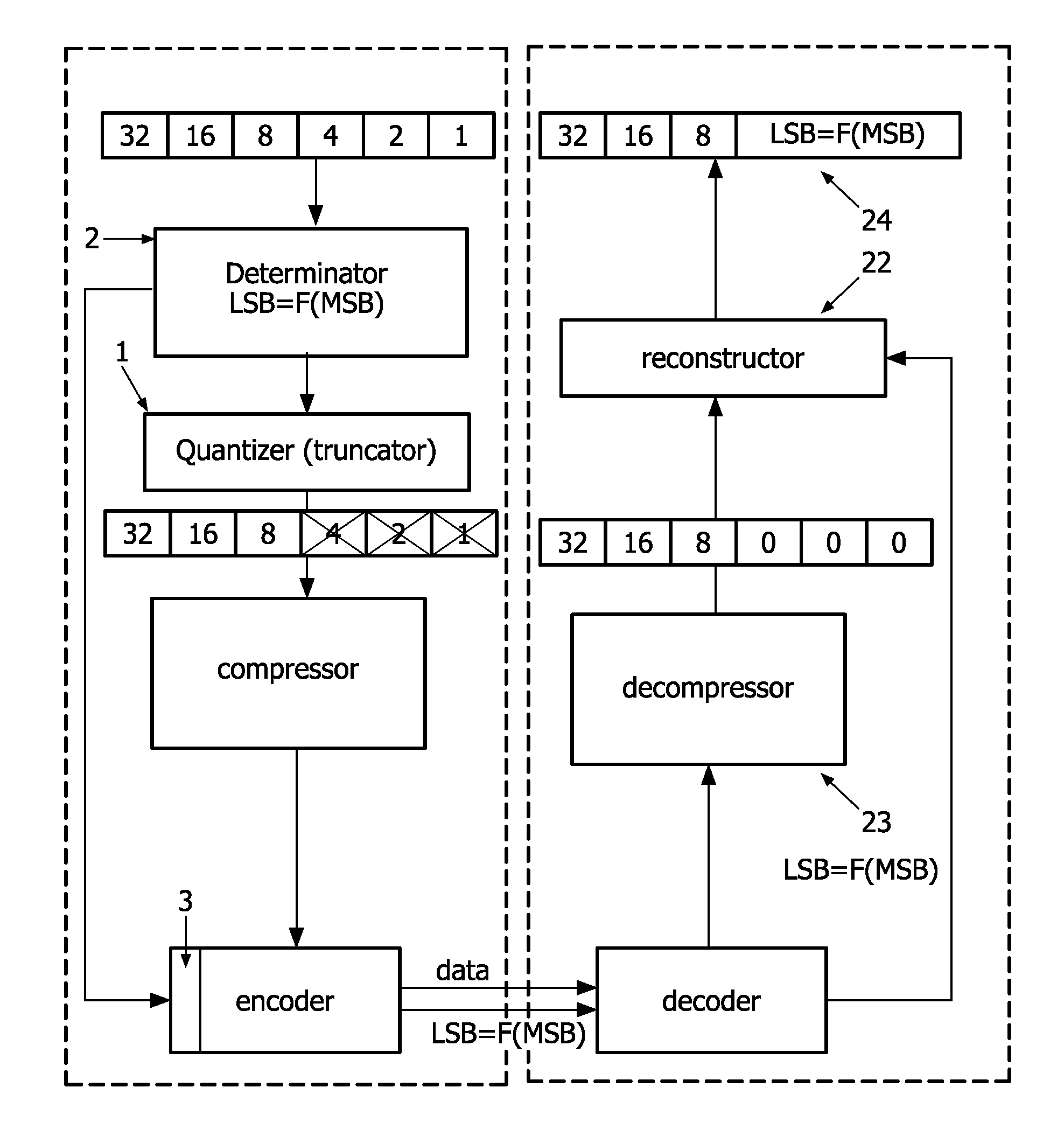
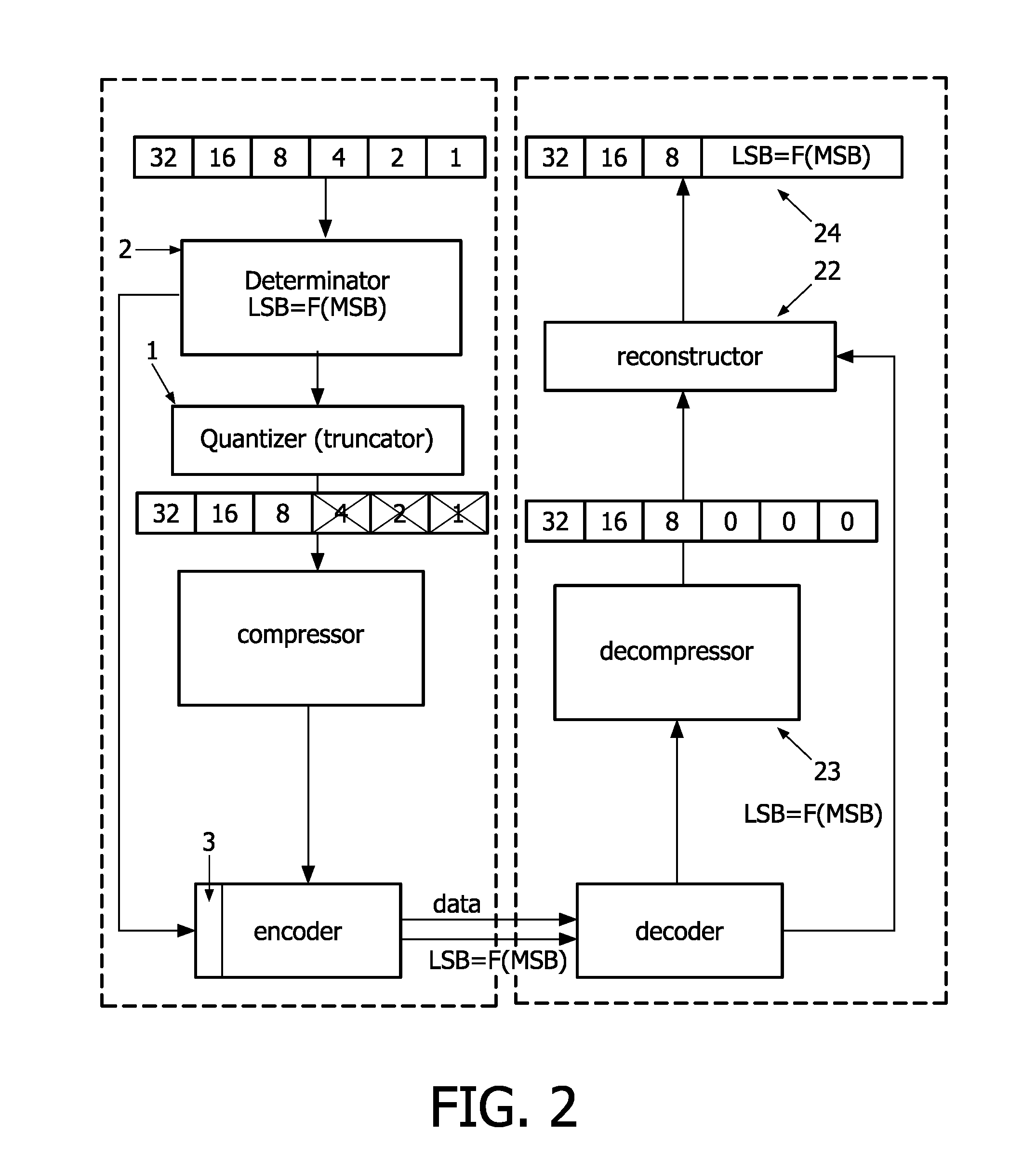
[0050]If for a DCT coefficient with a scalar quantizer of 10 for a given picture the DCT value is 32±2 (with a gaussian distribution) over the picture, the standard method will provide a single value: 100% having a quantized value of 3. The decoder will, at the decoder end, multiply the value with the quantized data interval (=10), and add 5 (=0.5 times the quantized data interval) to the result, giving a single result: 35. The average has then be changed from the original 32 to the reconstructed 35 leading to image errors.
example b
[0051]If for a DCT coefficient with a scalar quantizer of 10 for a given picture the DCT value is 30±4 (with a gaussian distribution) over the picture, the standard method will provide two values: 50% having a quantized value 2 and 50% having a quantized value 3. The decoder will, at the decoder end, multiply the quantized data value with the quantization data interval (=10) of the scalar quantizer, and add 5 to the result, giving two reconstruction values: 50% of the reconstructed data having a reconstructed value of 25, and 50% having a reconstructed value of 35. The original distribution in values prior to quantization (a gaussian distribution with a width of 4 around a peak value of 30, has thus been reconstructed by two peaks (at 25 and at 35) each lying outside the original distribution. The spread in signal has thus been greatly increased by the quantizing-dequantizing steps. This will lead to image errors.
[0052]In the invention the statistical relation between the quantized ...
PUM
 Login to View More
 Abstract
Description
Claims
Application Information
 Login to View More