
Preparation of 6-Alpha-Amino N-Substituted Morphinans by Catalytic Hydrogen Transfer
a technology of n-substituted morphinans and morphinans, which is applied in the direction of biocide, heterocyclic compound active ingredients, drug compositions, etc., can solve the problems of high reactive reducing agents, no 6-alpha-amino epimer provides stereoselective synthesis in good yield
- Summary
- Abstract
- Description
- Claims
- Application Information
AI Technical Summary
Benefits of technology
Problems solved by technology
Method used
Image

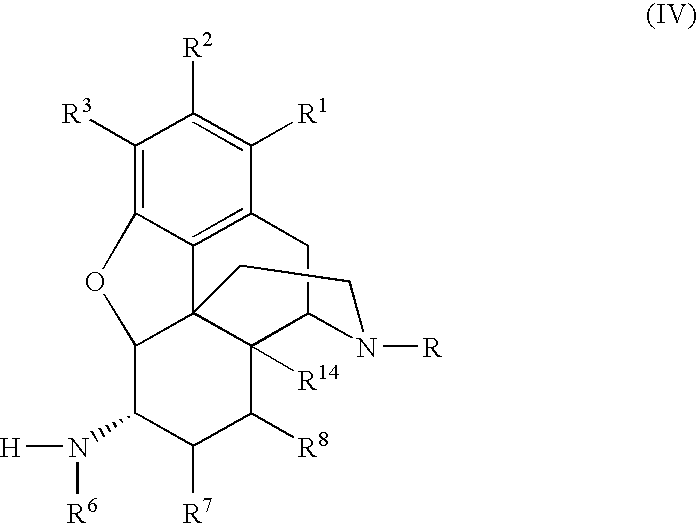
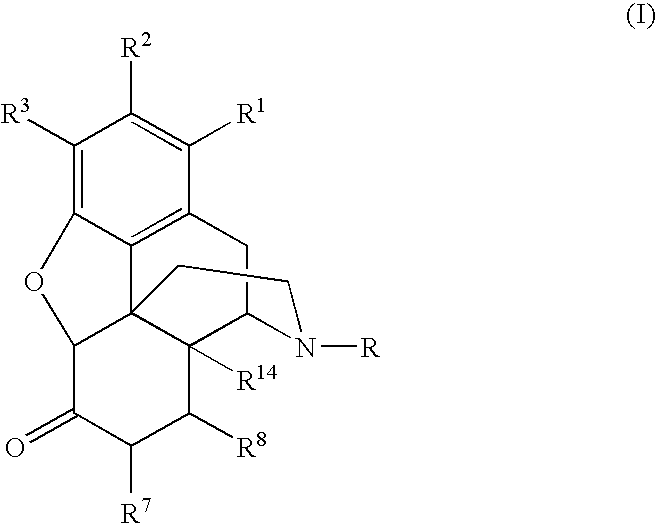
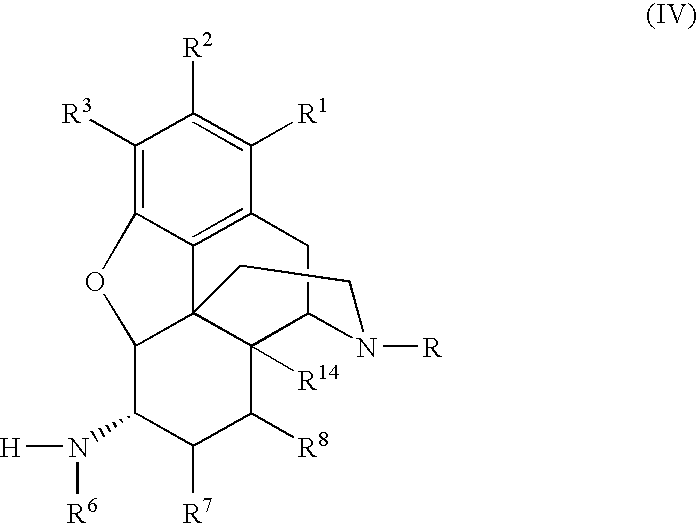
Examples
example 1
Reductive Amination of (−)-Oxymorphone with Benzylamine
[0111]The following reaction scheme depicts the preparation of a 6-alpha amino derivative of (−)-oxymorphone:
[0112]Into a round bottom flask was added oxymorphone (1.22 g, 0.004 mole), triethylamine (2.15 g, 0.021 moles, 2.96 mL), benzylamine (0.91 g, 0.008 moles, 0.9 mL), and acetonitrile (6.0 mL). To this solution was added >96% formic acid (2.44 g, 0.053 moles, 2.00 mL) dropwise. After stirring for 5 minutes, dichloro(p-cymene)ruthenium (II) dimer (Ru(II) dimer) (13 mg) was added and the reaction mixture was stirred at room temperature for 48 h. LC indicated that the reaction was ˜75% complete. To the reaction mixture was added an additional amount of benzylamine (0.91 g, 0.008 moles, 0.9 mL) and Ru(II) dimer (13 mg). The reaction was stirred for an additional 3 days. LC indicated that the reaction was complete. Under reduced pressure, the reaction mixture was evaporated to a thick oil. To the thick oil was added distilled wa...
example 2
Reductive Amination of (−)-Naltrexone with Benzylamine
[0113]A 6-alpha amino derivative of naltrexone was prepared according to the following reaction scheme:
[0114]Into a round bottom flask was added naltrexone (2.18 g, 0.006 mole), triethylamine (3.23 g, 0.032 moles, 4.45 mL), benzylamine (2.05 g, 0.019 moles, 2.01 mL), and acetonitrile (10.0 mL). To this solution was added >96% formic acid (3.67 g, 0.08 moles, 3.00 mL) dropwise, After stirring for 10 minutes, dichloro(p-cymene)ruthenium (II) dimer (20 mg) was added and the reaction mixture was stirred at room temperature for 72 h. LC indicated that the reaction was complete. Under reduced pressure, the reaction mixture was evaporated to a thick oil. To the thick oil was added distilled water (10 mL) and acetonitrile (1 mL). 29% NH3 / H2O was added dropwise until the pH of the mixture was 9.3. A precipitate formed and the mixture was stirred at room temperature for 18 h. The precipitate was then isolated by filtration, and the precipi...
example 3
Reductive Amination of (−)Naltrexone with Ammonium Acetate
[0115]The following reaction scheme depicts the preparation of 6-alpha-naltrexamine:
[0116]Into a round bottom flask equipped with a reflux condenser was added naltrexone (2.95 g, 0.009 mole), ammonium acetate (7.99 g, 0.104 mole), and absolute ethanol (30 mL). This mixture was refluxed for 2 hours. After replacing the reflux condenser with a short path distillation set-up, ˜10 mL of reaction solvent was removed. The mixture was cooled to room temperature, then triethylamine (4.37 g, 0.043 mole, 6.02 mL) was added, and >96% formic acid (4.97 g, 0.108 mole, 4.08 mL) was added dropwise. After 10 minutes of stirring, dichloro (p-cymene) ruthenium (II) dimer (26 mg) was added. The reaction stirred for 18 h at 60° C. LC indicated that two products were present, 6-α-naltrexamine and N-formyl-6α-naltrexamine. This reaction mixture stirred for an additional 24 h at 60° C. LC indicated that no 6-α-naltrexamine remained. The mixture was...
PUM
| Property | Measurement | Unit |
|---|---|---|
| Temperature | aaaaa | aaaaa |
| Temperature | aaaaa | aaaaa |
| Temperature | aaaaa | aaaaa |
Abstract
Description
Claims
Application Information
 Login to View More