
Print apparatus, print control apparatus and image processing apparatus
a technology of print control and print apparatus, which is applied in the direction of visual presentation, instruments, computing, etc., can solve the problems of reducing the complication of work and composition processing instructions accompanying the creation of each offset plate, affecting the convenience of the above approach, and affecting the positioning of image objects included in the respective image data
- Summary
- Abstract
- Description
- Claims
- Application Information
AI Technical Summary
Benefits of technology
Problems solved by technology
Method used
Image

Examples
first embodiment
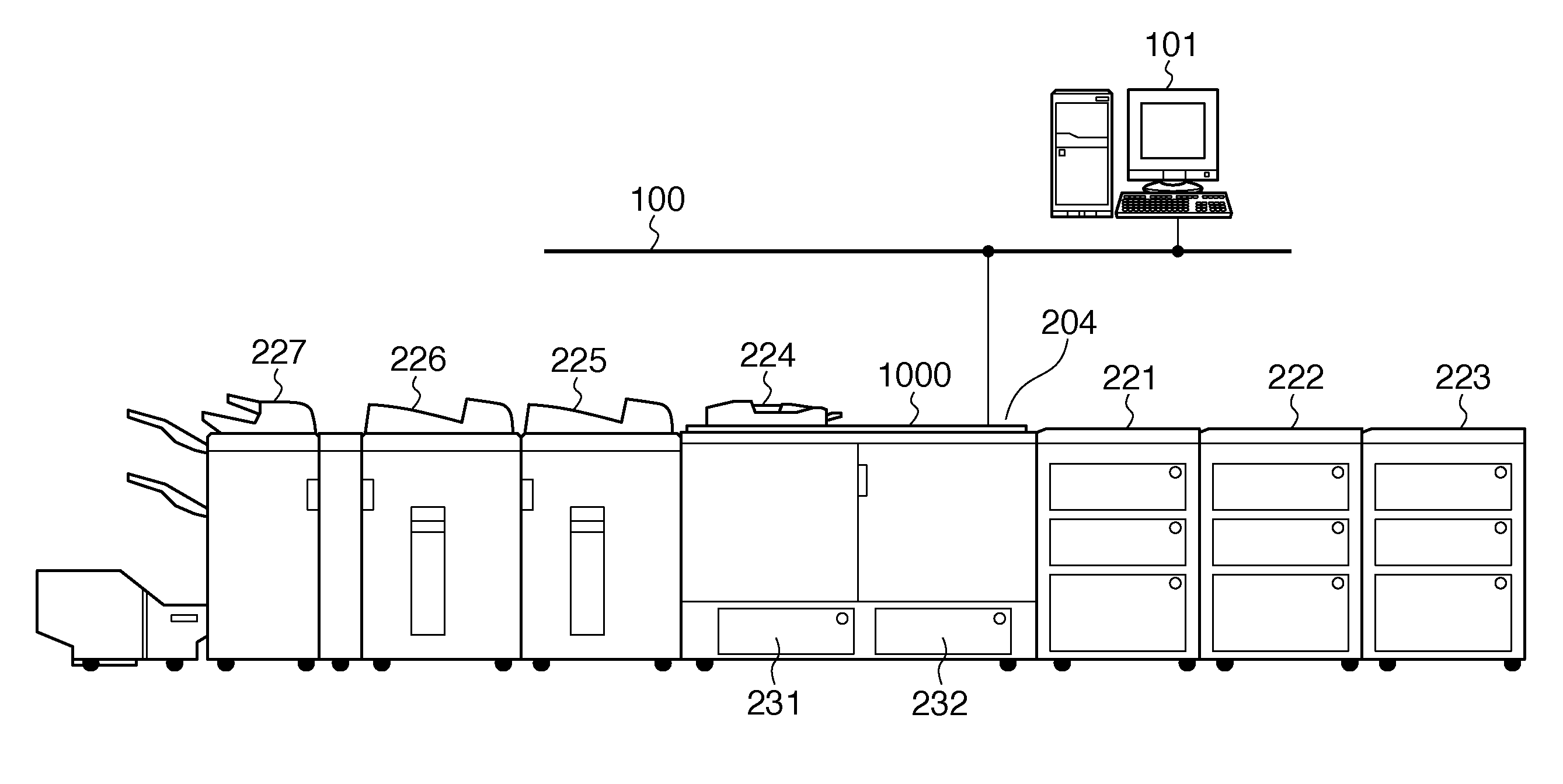
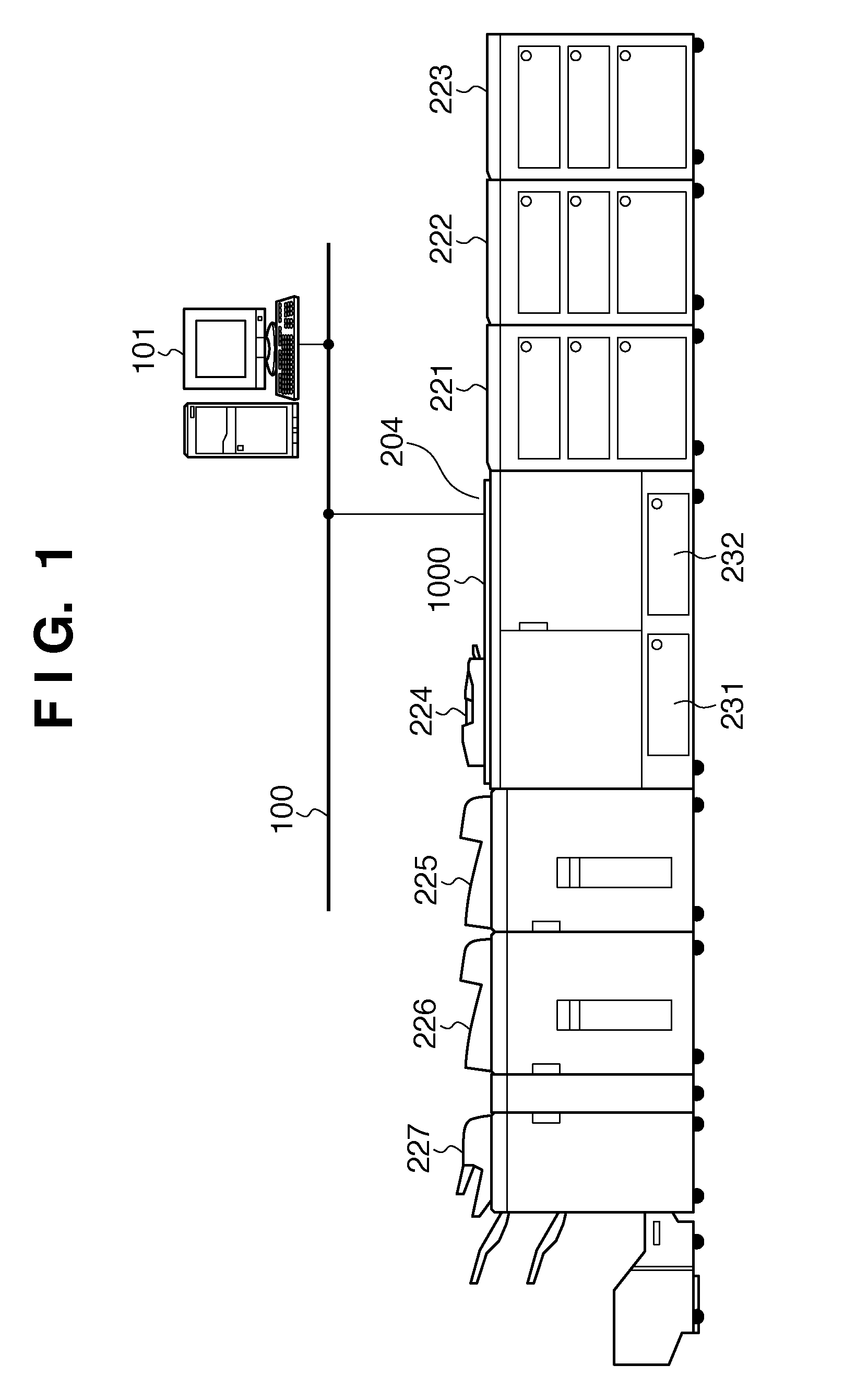
[0040]FIG. 1 depicts a view illustrating the configuration of a printing (POD) system according to an embodiment of the present invention. In this system, apparatuses having a plurality of different roles are connected to each other, and thus it is possible to perform complicated sheet processing (such as bookbinding, folding, or punching) on paper that has been printed.
[0041]A digital printing device 1000 prints images using a recording agent such as a toner on media (a sheet) based on image data. Below is a simple description of print processing when the digital printing device 1000 is a print apparatus employing an electrophotographic method. A semiconductor laser is driven by a signal modulated according to image data to emit laser light, and this laser light is reflected by a multi-sided mirror (such as a polygonal mirror) and irradiated onto a uniformly charged photosensitive drum. Thus, a latent image corresponding to the image data is formed on the photosensitive drum, and t...
second embodiment
[0104]In the above first embodiment, an example is described in which the digital printing device 1000 performs processing to adjust the scaling of the image to undergo composition relative to the image to be composited. However, a configuration may also be adopted in which scaling modification processing for matching the scalings to prevent misregistration when printing is performed by the computer 101.
[0105]Specifically, a configuration is acceptable in which when performing the data conversion processing in step S3 in FIG. 16, that is, when producing PDL data, data conversion processing is executed in consideration of the scaling setting that was modified in step S27 in FIG. 18.
[0106]Also, the above first embodiment describes modifying the scaling of the image to undergo composition, which will be composited with the clear color offset plate. A configuration may also be adopted in which, for example, scaling is modified for the image data of the image to be composited, that is, t...
third embodiment
[0111]In the above embodiments, when the scaling of the image to be composited is not the same as the scaling of the image to undergo composition, this fact is detected, and correction is performed such that those scalings become the same. In the third embodiment, although detection of whether or not those scalings are the same is performed, correction processing is not performed.
[0112]FIG. 23 depicts a view illustrating an example of a screen that corresponds to FIG. 14 according to the above first embodiment. This screen differs from the screen in FIG. 14 in that here, there is no radio button 1402 for automatic setting of scaling when scaling is not the same.
[0113]FIG. 24 depicts a view illustrating an example of a screen displayed immediately after identifying that the scaling of the image to be composited and the scaling of the image to undergo composition are not the same, when clear image data to be composited has been selected in the screen shown in FIG. 23.
[0114]Here, becau...
PUM
 Login to View More
 Abstract
Description
Claims
Application Information
 Login to View More