Determining whether an input string matches at least one regular expression using lookahead finite automata based regular expression detection
Inactive Publication Date: 2011-04-21
POLYTECHNIC INSTITUTE OF NEW YORK UNIVERSITY
View PDF16 Cites 59 Cited by
Summary
Abstract
Description
Claims
Application Information
AI Technical Summary
This helps you quickly interpret patents by identifying the three key elements:
Problems solved by technology
Method used
Benefits of technology
Benefits of technology
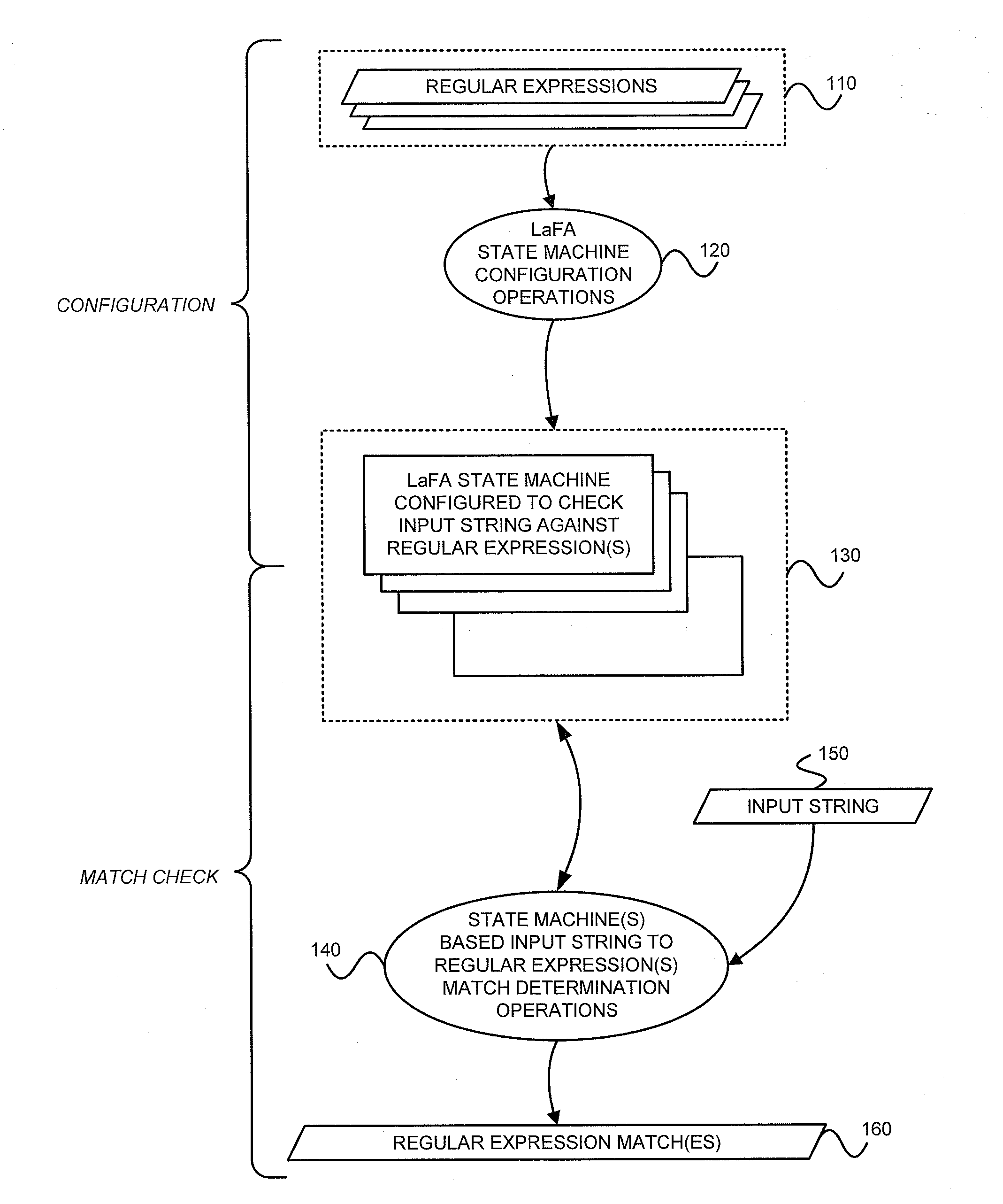
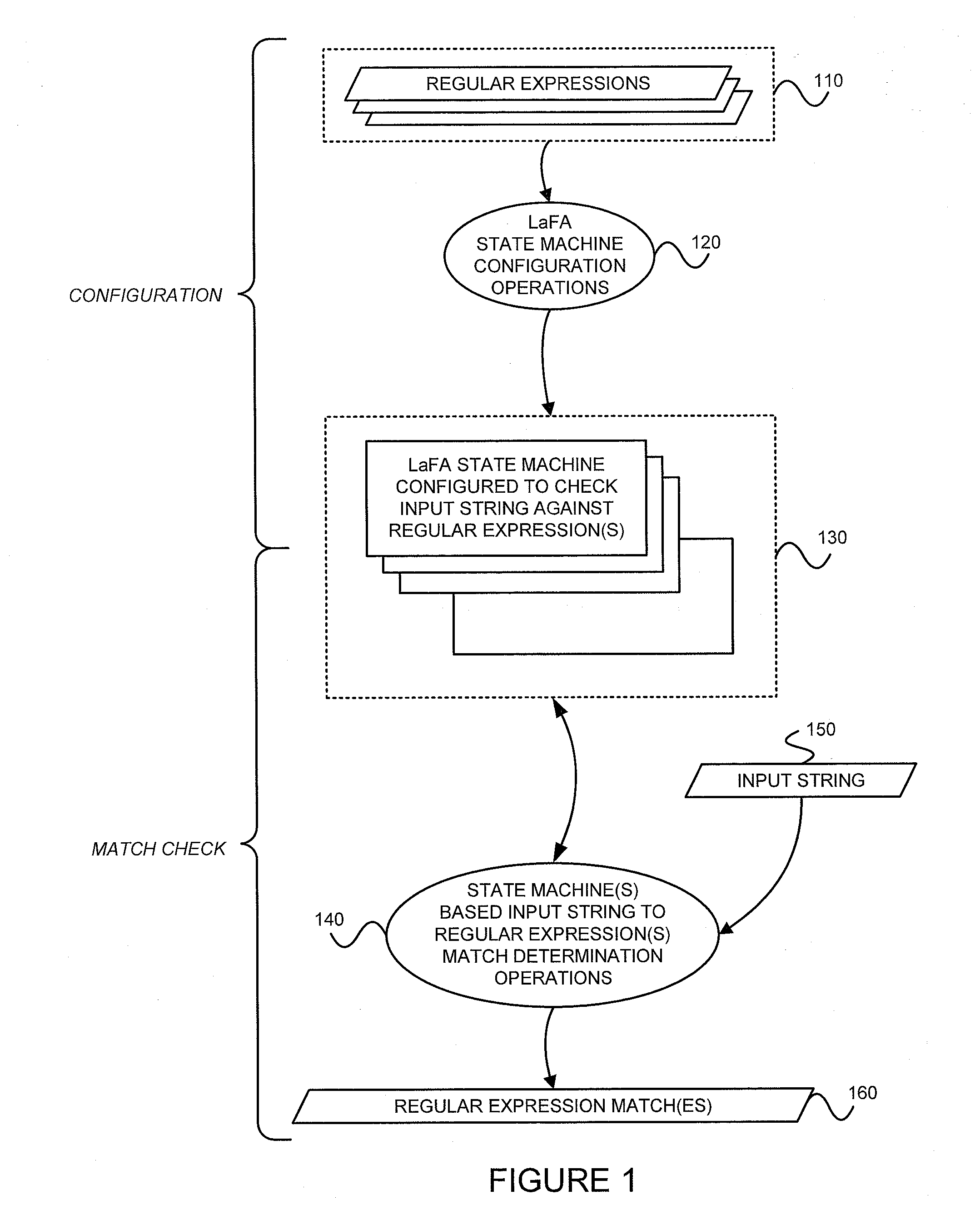
[0017]Embodiments consistent with the present invention use LaFA to perform scalable RegEx detection using a very small amount of memory. LaFA's memory requirement can be made very small due to the following features. First, different parts of a RegEx (namely RegEx “components”) are detected using different detectors, each of which may be specialized and optimized for the detection of a certain RegEx component. Second, the RegEx component detection sequence is systematically reordered. This provides new opportunities for memory optimization. Third, many redundant states in classical finite automata are identified and eliminated. Simulations have shown that embodiments consistent with the present invention require an order of magnitude less memory compared to today's state-of-the-art RegEx detection systems. A single commodity Field Programmable Gate Array (“FPGA”) chip can accommodate up to twenty-five thousand (25k) RegExes. Based on the throughput of an exemplary LaFA embodied on an FPGA, it is estimated that a 34-Gbps throughput can be achieved.
Problems solved by technology
Furthermore, the potential benefits of reduced number of operations and states using out-of-sequence detection methods have not been explored.
Method used
the structure of the environmentally friendly knitted fabric provided by the present invention; figure 2 Flow chart of the yarn wrapping machine for environmentally friendly knitted fabrics and storage devices; image 3 Is the parameter map of the yarn covering machine
View more
Image
Smart Image Click on the blue labels to locate them in the text.
Viewing Examples
Smart Image
Click on the blue label to locate the original text in one second.
Reading with bidirectional positioning of images and text.
Smart Image
Examples
Experimental program
Comparison scheme
Effect test
case 1
[0069]If a RegEx includes only simple strings S and look-ahead type variable string(s) Vla, then the rule for reordering is as follows. Examining each component and starting from the first component (leftmost component) of the RegEx and moving / scanning towards the right components, for every variable string Vla (or group of adjacent Vla only) that is directly followed by a simple string S, a swap in component positions between the encountered Vla (or group of adjacent Vla only) and the directly following simple string S shall be performed, resulting in a reordered RegEx.
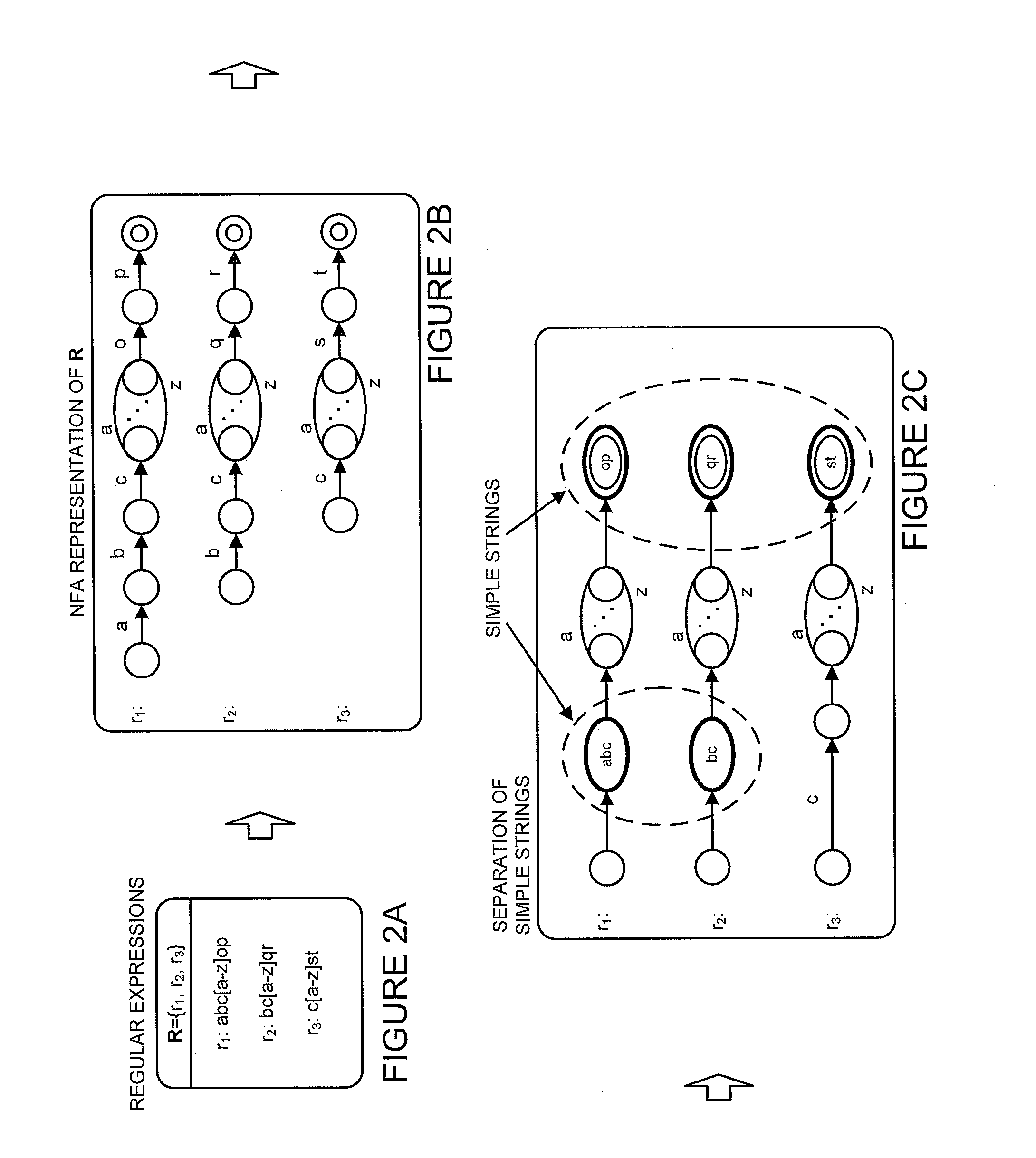
[0070]As an example given for the above case 1, consider the regular expression: RegEx: abc[a-z]xyz[0-9]op→S1: abc, V1: [a-z], S2: xyz, V2: [0-9], S3: op→RegEx: S1 V1 S2 V2 S3. Note that V1 and V2 are look-ahead-type variable strings. Then, applying the reordering rule of case 1, discussed above, to the RegEx: S1 V1 S2 V2 S3→results in the reordered RegEx: S1 S2 V1 S3 V2.
[0071]The information obtained from this reord...
case 2
[0072]If a RegEx includes simple strings S and “sequential type” variable string(s) Vseq only, then the RegEx are not reordered. For example, the RegEx: abc[a-z]{3}op→S1: abc, V3: [a-z]{3}, S3: op→RegEx: S1 V3 S3 should not be reordered since the V3 is a sequential type variable string Vseq. The information obtained directly from this RegEx (non-reordered) is used for configuring the LaFA state machine such as configuring the nodes and their information in the correlation block.
case 3
[0073]If a RegEx includes simple strings S and both look-ahead type variable string(s) Vla and sequential type variable string(s) Vseq, then the rule for reordering is as follows. Examining each component and starting from the first component (leftmost component) of the RegEx and moving / scanning towards the right components, for every variable string Vla (or group of adjacent Vla only) that is directly followed by a simple string S or variable string Vseq, a swap in component positions between the encountered Vla (or group of adjacent Vla only) and the directly following simple string S or variable string Vseq shall be performed, resulting in a reordered RegEx. Basically, case 3 is similar to case 1, with the variable string Vseq treated like another simple string S (while applying the rules of case 1).
[0074]As an example given for the above case 3, consider the regular expression: RegEx: abc[a-z][a-z]{3}[0-9]{2}op→S1: abc, V1: [a-z], V3: [a-z]{3}, V4:[0-9]{2}, S3: op→RegEx: S1 V1 V...
the structure of the environmentally friendly knitted fabric provided by the present invention; figure 2 Flow chart of the yarn wrapping machine for environmentally friendly knitted fabrics and storage devices; image 3 Is the parameter map of the yarn covering machine
Login to View More
PUM
Login to View More
Abstract
Previously configured state machines may accept an input string, and for each of the regular expression(s), check for a match between the input string accepted and the given regular expression using the configured nodes of the state machine corresponding to the given regular expression. Checking for a match between the input string accepted and the given regular expression using configured nodes of a state machine corresponding to the given regular expression by using the configured nodes of the state machine may include (1) checking detection events from a simple string detector, (2) submitting queries to identified modules of a variable string detector, and (3) receiving detection events from the identified modules of the variable string detector.
Description
0. PRIORITY CLAIM[0001]This application claims the benefit of U.S. Provisional Patent Application Ser. No. 61 / 252,651 (incorporated herein by reference and referred to as “the '651 provisional”), titled “LaFA: LOOKAHEAD FINITE AUTOMATA REGULAR EXPRESSION DETECTION SYSTEM,” filed on Oct. 17, 2009, and listing Masanori Bando, (Nabi) Sertac Artan and Hung-Hsiang Jonathan Chao as inventors. The present invention in not limited to requirements of the particular embodiments described in the '651 provisional.1. BACKGROUND OF THE INVENTION[0002]1.1 Field of the Invention[0003]The present invention concerns matching an arbitrary length string with one of a number of known regular expressions, and / or configuring state machines for this purpose. Such matching may be used for network intrusion detection and prevention.[0004]1.2 Background Information[0005]Although Regular Expressions (referred to as “RegExes”) have been widely used in network security applications, their inherent complexity oft...
Claims
the structure of the environmentally friendly knitted fabric provided by the present invention; figure 2 Flow chart of the yarn wrapping machine for environmentally friendly knitted fabrics and storage devices; image 3 Is the parameter map of the yarn covering machine
Login to View More
Application Information
Patent Timeline
Application Date:The date an application was filed.
Publication Date:The date a patent or application was officially published.
First Publication Date:The earliest publication date of a patent with the same application number.
Issue Date:Publication date of the patent grant document.
PCT Entry Date:The Entry date of PCT National Phase.
Estimated Expiry Date:The statutory expiry date of a patent right according to the Patent Law, and it is the longest term of protection that the patent right can achieve without the termination of the patent right due to other reasons(Term extension factor has been taken into account ).
Invalid Date:Actual expiry date is based on effective date or publication date of legal transaction data of invalid patent.
Login to View More
IPC IPC(8): G06F17/30
CPCG06F17/30985G06F16/90344
InventorBANDO, MASANORIARTAN, NABI SERTACCHAO, HUNG-HSIANG JONATHAN


 Login to View More
  Login to View More