
High permeance polyimide membranes for air separation
- Summary
- Abstract
- Description
- Claims
- Application Information
AI Technical Summary
Benefits of technology
Problems solved by technology
Method used
Image

Examples
example 1
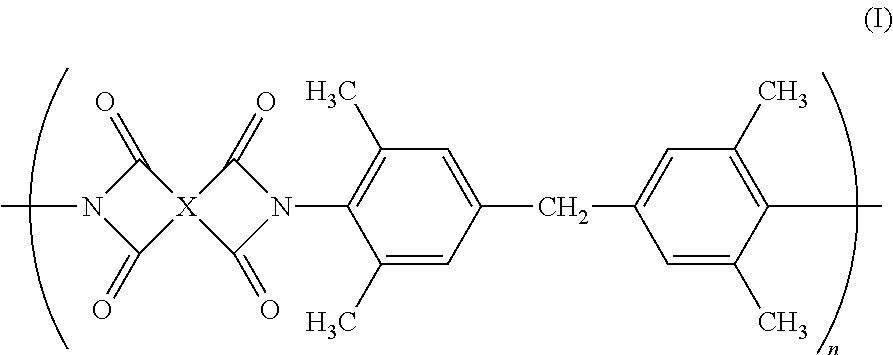
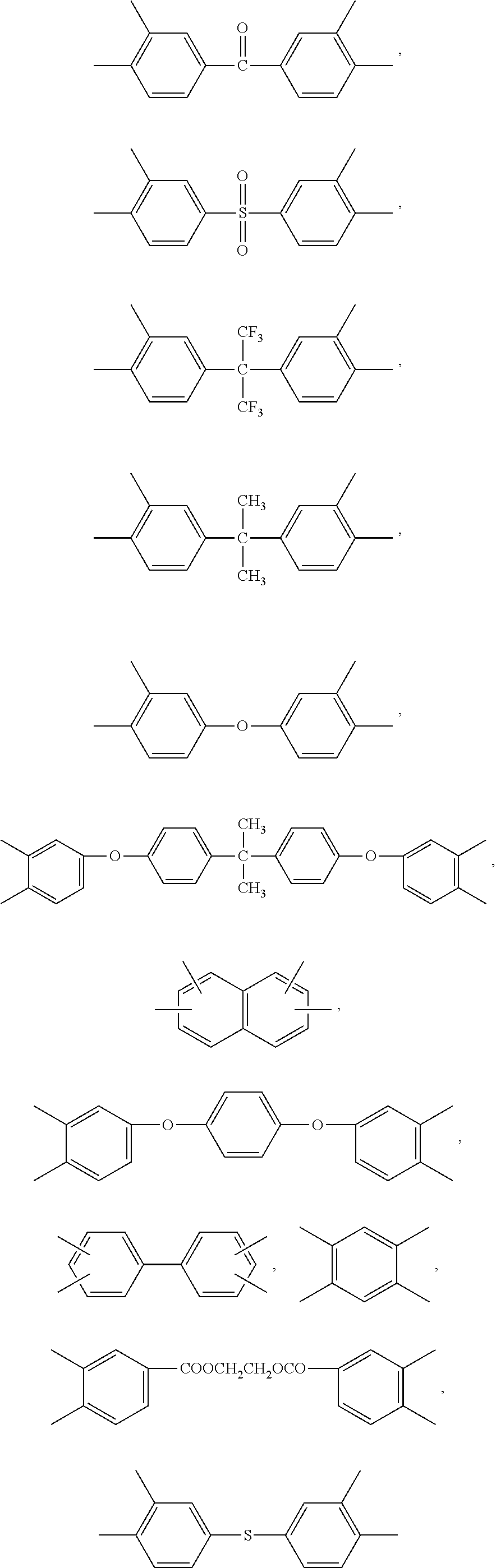
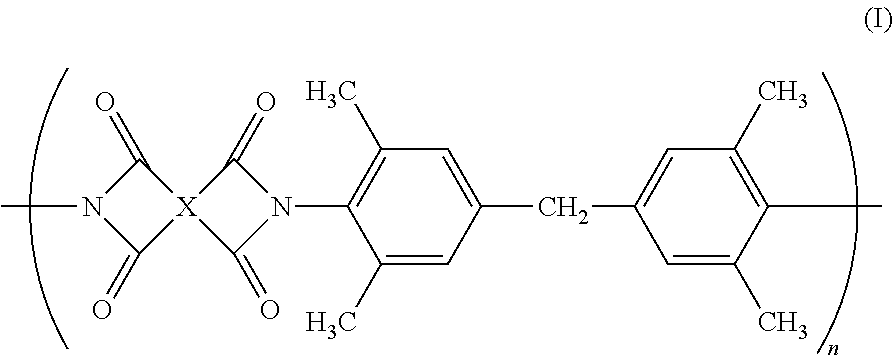
Preparation of polyimide hollow fiber membrane (PI-p) using poly(3,3′,4,4′-diphenylsulfone tetracarboxylic dianhydridepyromellitic dianhydride-pyromellitic dianhydride-3,3′,5,5′-tetramethyl-4,4′-methylene dianiline) derived from the condensation reaction of 3,3′,4,4′-diphenylsulfone tetracarboxylic dianhydride (DSDA, 80 mol-%) and pyromellitic dianhydride (PMDA, 20 mol-%) with 3,3′,5,5′-tetramethyl-4,4′-methylene dianiline (TMMDA, 100 mol-%) (abbreviated as poly(DSDA-PMDA-TMMDA))
[0040]A hollow fiber spinning dope containing 29.0 wt-% of poly(DSDA-PMDA-TMMDA) polyimide, 65.0 wt-% NMP, and 6.0 wt-% 1,3-dioxolane was prepared. The spinning dope was extruded at a flow rate of 0.7 mL / min through a spinneret at 50° C. spinning temperature. A bore fluid containing 10% by weight of water in NMP was injected to the bore of the fiber at a flow rate of 0.4 mL / min simultaneously with the extruding of the spinning dope. The nascent fiber traveled through an air gap length of 3 cm at room tempera...
example 2
Preparation of Polyimide Hollow Fiber Membrane (PI-g) Using Poly(DSDA-PMDA-TMMDA) Polymer
[0041]The PI-g polyimide hollow fiber membrane was prepared using the same spinning dope and the spinning conditions as described in Example 1 except the fiber wound-up rate was 23.5 m / min and the fibers traveled through an air gap length of 15 cm. The fibers were annealed and dried by the procedures described in Example 1.
example 3
Preparation of Polyimide Hollow Fiber Membrane (PI-wy) Using Poly(DSDA-PMDA-TMMDA) Polymer
[0042]The PI-wy polyimide hollow fiber membrane was prepared using the same spinning dope and the spinning conditions as described in Example 1 except nascent fiber traveled through an air gap length of 10 cm at room temperature and immersed into a water coagulant bath at 8° C., and then wound up at a rate of 18.1 m / min. The fibers were annealed and dried by the procedures described in Example 1.
PUM
| Property | Measurement | Unit |
|---|---|---|
| Temperature | aaaaa | aaaaa |
| Time | aaaaa | aaaaa |
| Angle | aaaaa | aaaaa |
Abstract
Description
Claims
Application Information
 Login to View More