Unlock instant, AI-driven research and patent intelligence for your innovation.
Drying and warming appliance
What is Al technical title?
Al technical title is built by PatSnap Al team. It summarizes the technical point description of the patent document.
a technology of heating appliances and drying racks, applied in the direction of dryers, other washing machines, textiles and paper, etc., can solve the problems of long drying time, affecting the drying effect of garments, so as to reduce the impact of laundry items, reduce wear, fading or shrinkage, and achieve the effect of drying more delicate clothes
Inactive Publication Date: 2012-03-08
GENERAL ELECTRIC CO
View PDF6 Cites 23 Cited by
Summary
Abstract
Description
Claims
Application Information

AI Technical Summary
This helps you quickly interpret patents by identifying the three key elements:
Problems solved by technology
Method used
Benefits of technology
[0012]A primary advantage associated with the present disclosure is an expedited drying time for laundry garments without tumble drying.
[0013]A further advantage associated with the present disclosure relates to the ability to effectively dry more delicate laundry such as finer fabrics, linens, wools, and other laundry items such as shoes, gloves, scarves, ties, etc.
[0014]Another advantage associated with the present disclosure is that the drying apparatus has a reduced impact on the laundry items, i.e., reduced wear, fading, or shrinking.
[0015]Still another advantage is the ability to function as a warming drawer for laundry items such as towels, etc., while utilizing a fraction of the energy required by a known tumble dryer.
Problems solved by technology
Tumble drying and heat are also hard on some clothing creating lint as a result of the heated tumbling action.
One disadvantage associated with these indoor options is the extended drying time because the laundry is not exposed to the sun or elevated temperatures, and there is typically no breeze of warm current of air.
However, under such indoor conditions, the air current generally contacts only one face or surface of the laundry article and not the entire garment.
Still another disadvantage associated with indoor air dry methods is that the garments may smell musty if the laundry dries in a damp area (e.g., basement) or in a manner with insufficient airflow circulated around the garments or laundry items.
Method used
the structure of the environmentally friendly knitted fabric provided by the present invention; figure 2 Flow chart of the yarn wrapping machine for environmentally friendly knitted fabrics and storage devices; image 3 Is the parameter map of the yarn covering machine
View more
Image
Smart Image Click on the blue labels to locate them in the text.
Viewing Examples
Smart Image
Click on the blue label to locate the original text in one second.
Reading with bidirectional positioning of images and text.
Smart Image
Examples
Experimental program
Comparison scheme
Effect test
Embodiment Construction
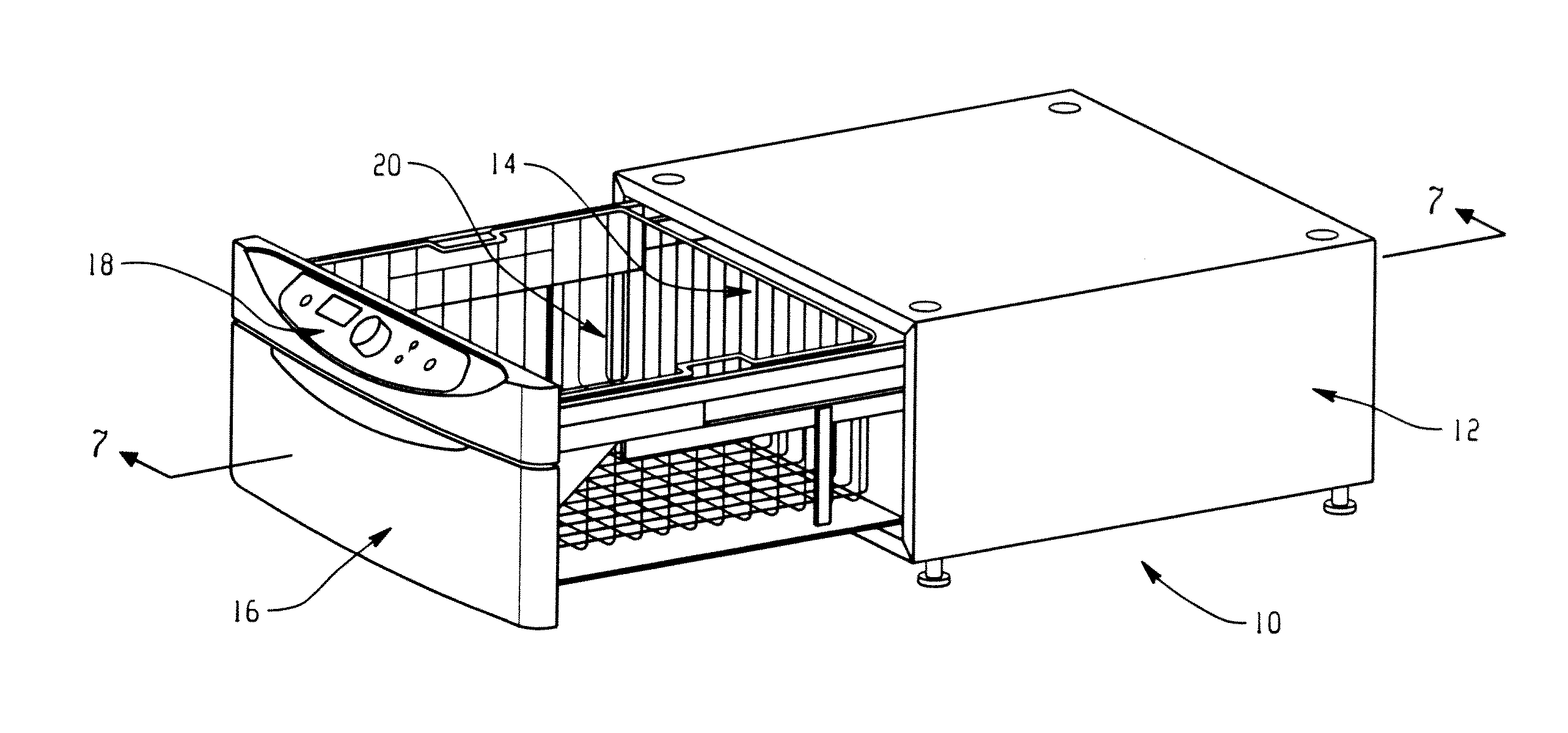
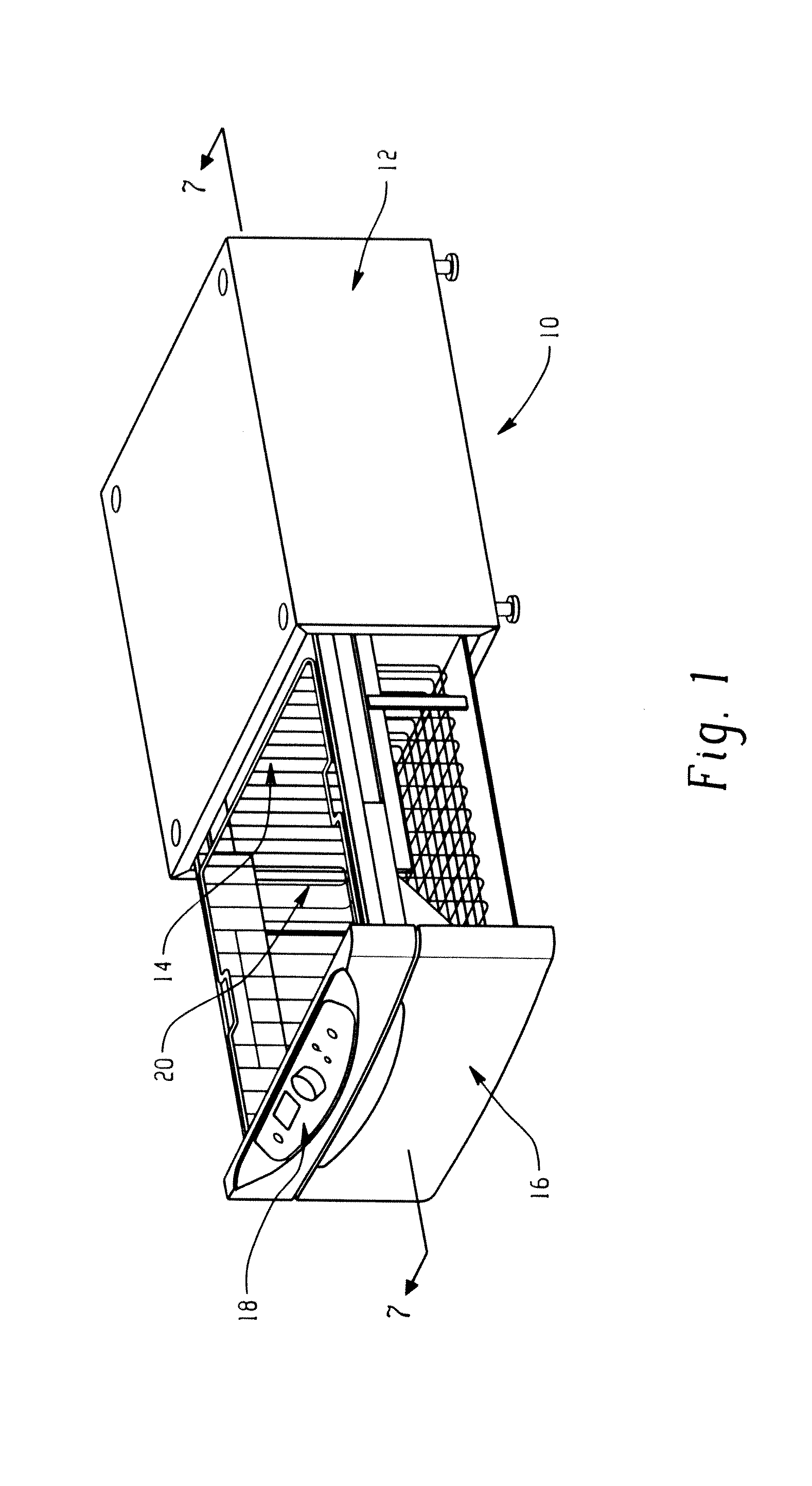
[0026]The present disclosure is directed toward a drying and / or warming appliance 10 (sometimes referred to herein as an appliance, dryer, warmer, drying drawer, or drying cabinet) that serves as a supplement to or an alternative for tumble and air drying of laundry (which includes clothing, fabrics, garments, shoes, gloves, and other articles). FIG. 1 generally illustrates the appliance 10 which includes a housing 12 having a rigid wall or walls 12 forming a closed, stationary cavity 14 dimensioned to receive the laundry therein. The appliance 10 preferably takes the form of a stand-alone appliance powered independently or through an adjacent laundry appliance such as a clothes washer or dryer (not shown). The appliance 10 includes a drawer or door 16 providing access to the cavity 14. The drawer moves relative to the housing to provide selective access to the housing interior or cavity and in the preferred arrangement includes a pair of side rails or supports that allow the drawer...
the structure of the environmentally friendly knitted fabric provided by the present invention; figure 2 Flow chart of the yarn wrapping machine for environmentally friendly knitted fabrics and storage devices; image 3 Is the parameter map of the yarn covering machine
Login to View More
PUM
Login to View More
Abstract
An appliance for drying or warming associated laundry items includes a housing having a wall forming a stationary cavity dimensioned to receive the associated laundry items. At least one article support member is preferably contained within the cavity. A heater increases a temperature of associated air within the cavity and a fan circulates the heated air within the cavity. A vent is dimensioned to allow air to exit the housing cavity, and a controller regulates circulation of the associated heated air within the cavity.
Description
BACKGROUND OF THE DISCLOSURE[0001]The present disclosure is directed to an article warming or heating appliance including an adjustable article support member provided for interaction with a circulating, preferably heated air current.[0002]Known appliances such as clothes dryers include a housing that contains a drum which rotates as heated air is circulated through the drum to remove moisture from clothes contained therein. The rotation tumbles the clothes and distributes heated air into contact with the articles being warmed or dried. Tumble drying and heat are also hard on some clothing creating lint as a result of the heated tumbling action. For this reason, delicate laundry items are sometimes dry cleaned or air-dried to better preserve the laundry items. Although durable garments can withstand tumble dry cycles, there are times when it is desirable to air dry laundry items including laundry that is deemed delicate.[0003]Traditionally, line drying was a method that used the hea...
Claims
the structure of the environmentally friendly knitted fabric provided by the present invention; figure 2 Flow chart of the yarn wrapping machine for environmentally friendly knitted fabrics and storage devices; image 3 Is the parameter map of the yarn covering machine
Login to View More
Application Information
Patent Timeline
Application Date:The date an application was filed.
Publication Date:The date a patent or application was officially published.
First Publication Date:The earliest publication date of a patent with the same application number.
Issue Date:Publication date of the patent grant document.
PCT Entry Date:The Entry date of PCT National Phase.
Estimated Expiry Date:The statutory expiry date of a patent right according to the Patent Law, and it is the longest term of protection that the patent right can achieve without the termination of the patent right due to other reasons(Term extension factor has been taken into account ).
Invalid Date:Actual expiry date is based on effective date or publication date of legal transaction data of invalid patent.
Login to View More
Patent Type & Authority Applications(United States)
IPC IPC(8): F26B25/06D06F34/26
CPCD06F29/005D06F58/10D06F39/125D06F34/26
Inventor WATSON, ERIC K.BESORE, JOHN K.ZENTNER, MARTIN MITCHELLJOSHI, ANAND GANESHKOLLENGODE, SUBHASH VISWANATHANDUNN, DAVID SCOTTFAIN, LEEALLIMALLI, YOGESH KUMARKIRCHOFF, SARAH LYNNEDEN, KYLE ROBERTSTROJAN, ROBERTPATEL, MANISHKROEGER, JOHNATHAN JAMESABEND, ALICIAWARMUTH, DAVID DUANEKULKARNI, RAJESH NARAYAN