Imaging lens
a technology of chromatic aberration and lens, applied in the field of imaging lenses, can solve the problems of insufficient small aberration achievement, inconvenient downsizing, and inability to achieve small aberrations, etc., and achieve the effect of effective correction of chromatic aberration, large aperture ratio, and high performan
- Summary
- Abstract
- Description
- Claims
- Application Information
AI Technical Summary
Benefits of technology
Problems solved by technology
Method used
Image



Examples
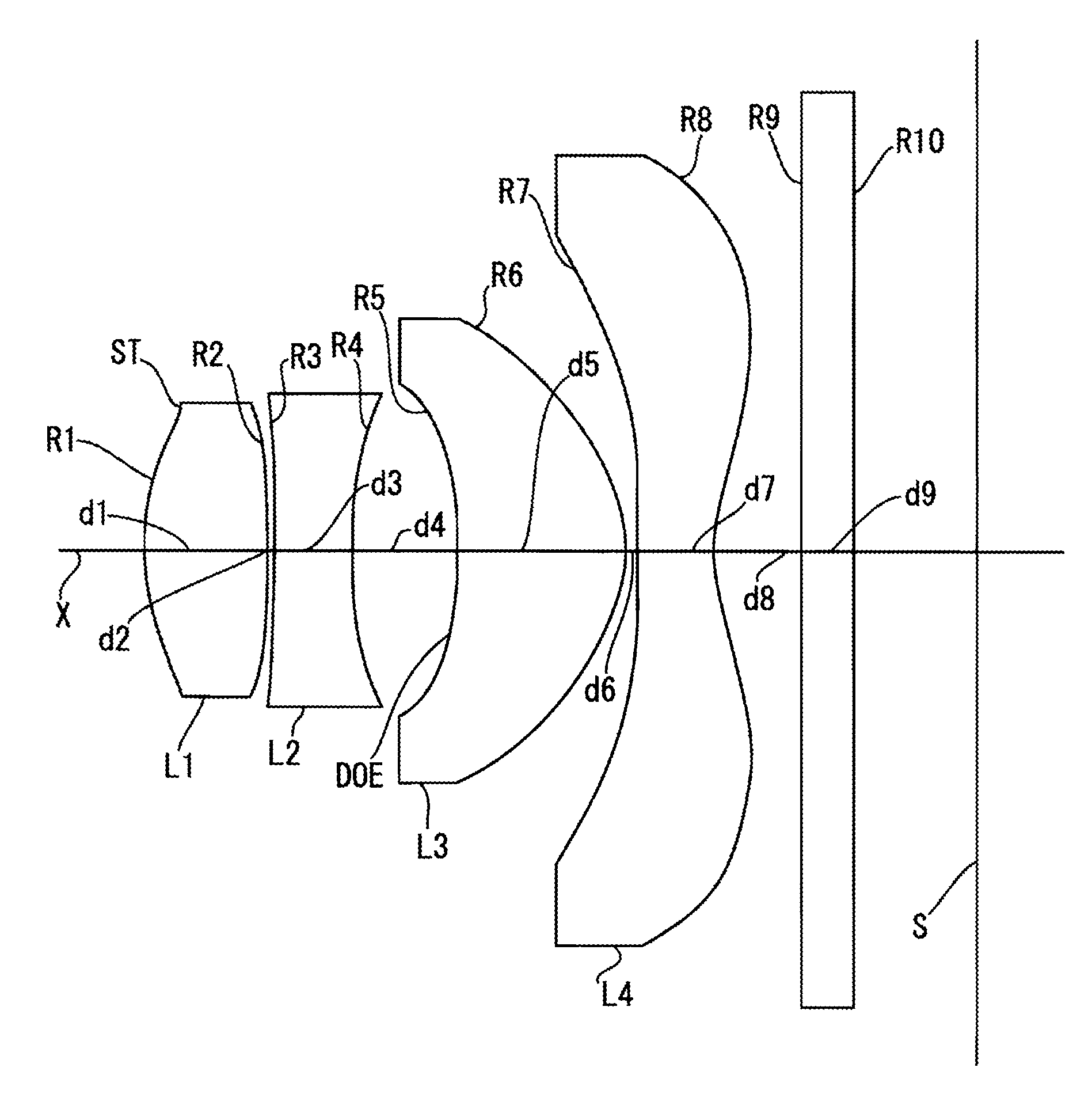
embodiment 1
[0049]The basic lens data is shown in Table 1 below. The diffraction optics surface DOE is formed on the surface R5 of the third lens L3 on the object side.
TABLE 1Surface dataSurface No.RdnvObject surface∞∞ 1 (diaphragm)1.57500.70001.5369056.1 2−6.20590.0394 3−9.36600.44191.6198825.4 43.63060.6077 5 (DOE)−2.34700.96021.5464755.8 6−0.74200.0682 7−31.00000.43491.5369056.1 80.87120.5000 9∞0.30001.5187264.010∞0.7076Image surface∞f = 3.905, Fno = 2.4, ω = 36.4°
[0050]Next, Table 2 shows the aspheric coefficient and the values of each coefficient of the optical path difference function of the diffraction optics surface in embodiment 1.
TABLE 2Aspheric surface dataFirst surfaceSecond surfaceAspheric coefficientAspheric coefficientK = −5.0322E+00K = 0.0000E+00A4 = 1.5537E−01A4 = 1.5010E−01A6 = −1.3886E−01A6 = −5.1353E−01A8 = 1.5429E−01A8 = 2.7025E−01A10 = −1.5617E−01A10 = 0.0000E+00Third surfaceFourth surfaceAspheric coefficientAspheric coefficientK = 2.5754E+01K = −4.6191E−01A4 = 2.0551E−01A...
embodiment 2
[0055]The basic lens data is shown in Table 3 below. Similar to embodiment 1, the diffraction optics surface DOE is formed on the surface R5 of the third lens L3 on the object side in embodiment 2.
TABLE 3Surface No.RdnvObject surface∞∞ 1 (diaphragm)1.49480.69211.5369056.1 2−6.17210.0348 3−6.19000.34191.6198825.4 44.20690.6659 5 (DOE)−2.00090.98741.5464755.8 6−0.75910.1184 7−39.05060.40001.5369056.1 80.91660.5000 9∞0.30001.5187264.010∞0.7196Image surface∞f = 3.945, Fno = 2.4, ω = 36.1°
[0056]Next, Table 4 shows the aspheric coefficient and the values of each coefficient of the optical path difference function of the diffraction optics surface in embodiment 2.
TABLE 4Aspheric surface dataFirst surfaceSecond surfaceAspheric coefficientAspheric coefficientK = −7.0303E+00K = 0.0000E+00A4 = 2.5117E−01A4 = 1.9275E−01A6 = −2.7772E−01A6 = −5.9949E−01A8 = 3.0853E−01A8 = 3.2689E−01A10 = −2.3573E−01A10 = 0.0000E+00Third surfaceFourth surfaceAspheric coefficientAspheric coefficientK = 0.0000E+00K ...
embodiment 3
[0060]The basic lens data is shown in Table 5 below. In embodiment 3, the diffraction optics surface DOE is formed on the surface R3 of the second lens L2 on the object side.
TABLE 5Surface No.RdnvObject surface∞∞ 1(diaphragm)1.98900.68481.5369056.1 2−6.50000.1075 3(DOE)−54.99990.55061.6198825.4 43.91590.5259 5−2.09100.75971.5369056.1 6−0.84650.1384 7−100.00000.49881.5369056.1 81.07070.6945 9∞0.30001.5187264.010∞0.5000Image surface∞f = 3.918, Fno = 2.4, ω = 36.3°
[0061]Next, Table 6 shows the aspheric coefficient and the values of each coefficient of the optical path difference function of the diffraction optics surface in embodiment 3.
TABLE 6Aspheric surface dataFirst surfaceSecond surfaceAspheric coefficientAspheric coefficientK = 2.0524E+00K = 0.0000E+00A4 = −6.4874E−02A4 = −1.2081E−01A6 = −8.3277E−02A6 = 8.0359E−03A8 = 1.5937E−02A8 = 1.0148E−02A10 = −5.4916E−02A10 = 0.0000E+00Third surfaceFourth surfaceAspheric coefficientAspheric coefficientK = 0.0000E+00K = −3.2492E+01A4 = 1.319...
PUM
 Login to View More
 Abstract
Description
Claims
Application Information
 Login to View More