
Serpin Fusion Polypeptides and Methods of Use Thereof
a polypeptide and fusion technology, applied in the field of molecules, can solve the problems of protease-mediated tissue destruction, inflammatory response, and increase the risk of infection, and achieve the effects of enhancing binding to fcrn, preventing proinflammatory mediator release, and enhancing fcrn binding
- Summary
- Abstract
- Description
- Claims
- Application Information
AI Technical Summary
Benefits of technology
Problems solved by technology
Method used
Image

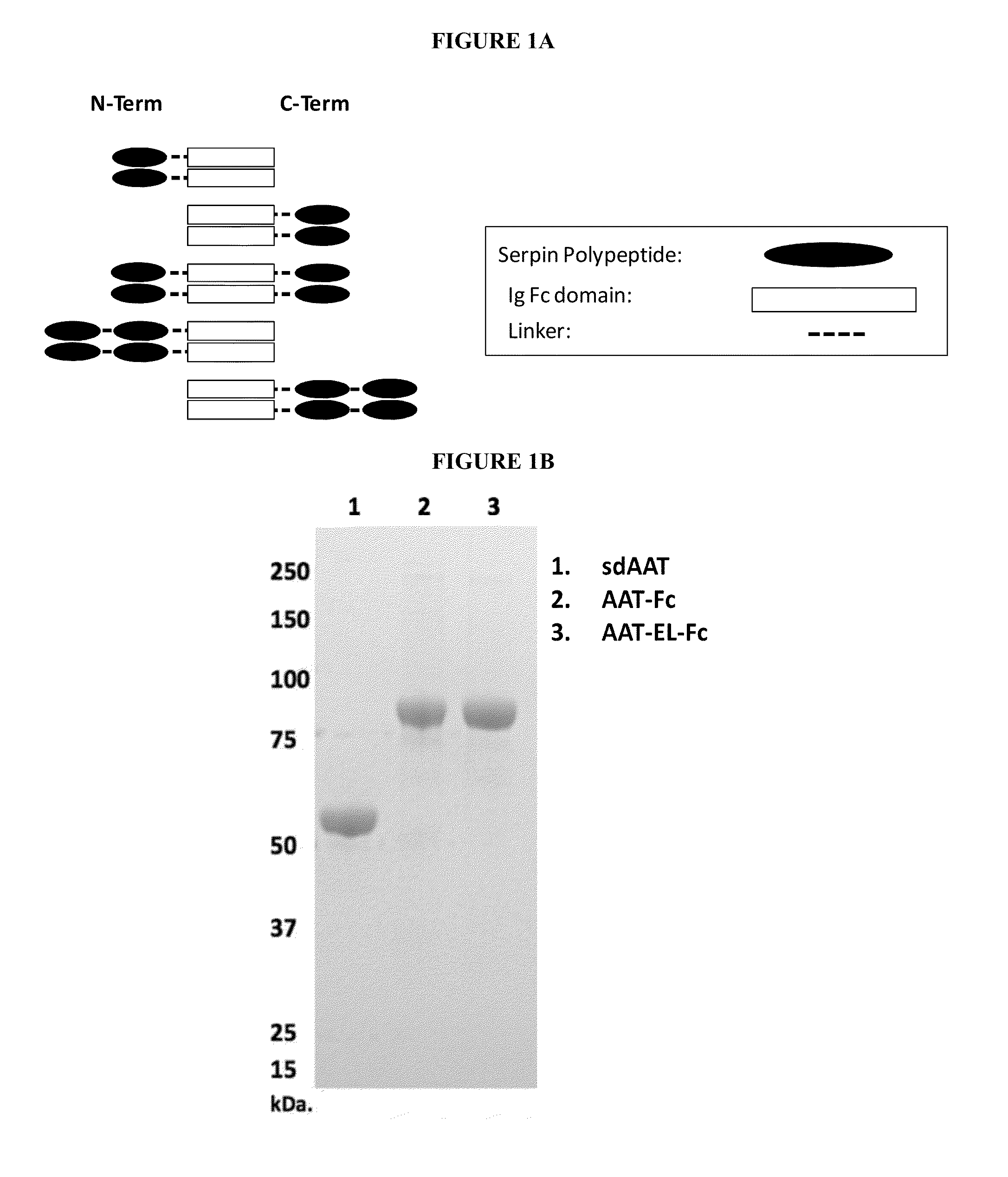
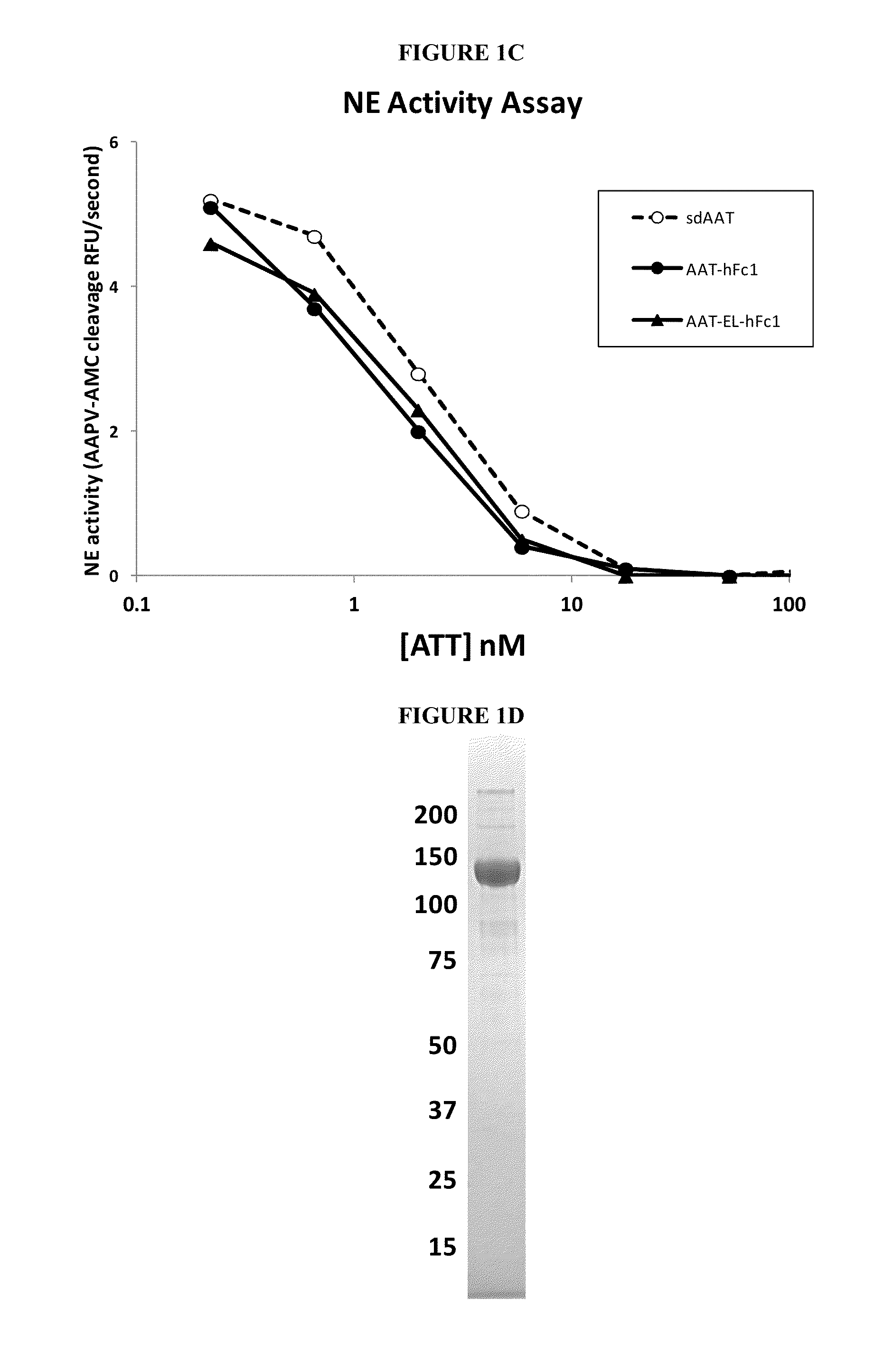
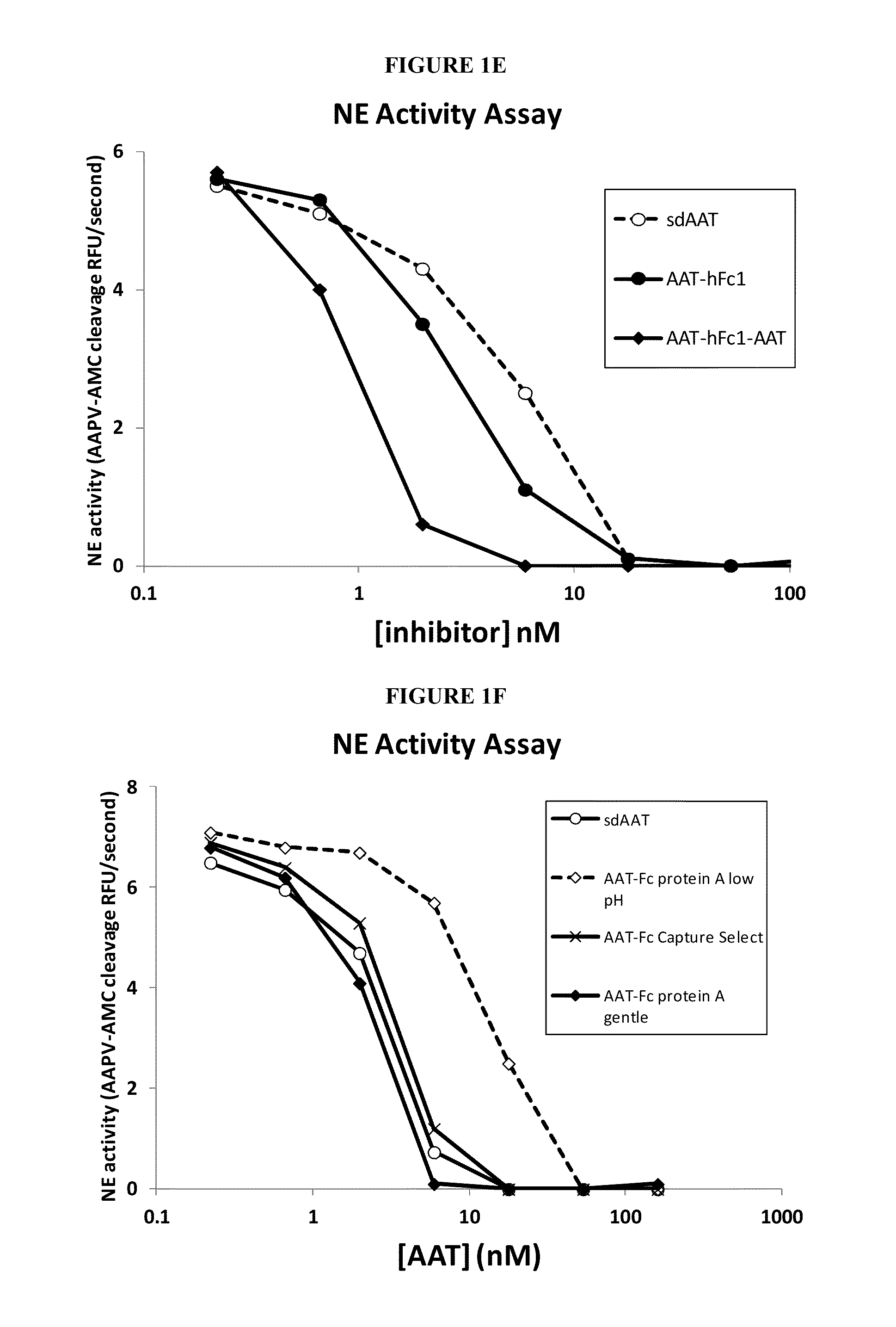
Examples
example 1
AAT-Fc Fusion Proteins and Variants
[0139]Exemplary, but non-limiting examples of AAT-Fc fusion proteins according to the invention include the following sequences. While these examples include a hinge sequence and / or a linker sequence, fusion proteins of the invention can be made using any hinge sequence and / or a linker sequence suitable in length and / or flexibility. Alternatively fusion proteins can be made without using a hinge and / or a linker sequence. For example, the polypeptide components can be directly attached.
[0140]An exemplary AAT-Fc fusion protein is the AAT-hFc1 (human IgG1 Fc) described herein. As shown below, AAT polypeptide portion of the fusion protein is underlined (SEQ ID NO: 2) and the IgG-Fc polypeptide portion of the fusion protein is italicized (SEQ ID NO: 3).
AAT-hFc1 (human IgG1 Fc)(SEQ ID NO: 16)MGKVVNPTQKEPKSCDKIHTCPPCPAPELLGGPSVFLFPPKPKDTLMISRTPEVTCVVVDVSHE
[0141]An exemplary AAT-Fc fusion protein is the AAT-hFc2 (human IgG2 Fc), described herein. As shown ...
example 2
AAT-TNFα Targeting Molecule Fusion Proteins
[0153]The studies presented herein describe several, non-limiting examples of recombinant AAT derivatives comprising human AAT fused to an anti-TNFα antibody or a derivative of a TNFα receptor. These examples are provided below to further illustrate different features of the present invention. The examples also illustrate useful methodology for practicing the invention. These examples do not and are not intended to limit the claimed invention.
[0154]The fusion proteins below include cytokine targeting polypeptide sequences that are from or are derived from (i) the anti-TNFα antibody D2E7 (also known as Adalimumab or Humira®), or (ii) the extracellular domain of Type 2 TNFα Receptor (TNFR2-ECD). The AAT polypeptide portion of the fusion protein is underlined, the antibody constant regions (CH1-hinge-CH2-CH3, or CL) are italicized, and D2E7-VH, D2E7-VK, and TNFR2-ECD are denoted in bold text. While these examples include a hinge sequence and / o...
example 3
AAT-Fc-SLPI and AAT-Fc-Elafin
[0167]The studies presented herein describe several, non-limiting examples of recombinant AAT derivatives comprising human AAT fused a WAP domain containing protein. These examples are provided below to further illustrate different features of the present invention. The examples also illustrate useful methodology for practicing the invention. The AAT polypeptide portion of the fusion protein is underlined, the Fc portion is italicized, and the WAP domain containing polypeptide is in bold font. While these examples include a hinge sequence and / or a linker sequence, fusion proteins of the invention can be made using any hinge sequence and / or a linker sequence suitable in length and / or flexibility. Alternatively fusion proteins can be made without using a hinge and / or a linker sequence. For example, the polypeptide components can be directly attached.
[0168]An exemplary AAT-Fc-SLPI fusion protein is AAT-hFc1-SLPI (human IgG1 Fc), described herein. As shown b...
PUM
 Login to View More
 Abstract
Description
Claims
Application Information
 Login to View More