

Adaptive Temperature Controller
a temperature controller and adaptive technology, applied in the direction of temperatue control, process and machine control, instruments, etc., can solve the problems of insufficient speed, inability to produce rapid temperature changes, etc., to achieve the effect of ensuring the temperature of the material
- Summary
- Abstract
- Description
- Claims
- Application Information
AI Technical Summary
Benefits of technology
Problems solved by technology
Method used
Image



Examples
Embodiment Construction
[0024]As depicted in FIGS. 1a and 1b, temperature controllers are known where a conductive element 250 and a sensor 251 were placed in proximity to or about the component 301 of a system 300 to respectively heat and monitor the temperature of element 301. It is well known to provide a source of heat that is easily controlled. Most often heat is transferred from a conductive element 250 to be subsequently distributed to element 301. The conductive element 250 may be placed adjacent (FIG. 1a) or surrounding (FIG. 1b) element 301. In the prior art the temperature of conductive element 250 was monitored by a separate sensor 251, often a RTD. This requires multiple parts, increasing the space consumed by such equipment, the weight of such equipment, and its cost.
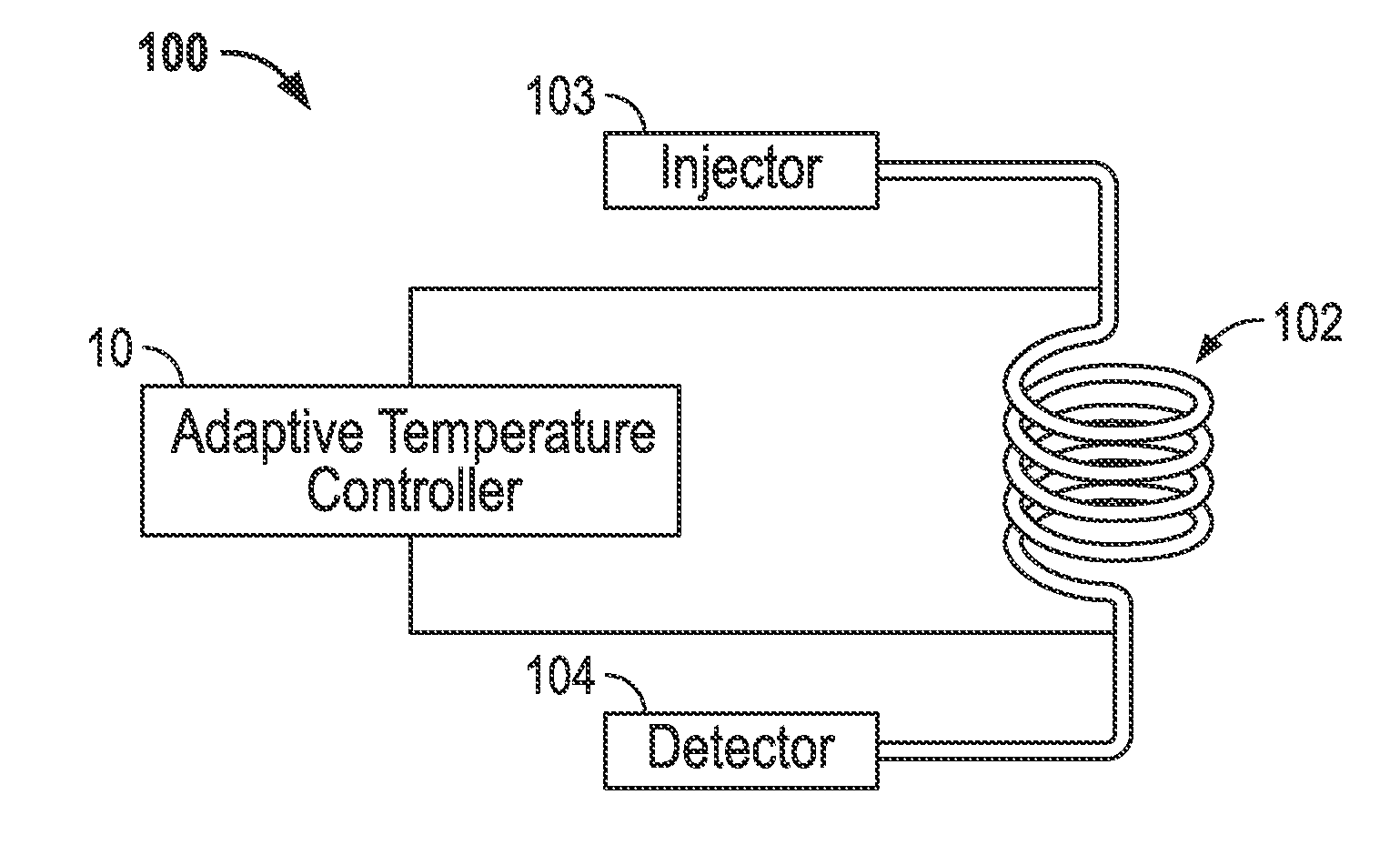
[0025]An electrically-conductive material 50 may be used to heat a component 101 of a system 100, such as a detector or column in the case of chromatographic analysis, directly or indirectly. In the case of chromatographic analys...
PUM
 Login to View More
 Abstract
Description
Claims
Application Information
 Login to View More