Flux injection assembly and method

a technology of refining agent and assembly method, which is applied in the direction of heat treatment apparatus, charge manipulation, furnaces, etc., can solve the problems of harmful effluent bi-products, hydrogen evolution, and detrimental to the mechanical properties of solid alloys

US20140083253A1Active Publication Date: 2014-03-27PYROTECK INC
8 Cites 72 Cited by

Patent Information

Authority / Receiving Office
US · United States
Patent Type
Applications(United States)
Current Assignee / Owner
Publication Date
2014-03-27

Smart Images

  • Figure 1
    Figure 1
  • Figure 2
    Figure 2
  • Figure 3
    Figure 3
Patent Text Reader

Abstract

A flux injector apparatus and method adapted to distribute a predetermined amount of flux to an associated pool of molten aluminum. The flux injector apparatus includes a pressurized tank adapted to store and feed the flux under pressure. A feed mechanism operative to discharge a predetermined amount of flux to an outlet and a controller for monitoring and operating the apparatus. The feed mechanism includes a housing having an inner wall defining a cavity with an inlet and an outlet. A feed wheel is positioned within the cavity and operative to receive a predetermined amount of flux from the inlet, translate the flux within the cavity and discharge the predetermined amount of flux through the outlet of the pressurized tank.
Need to check novelty before this filing date? Find Prior Art

Description

BACKGROUND

[0001] The present exemplary embodiment relates to an apparatus and method for introducing a refining agent into molten metal. It finds particular application in conjunction with a system for introducing a predetermined amount of chloride flux into a trough of molten aluminum, and will be described with particular reference thereto. However, it is to be appreciated that the present exemplary embodiment is also amenable to other like applications.

[0002] Molten metals such as aluminum are known to include high levels of oxide and / or nitride debris that have a negative effect on the solidification of the particular alloy. The melted or liquefied form of aluminum also attracts the formation and absorption of hydrogen within the molten aluminum. Hydrogen evolves as porosity during the solidification of aluminum alloys and is detrimental to the mechanical properties of the solid alloy. Degassing is an effective way of reducing hydrogen caused porosity.

[0003] One example of degassin...

Examples

Embodiment Construction

[0019]It is to be understood that the detailed figures are for purposes of illustrating the exemplary embodiments only and are not intended to be limiting. Additionally, it will be appreciated that the drawings are not to scale and that portions of certain elements may be exaggerated for the purpose of clarity and ease of illustration.

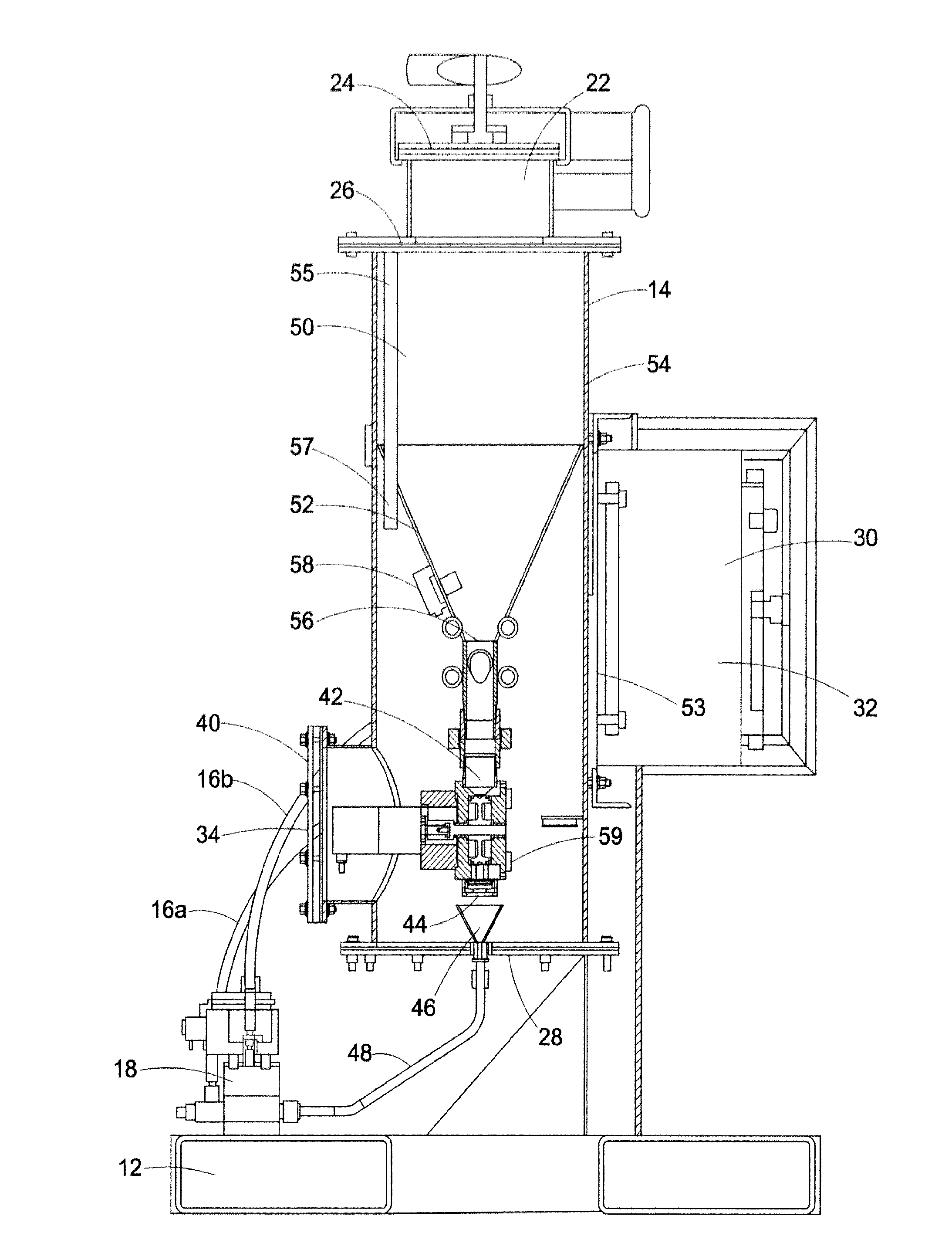
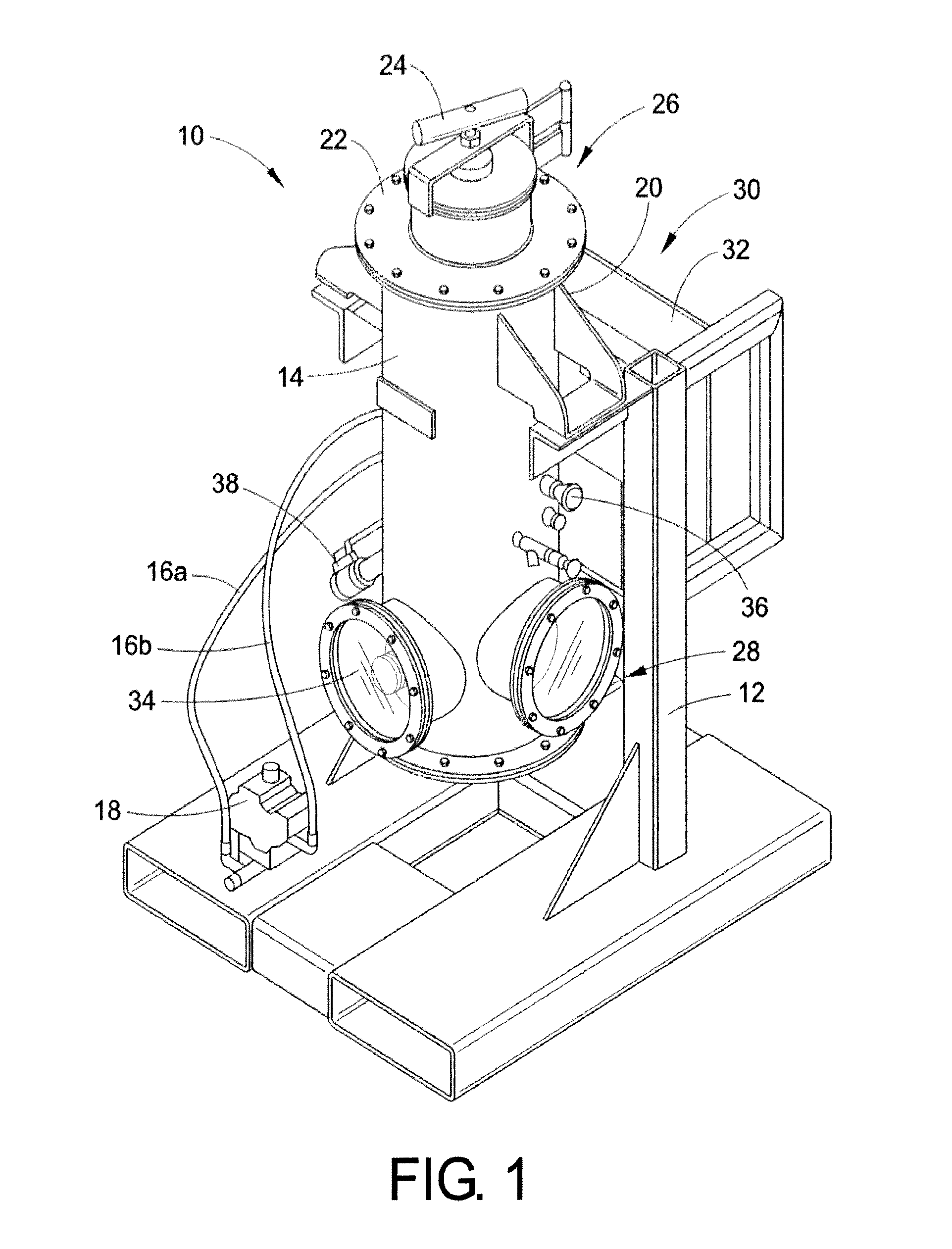
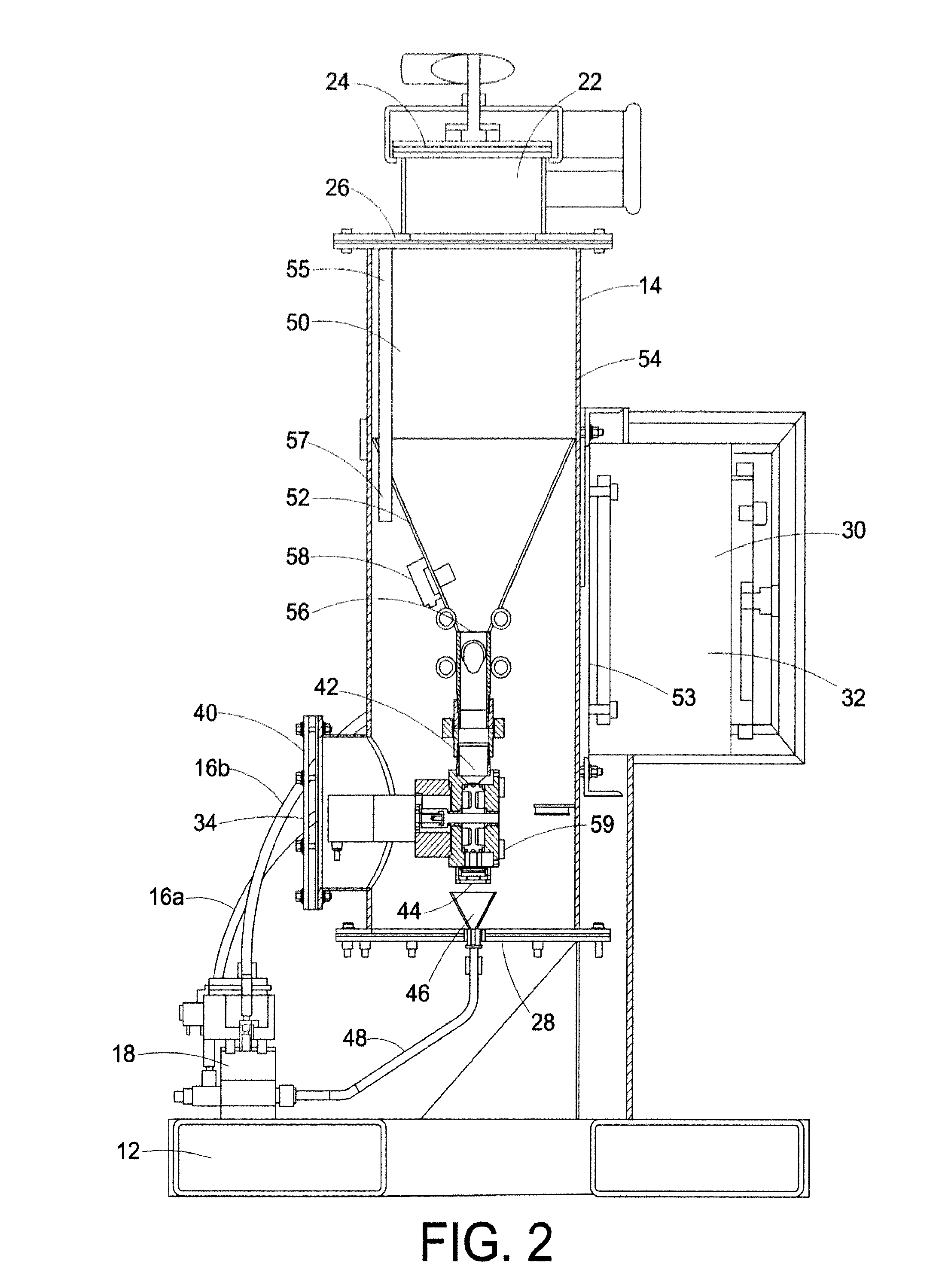
[0020]With reference to FIG. 1, a flux injector assembly 10 is supported by a structural base 12 that maintains the flux injector assembly 10 in an upright position. As used herein, the term “flux” is used to refer to a granulated particulate. An exemplary grain size ranges between about 1 mm to about 3 mm. The flux injector assembly 10 includes a pressurized tank 14 in communication with an isolation mechanism 18. In one embodiment, the isolation mechanism 18 is secured to the structural base 12 and configured to isolate the tank 14 from a flow of independent direct inert gas flow to a hollow shaft of a rotary apparatus (not shown). Moreover, mechanis...