
Controlled Electronic System Power Dissipation via an Auxiliary-Power Dissipation Circuit
- Summary
- Abstract
- Description
- Claims
- Application Information
AI Technical Summary
Benefits of technology
Problems solved by technology
Method used
Image

Examples
Embodiment Construction
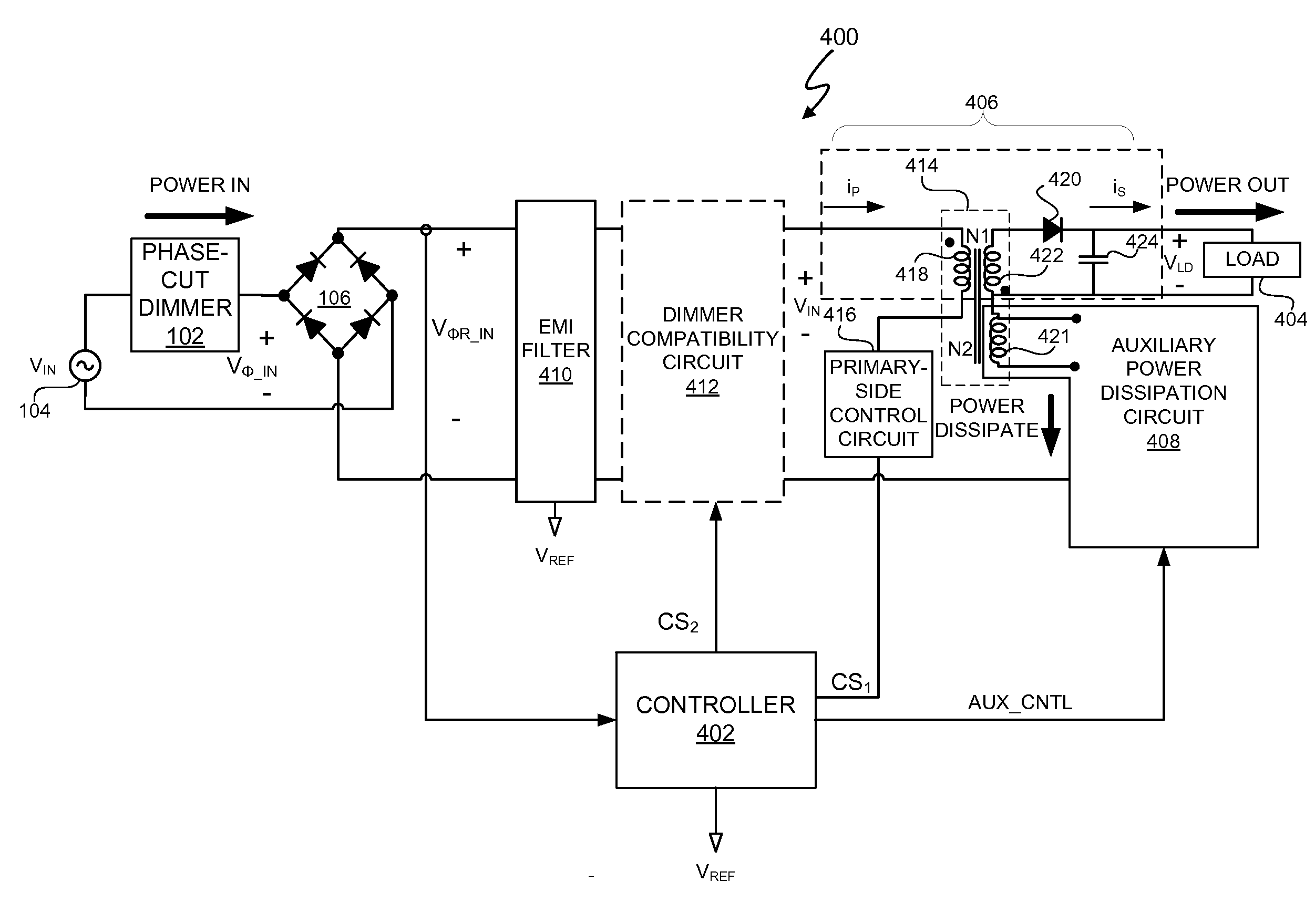
[0028]An electronic system and method include a controller to actively control transfer of excess energy to an auxiliary transformer winding of an auxiliary power dissipation circuit. The “auxiliary transformer winding” is referred to herein as an “auxiliary-winding.” The excess energy is a transfer of energy from a primary winding of a switching power converter to the auxiliary-winding of the auxiliary power dissipation circuit. In at least one embodiment, the electronic system is a lighting system that includes a triac-based dimmer. The excess energy is energy drawn through the primary-side winding of the switching power converter to provide operational compatibility between a dimmer through which a power supply provides energy to the switching power converter and a load to which the switching power converter provides energy. As previously described, when the lighting system includes a light source, such as one or more light emitting diodes (LEDs), that uses less power than an inc...
PUM
 Login to View More
 Abstract
Description
Claims
Application Information
 Login to View More