

Distributed similarity learning for high-dimensional image features
a similarity learning and feature technology, applied in the field of similarity computation, can solve the problems of limiting computational scalability and impracticality of traditional similarity learning algorithms
- Summary
- Abstract
- Description
- Claims
- Application Information
AI Technical Summary
Benefits of technology
Problems solved by technology
Method used
Image

Examples
example embodiments
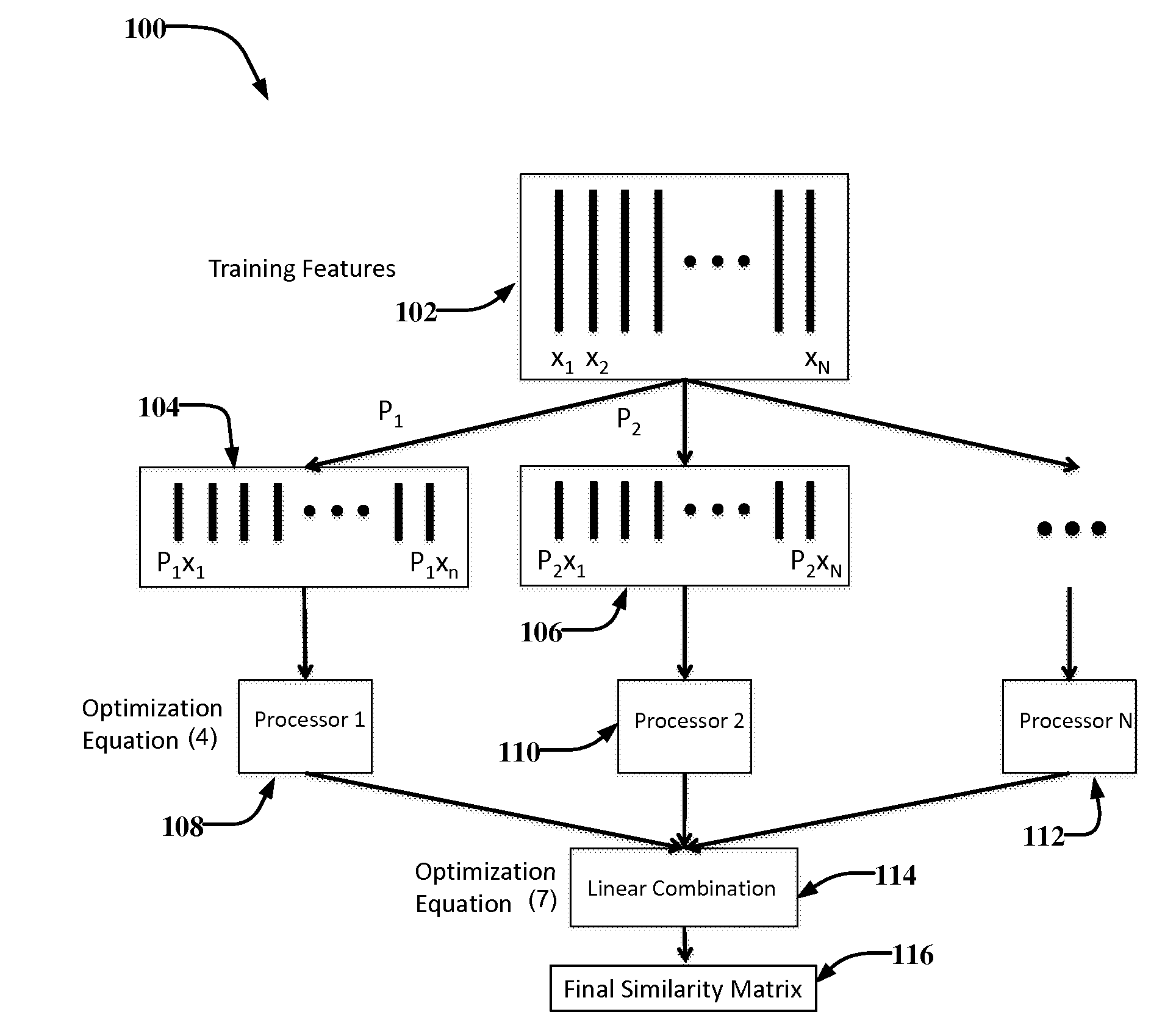
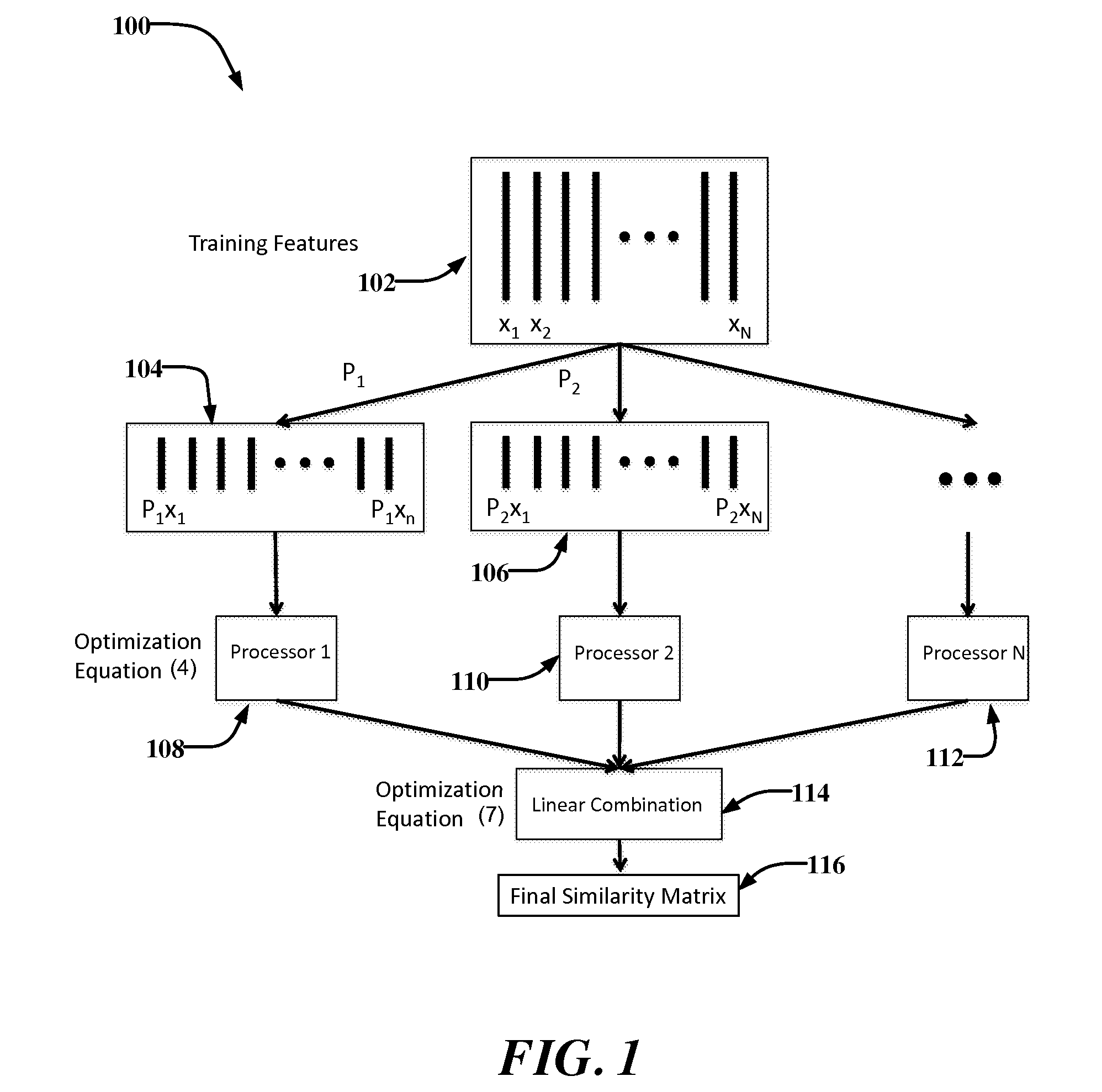
[0016]FIG. 1 is a diagram illustrating a method 100, in accordance with an example embodiment, for distributed similarity learning of high-dimensional image features. A set of data features 102 (e.g., x1, x2, xn) corresponding to an image may be accessed. The image may be broken down or decomposed into a set of data features based characteristics such as texture and contrast in the image. The set of data features may include vectors corresponding to data points represented in the image. The vectors may form a space corresponding to the set of data features. In an example embodiment, the set of data features 102 may also be referred to as training features for the method 100. As such, the similarity learning method may analyze or process the set of data features 102 to learn a similarity function corresponding to the set of data features 102. Examples of data features include, but are not limited to, visual features such colors of pixels and the location thereof within the image, tex...
example equations
[0022]As mentioned above, a similarity function may be learned for each of the set of lower dimensional data feature(s) 104, 106, and so on. A similarity function may be expressed in a bilinear form to measure the similarity between two image features with xiεRd and xjεRd (where xi and xj represent vectors and Rd represents a set of d-dimensional real-valued vectors), as follows:
S(xi,xj)=xTiMxj Equation (1)[0023]where S(xi, xj) represents the similarity function and M represents a d×d matrix. The image features may have very high dimensionality d that can be for example, 105 or above.
[0024]Existing similarity learning algorithms are not scalable when processing high dimensional image features because of a quadratic time complexity with respect to a high dimension d. Accordingly, in an example embodiment of the present disclosure where d is very large, the similarity function S(xi, xj) based on a similarity matrix M is processed in a distributed and scalable way.
[0025]Accordingly, t...
PUM
 Login to View More
 Abstract
Description
Claims
Application Information
 Login to View More