Asymmetrical nasal delivery elements and fittings for nasal interfaces

US20160158476A1Active Publication Date: 2016-06-09FISHER & PAYKEL HEALTHCARE

Image

Smart Image Click on the blue labels to locate them in the text.
Viewing Examples
Smart Image
  • Asymmetrical nasal delivery elements and fittings for nasal interfaces
  • Asymmetrical nasal delivery elements and fittings for nasal interfaces
  • Asymmetrical nasal delivery elements and fittings for nasal interfaces

Examples

Experimental program
Comparison scheme
Effect test

first embodiment

[0154]FIGS. 15 to 19 show a nasal cannula 2000 useful herein in detail, which is also described in published international application WO2012 / 053910, which is hereby incorporated by reference in its entirety. Nasal cannula arrangement 2000 comprises at least one nasal prong 2001, modified as described above, the or each prong 2001 having a gas outlet 2002 adapted to be inserted into a user's nare (or nares) and a gas inlet 2003 fluidly connected to the gas outlet 2001. The at least one nasal prong 2001 comprises a backing 2004, the hacking 2004 configured to rest on a user's face, and where a lip 2005 extends about at least a part of the perimeter of a rear surface 2006 of the backing 2004. The rear surface 2004 is configured for receiving or retaining a user interface patch 2007. In use, the user interface patch 2007 may be releasably attachable or connectable to, or with, a dermal patch 2008 that is or can be affixed to a user's face.

[0155]As shown by FIGS. 16 and 19, the rear sur...

second embodiment

[0158]A patient interface useful herein is shown in 20 to 23, and is described in unpublished international application PCT / NZ2014 / 000082, which is hereby incorporated by reference in its entirety.

[0159]Referring to FIGS. 20 to 23, the nasal prongs 111 and 112 are curved to extend into the patient's nares in use and to provides smooth flow path for gases to flow through, and are modified to be asymmetric, as described above. The inner surfaces of the prongs 111 and 112 may be contoured to reduce noise. The bases of the prongs 111 and 112 may include curves surfaces to provide for smoother gases flow. This may reduce the noise level during operation.

[0160]In some configurations, pads may be mounted around the base of the prongs to reduce noise. The pad may be a foam material or a mouldable material that generally conforms to the patient's nose anatomy. Soft cushions or pillows may alternatively be provided.

[0161]The nasal prongs 111 and 112 are substantially hollow and substantially ...

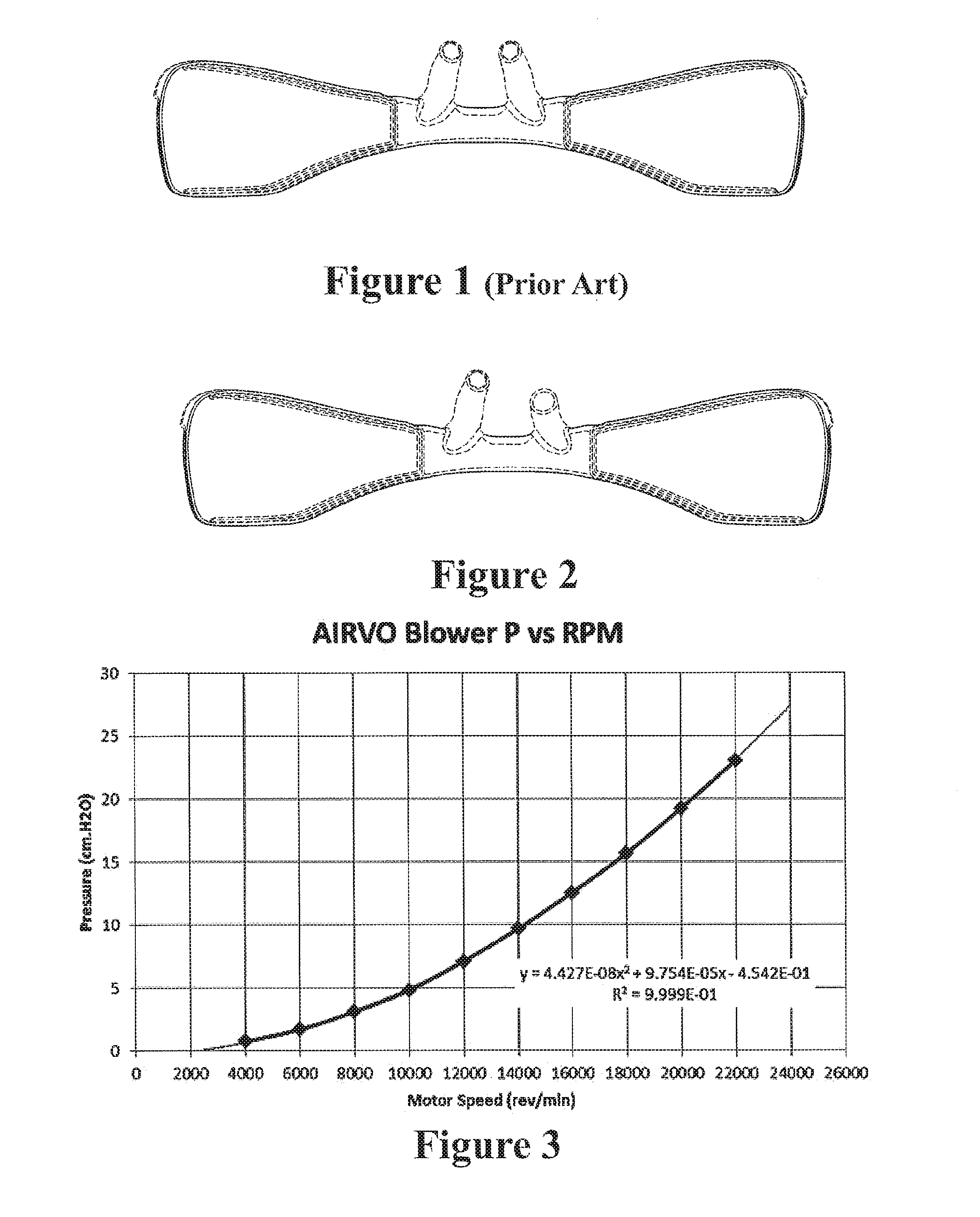
the structure of the environmentally friendly knitted fabric provided by the present invention; figure 2 Flow chart of the yarn wrapping machine for environmentally friendly knitted fabrics and storage devices; image 3 Is the parameter map of the yarn covering machine
Login to View More

PUM

No PUM Login to View More

Abstract

A nasal interface uses asymmetrical nasal delivery elements to deliver an asymmetrical flow through the interface to both nares or to either nare, and a mouthpiece may be inserted to maintain a leak, to improve dead space clearance in the upper airways, decrease peak expiratory pressure, reduce noise, increase safety of the therapy for smaller patients and reduce resistance in the interface allowing desired flow rates to be achieved at reduced motor speeds of associated flow generating devices. Different forms of fittings, such as sleeves or inserts can be attached to nasal delivery elements to improve or optimise the therapeutic effects of nasal high flow. It may allow high pressures to be achieved at lower flow rates, reduce noise, improve patient comfort and efficiently clear anatomical dead space.

Description

TECHNICAL FIELD OF THE INVENTION[0001]The present invention generally relates to a nasal interface. More particularly, the present invention relates to asymmetrical nasal delivery elements for a nasal interface and other arrangements for achieving asymmetric flow or partial unidirectional flow.BACKGROUND OF THE INVENTION[0002]Humidifiers are used to provide humidified respiratory gases to a patient. Gases are delivered to the patient via a patient interface. Examples of a patient interface include an oral mask, a nasal mask, a nasal cannula, a combination of oral and nasal mask, and the like.[0003]Nasal interfaces can be used to deliver a high flow of gases to a patient. Nasal delivery elements are inserted into the nose of a patient to deliver the required therapy. The nasal delivery elements may be required to seal or semi-seal at the nose, or may not be required to seal at the nose, to deliver the therapy. Nasal high flow typically is a non-sealing therapy that delivers relativel...

Claims

the structure of the environmentally friendly knitted fabric provided by the present invention; figure 2 Flow chart of the yarn wrapping machine for environmentally friendly knitted fabrics and storage devices; image 3 Is the parameter map of the yarn covering machine
Login to View More

Application Information

Patent Timeline
09 Jun 2016
Publication
US20160158476A1
IPC
A61M16/06
CPC
A61M16/0672; A61M2205/42; A61M2202/0208; A61M2016/0027; A61M2016/003; A61M2202/0225; A61M2240/00; A61M16/0688
Inventors
TATKOV, STANISLAV