Unlock instant, AI-driven research and patent intelligence for your innovation.

Data model design collaboration using semantically correct collaborative objects

Active Publication Date: 2017-06-15
ATSCALE
View PDF4 Cites 17 Cited by
  • Summary
  • Abstract
  • Description
  • Claims
  • Application Information

AI Technical Summary

Benefits of technology

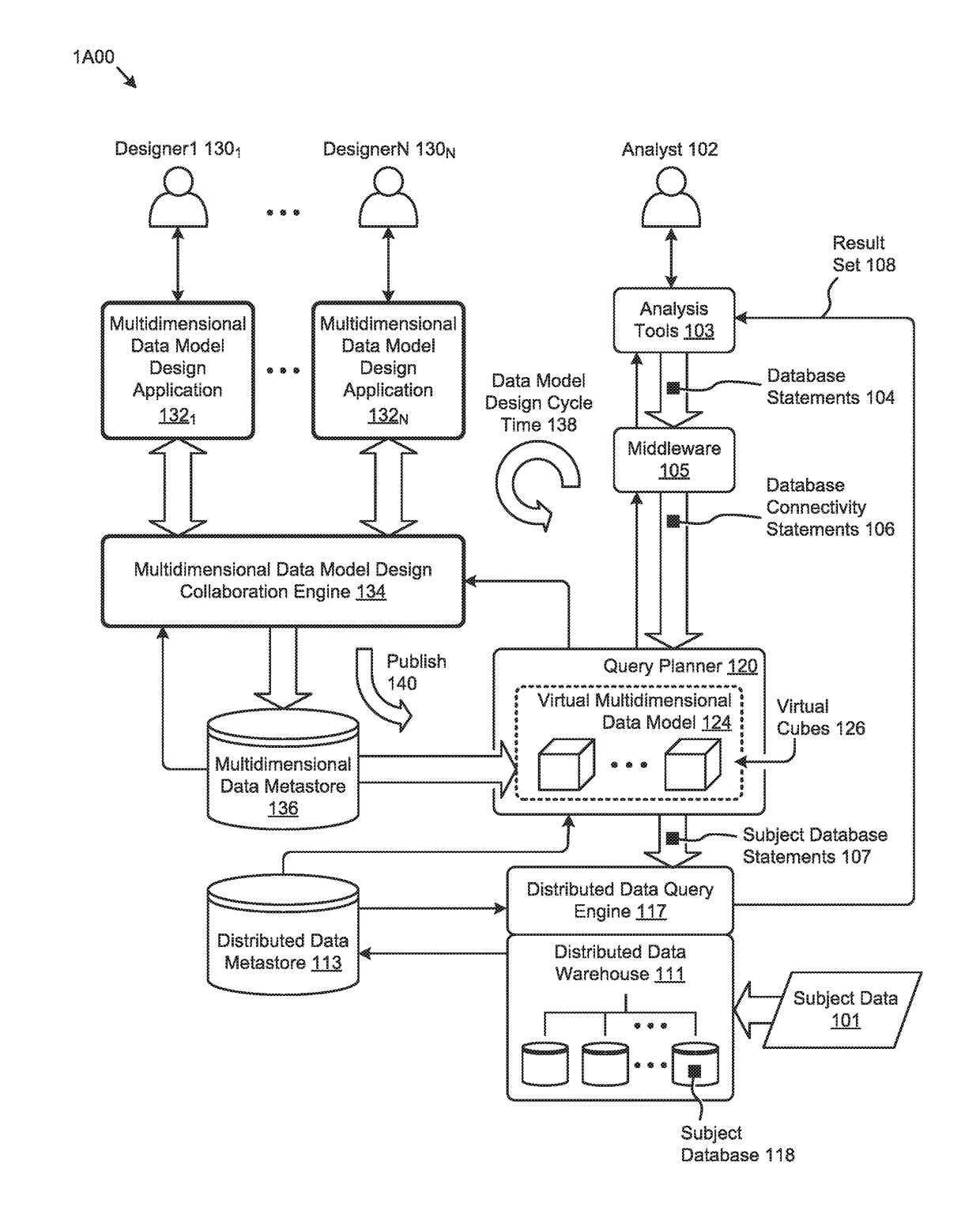
This patent describes a new way to design data models collaboratively using semantically correct objects. The technique reduces the amount of computer memory, processing power, and communication needed to create and verify multiple models. The disclosed methods improve how multiple systems work together. Overall, the technique allows for easier and more efficient collaborative model design.

Problems solved by technology

Using traditional database structures (e.g., relational) to store such large volumes of data can result in database statements (e.g., queries) that are complex, resource-intensive, and time consuming.
Unfortunately, multidimensional data model design environments for such distributed data systems can be limited at least in their design collaboration capabilities.
In this environment, one specialist might pass control of a particular data model being designed to another specialist, but both could not concurrently work on the model.
Further, each specialist is limited to working on the computing devices operating the specialized tools (e.g., software).
Such legacy environments are inefficient in terms of utilization of computing and / or human resources.
Further, such legacy approaches can introduce design conflicts and / or errors.
For example, while design changes might be syntactically correct, semantic and / or other errors can arise from conflicting changes from various designers, the manual merge process, the incorporation of a change into the overall model, and / or other aspects inherent in the legacy approaches.
In this case, legacy approaches having a few specialist designers using specialized tools operating on a few respective computing devices will be limited in achieving the data model design change cycle time desired by the enterprise.
The problem to be solved is rooted in technological limitations of the legacy approaches.
More specifically, the technologies applied in the aforementioned legacy approaches fail to achieve the sought after capabilities of the herein disclosed techniques for data model design collaboration using semantically correct collaborative objects, thus techniques are needed to improve the application and efficacy of various technologies as compared with the legacy approaches.

Method used

the structure of the environmentally friendly knitted fabric provided by the present invention; figure 2 Flow chart of the yarn wrapping machine for environmentally friendly knitted fabrics and storage devices; image 3 Is the parameter map of the yarn covering machine
View more

Image

Smart Image Click on the blue labels to locate them in the text.
Viewing Examples
Smart Image
  • Data model design collaboration using semantically correct collaborative objects
  • Data model design collaboration using semantically correct collaborative objects
  • Data model design collaboration using semantically correct collaborative objects

Examples

Experimental program
Comparison scheme
Effect test

application examples

Additional Practical Application Examples

[0073]FIG. 7 depicts a block diagram of a system to perform certain functions of a computer system. As an option, the present system 700 may be implemented in the context of the architecture and functionality of the embodiments described herein. Of course, however, the system 700 or any operation therein may be carried out in any desired environment. The system 700 comprises at least one processor and at least one memory, the memory serving to store program instructions corresponding to the operations of the system. As shown, an operation can be implemented in whole or in part using program instructions accessible by a module. The modules are connected to a communication path 705, and any operation can communicate with other operations over communication path 705. The modules of the system can, individually or in combination, perform method operations within system 700. Any operations performed within system 700 may be performed in any order ...

the structure of the environmentally friendly knitted fabric provided by the present invention; figure 2 Flow chart of the yarn wrapping machine for environmentally friendly knitted fabrics and storage devices; image 3 Is the parameter map of the yarn covering machine
Login to View More

PUM

No PUM Login to View More

Abstract

The present disclosure provides a detailed description of techniques for data model design collaboration using semantically correct collaborative objects. Certain embodiments comprise detecting various interaction events from designers collaborating on designing a virtual multidimensional data model to generate unit of work objects characterizing certain design transactions invoked by the interaction events. The unit of work objects are used to determine a set of committed modifications to the virtual multidimensional data model design for broadcasting to the collaborating designers. Some embodiments comprise unit of work objects based on various multidimensional data model rules, syntactic rules, semantic rules, and / or other criteria to determine valid committed modifications. Other embodiments comprise unit of work objects from multiple design transactions that are merged to determine the committed modifications. Further embodiments comprise committed modifications that are derived from the differences between the design changes and the then current virtual multidimensional data model.

Description

FIELD[0001]This disclosure relates to the field of data analytics, and more particularly to techniques for data model design collaboration using semantically correct collaborative objects.BACKGROUND[0002]With the continued proliferation of information sensing devices (e.g., mobile phones, online computers, RFID tags, sensors, etc.), increasingly larger volumes of data are collected for various business intelligence purposes. For example, the web browsing activities of online users are captured in various datasets (e.g., cookies, log files, etc.) for use by online advertisers in targeted advertising campaigns. Data from operational sources (e.g., point of sale systems, accounting systems, CRM systems, etc.) can also be combined with the data from online sources. Using traditional database structures (e.g., relational) to store such large volumes of data can result in database statements (e.g., queries) that are complex, resource-intensive, and time consuming. Deploying multidimension...

Claims

the structure of the environmentally friendly knitted fabric provided by the present invention; figure 2 Flow chart of the yarn wrapping machine for environmentally friendly knitted fabrics and storage devices; image 3 Is the parameter map of the yarn covering machine
Login to View More

Application Information

Patent Timeline
no application Login to View More
IPC IPC(8): G06F17/30
CPCG06F17/30592G06F17/30371G06F17/30377G06F17/30604G06F16/283G06F16/2365G06F16/2379G06F16/288
Inventor BAIRD, MATTHEWLAI, JAMES
Owner ATSCALE
Features
  • R&D
  • Intellectual Property
  • Life Sciences
  • Materials
  • Tech Scout
Why Patsnap Eureka
  • Unparalleled Data Quality
  • Higher Quality Content
  • 60% Fewer Hallucinations
Social media
Patsnap Eureka Blog
Learn More