
Organic light emitting display device and method for driving the same
a display device and organic technology, applied in semiconductor devices, instruments, electrical apparatuses, etc., can solve the problems of image quality deterioration, and reduced life of the element, so as to suppress ripple in the initialization power supply, suppress stains or blemishes, and remove luminance deviations.
- Summary
- Abstract
- Description
- Claims
- Application Information
AI Technical Summary
Benefits of technology
Problems solved by technology
Method used
Image

Examples
first embodiment
[0048]First, an organic light-emitting display device according to the present disclosure and a method for driving the device will be described with reference to FIGS. 1 to 3.
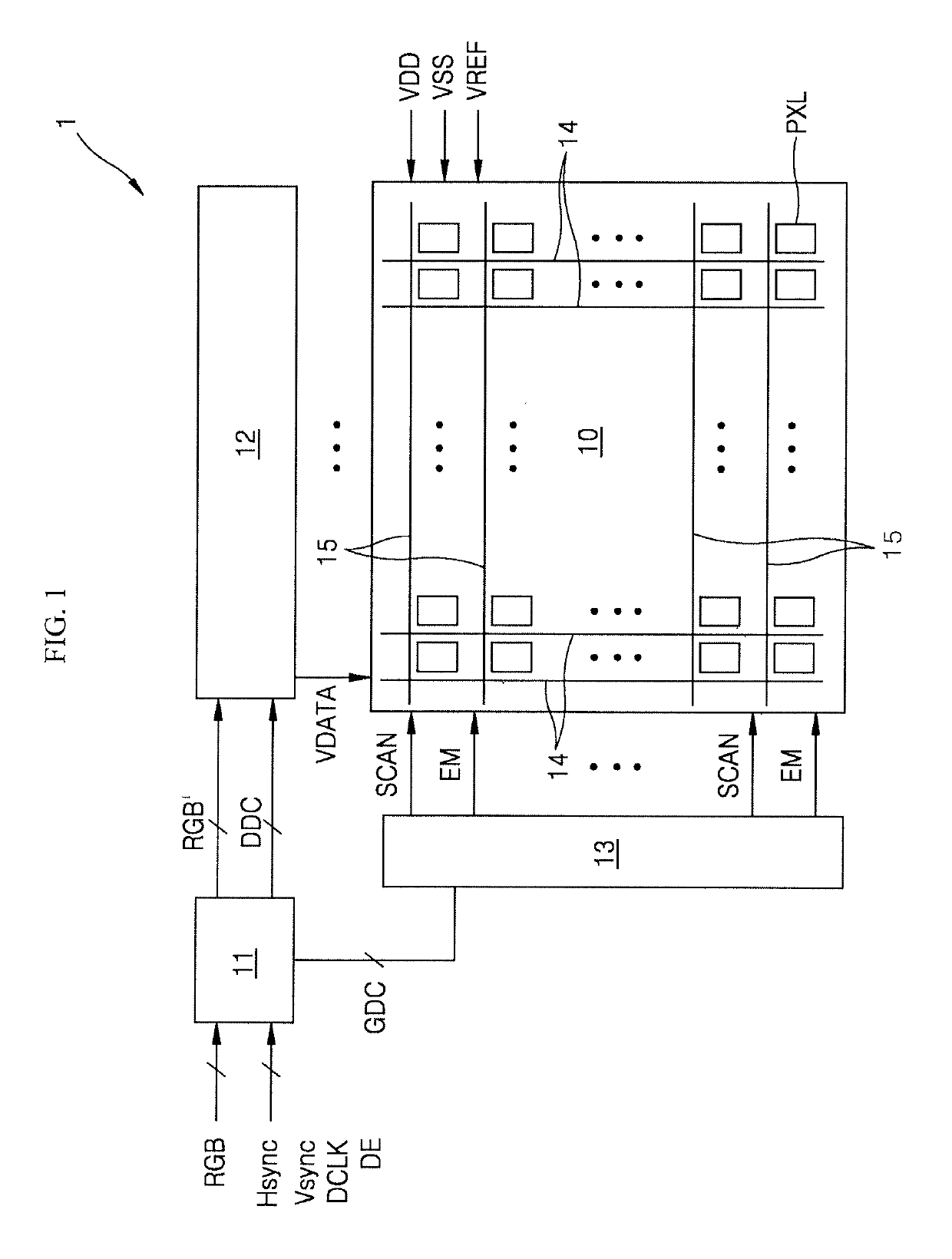
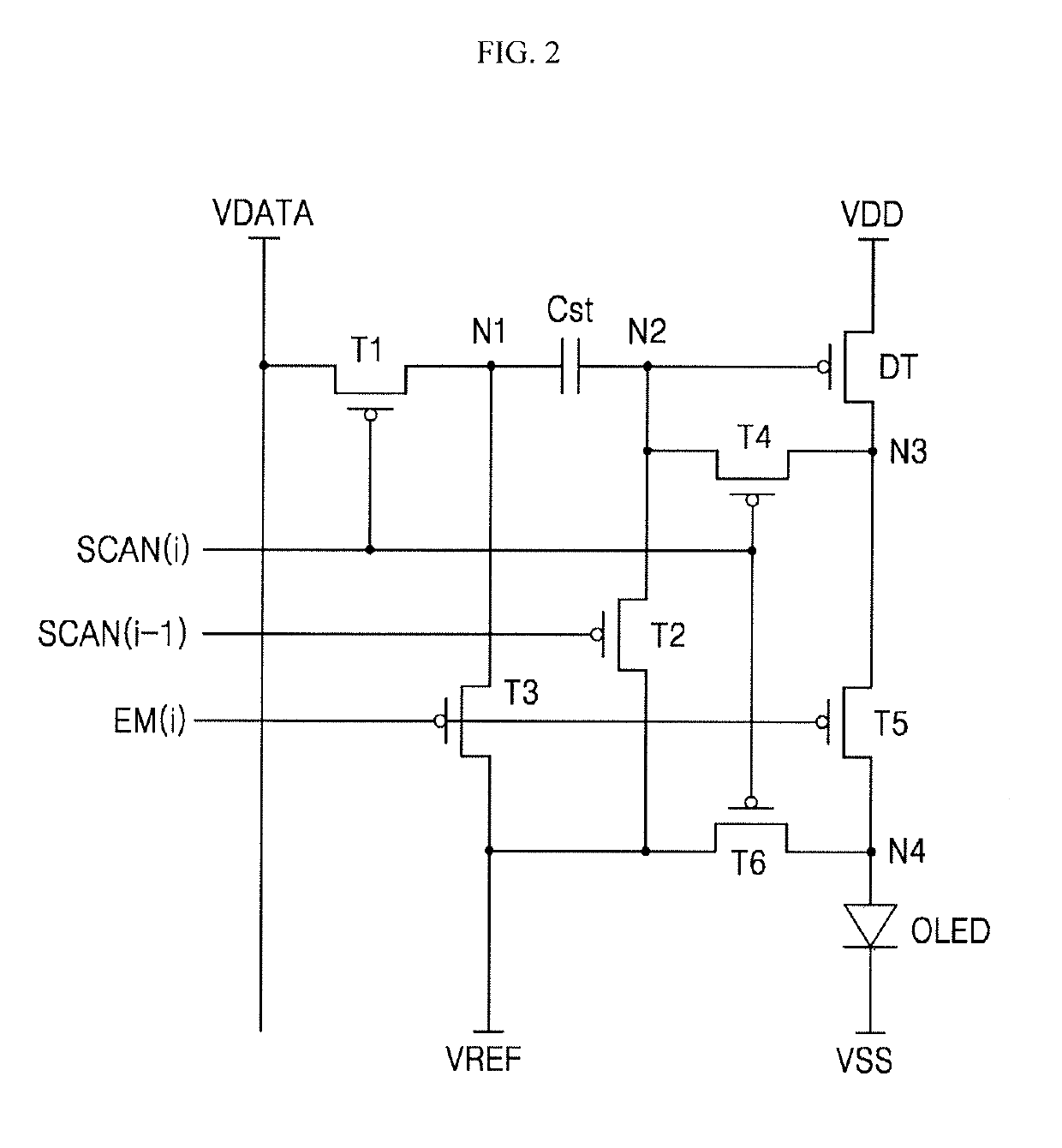
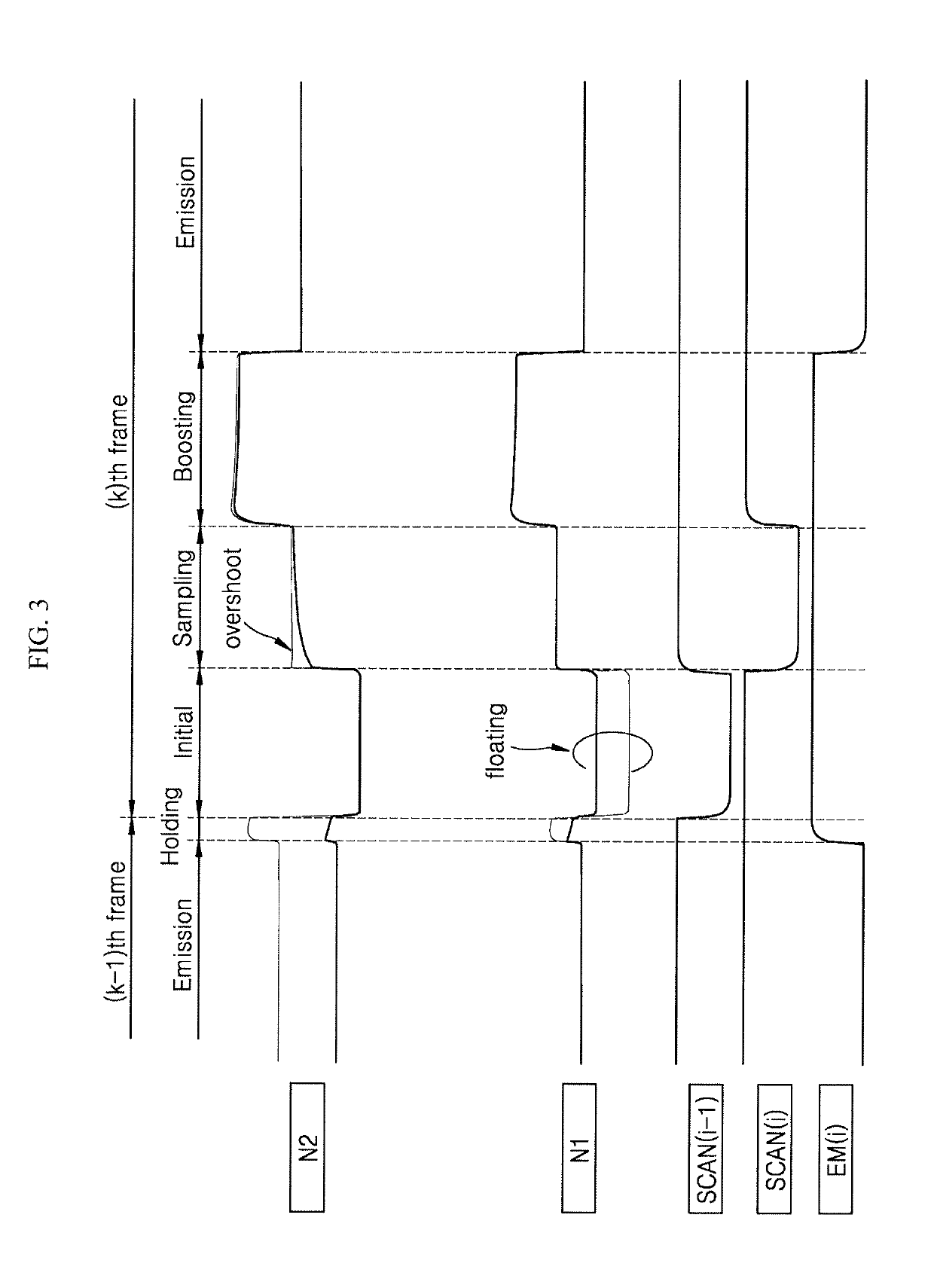
[0049]FIG. 1 illustrates an organic light-emitting display device according to a first embodiment of the present disclosure. FIG. 2 shows an equivalent circuit corresponding to any one pixel in an organic light-emitting display device according to the first embodiment of the present disclosure. FIG. 3 shows a waveform of a driving signal in FIG. 2 and an associated potential at each node.
[0050]As illustrated in FIG. 1, an organic light-emitting display device 1 according to a first embodiment of the present disclosure includes a display panel 10 including a plurality of pixel PXLs, a data driving circuit 12 for driving data-lines 14 of the display panel 10, a gate driving circuit 13 for driving scan-lines 15 of the display panel 10, and a timing controller 11 for controlling the driving timing of the data drivi...
second embodiment
[0108]To solve this problem, in accordance with the present disclosure, a second embodiment is provided in which both potentials of the first and second nodes N1 and N2 are initialized for the initialization period (Initial).
[0109]FIG. 4 shows an equivalent circuit corresponding to any one pixel in an organic light-emitting display device according to the second embodiment of the present disclosure. FIG. 5 shows a waveform of a driving signal in FIG. 4 and an associated potential at each node according to the second embodiment of the present disclosure.
[0110]As illustrated in FIG. 4, the organic light-emitting display device according to the second embodiment of the present disclosure further includes a seventh transistor T7. When the seventh transistor T7 is turned on based on the (i−1)-th scan signal SCAN(i−1), the reference voltage VREF is supplied to the first node N1 via the turned-on seventh transistor T7. Except for the presence of the seventh transistor T7, a configuration o...
third embodiment
[0118]FIG. 6 shows an equivalent circuit corresponding to any one pixel in an organic light-emitting display device according to the present disclosure.
[0119]As illustrated in FIG. 6, in the organic light-emitting display device according to the third embodiment of the present disclosure, when the second transistor T2 turns on, a first reference voltage VREF1 is supplied to the second node N2 via the turned-on second transistor T2. At the same time, when the seventh transistor T7 turns on, the first node N1 is supplied with a second reference voltage VREF2 which is different from the first reference voltage VREF1. A configuration of the third embodiment is the same as those of the first and second embodiments illustrated in FIGS. 1 to 5, except that, in the third embodiment, the first reference voltage for initializing the first node N1 and the second reference voltage for initializing the second node N2 have different voltage levels. Therefore, the descriptions of the overlapping p...
PUM
 Login to View More
 Abstract
Description
Claims
Application Information
 Login to View More