
Adjusting a field distribution of an antenna arrangement of a magnetic resonance system
a magnetic resonance system and field distribution technology, applied in the field of adjusting the field distribution of the antenna arrangement of the magnetic resonance system, can solve the problems of impaired symmetry of the field distribution, and achieve the effects of increasing the symmetry or homogeneity of the field distribution in the antenna arrangement, increasing the capacitive coupling, and increasing the symmetry or homogeneity of the field distribution
- Summary
- Abstract
- Description
- Claims
- Application Information
AI Technical Summary
Benefits of technology
Problems solved by technology
Method used
Image

Examples
Embodiment Construction
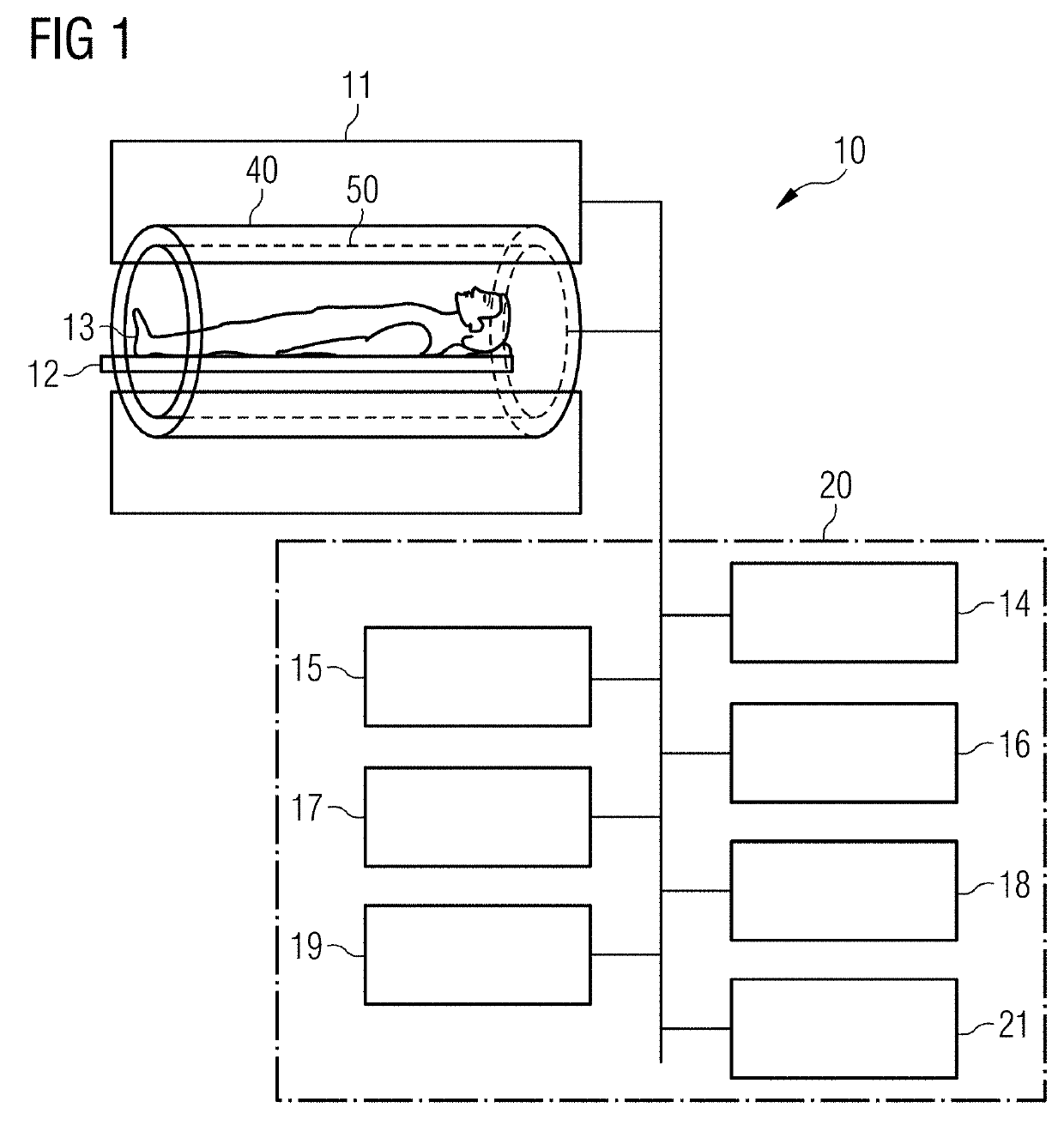
[0040]FIG. 1 is a schematic representation of one embodiment of a magnetic resonance (MR) system 10. The magnetic resonance system 10 includes a magnet 11 for the generation of a polarization field B0. A person to be examined 13 lying on a bench 12 may be moved into a cylindrical bore in the magnet 11 for the recording spatially encoded magnetic resonance signals or MR data from the person to be examined 13. A cylindrical antenna arrangement 50 is provided around the cylindrical bore in order to generate radio-frequency signals (e.g., radio-frequency (RF) pulses). To provide a defined environment for field generation by the antenna arrangement 50, a cylindrical radio-frequency screen 40 is provided around the antenna arrangement 50. The irradiation of radio-frequency pulses with the antenna arrangement 50 and switching of magnetic field gradients may cause the magnetization generated by the polarization field B0 to be deflected out of the equilibrium position and spatially encoded, ...
PUM
 Login to View More
 Abstract
Description
Claims
Application Information
 Login to View More