

Electronic device, control method, and non-transitory computer readable medium
a control method and electronic technology, applied in the field of electronic devices, can solve the problems of inability to improve the accuracy of viewed point estimation in the state of the head, invite increases in the complexity and cost of the device, and cannot achieve the effect of high precision and simple configuration
- Summary
- Abstract
- Description
- Claims
- Application Information
AI Technical Summary
Benefits of technology
Problems solved by technology
Method used
Image



Examples
first embodiment
[0052]A first embodiment of the present invention will be described below with reference to the attached figures.
[0053]Description of Configuration
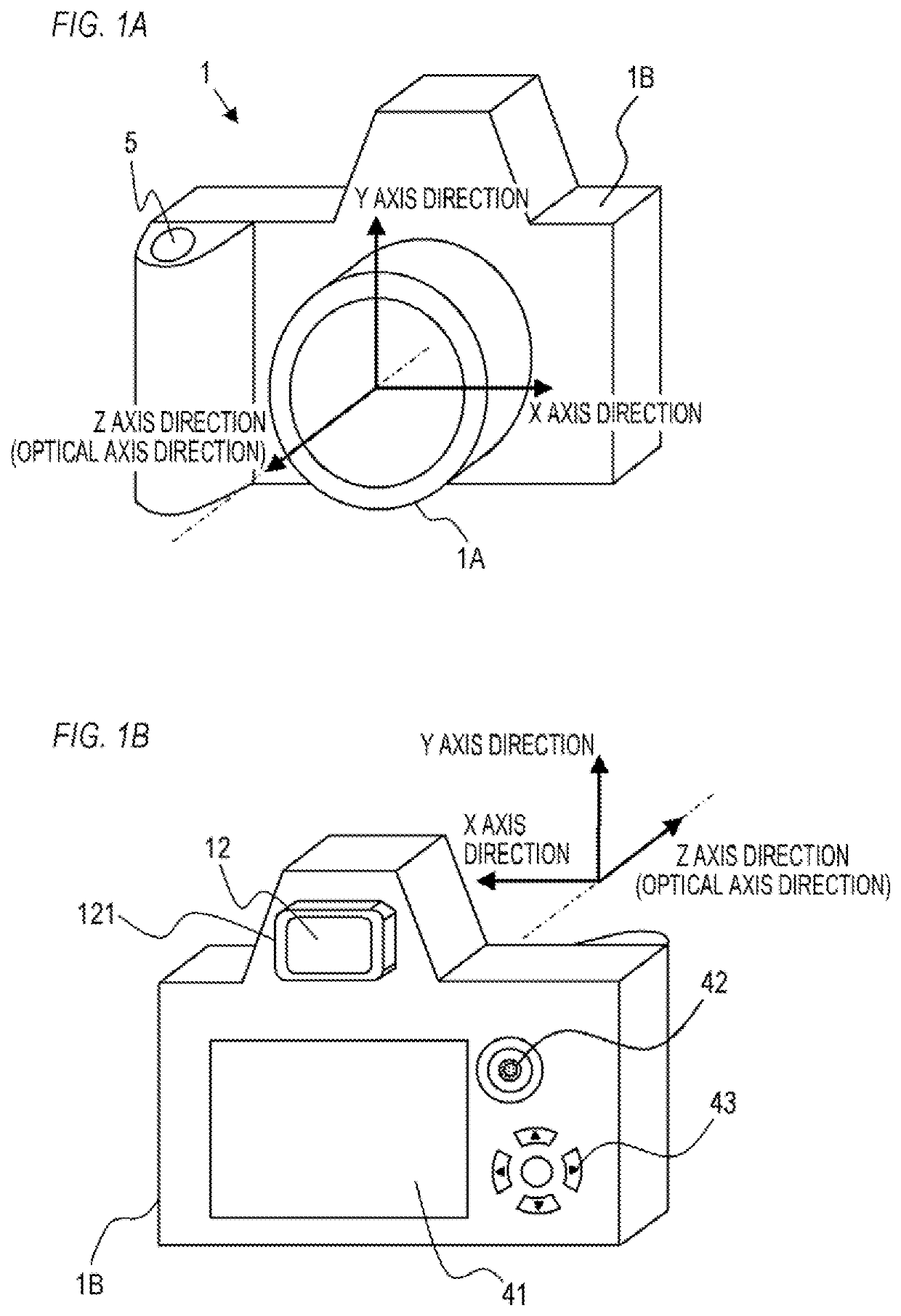
[0054]FIGS. 1A and 1B show the outer appearance of a camera 1 (a digital still camera; an interchangeable lens camera) according to a first embodiment. FIG. 1A is a front perspective view, and FIG. 1B is a back perspective view. As shown in FIG. 1A, the camera 1 includes an image-capturing lens unit 1A and a camera housing 1B. A release button 5, which is an operating member that receives image capturing operations from a user (a photographer), is disposed on the camera housing 1B. As shown in FIG. 1B, an eyepiece window frame 121 and an eyepiece lens 12 (an eyepiece optical system) through which the user looks at a display device 10 (a display panel), to be described below, provided inside the camera housing 1B are disposed on a back surface of the camera housing 1B. The eyepiece window frame 121 surrounds the eyepiece lens 12 and projec...
second embodiment
[0126]A second embodiment of the present invention will now be described. Note that below, description of the same points (configurations, processing, and so on) as in the first embodiment will be omitted, and points that differ from the first embodiment will be described. In the example described in the first embodiment, the oblique look-through state is detected while displaying the through image. In the second embodiment, an example in which the oblique look-through state is detected during the calibration operation will be described. Further, in the second embodiment, an example in which an image display range (the range in which an image is displayed) within the viewfinder is determined on the basis of the oblique look-through state detection result will be described. More specifically, an example in which the image display range of the display device 10 is determined on the basis of the oblique look-through state detection result so as to prompt the user to look through the vi...
third embodiment
[0169]A third embodiment of the present invention will now be described. Note that below, description of the same points (configurations, processing, and so on) as in the second embodiment will be omitted, and points that differ from the second embodiment will be described. In the example described in the second embodiment, the image display range is reduced. In the third embodiment, an example in which the image display range is moved will be described.
[0170]Description of Viewing State Improvement Method
[0171]As described above, the user adopts the oblique look-through state when the visual line of the user is blocked by the eyepiece window frame or the like so that the user cannot see the edges of the display device 10 (the screen). Hence, in the third embodiment, when the oblique look-through state is detected, the image display range of the display device 10 is moved from the current range and set.
[0172]FIG. 17A shows an image display state before detecting the oblique look-thr...
PUM
 Login to View More
 Abstract
Description
Claims
Application Information
 Login to View More