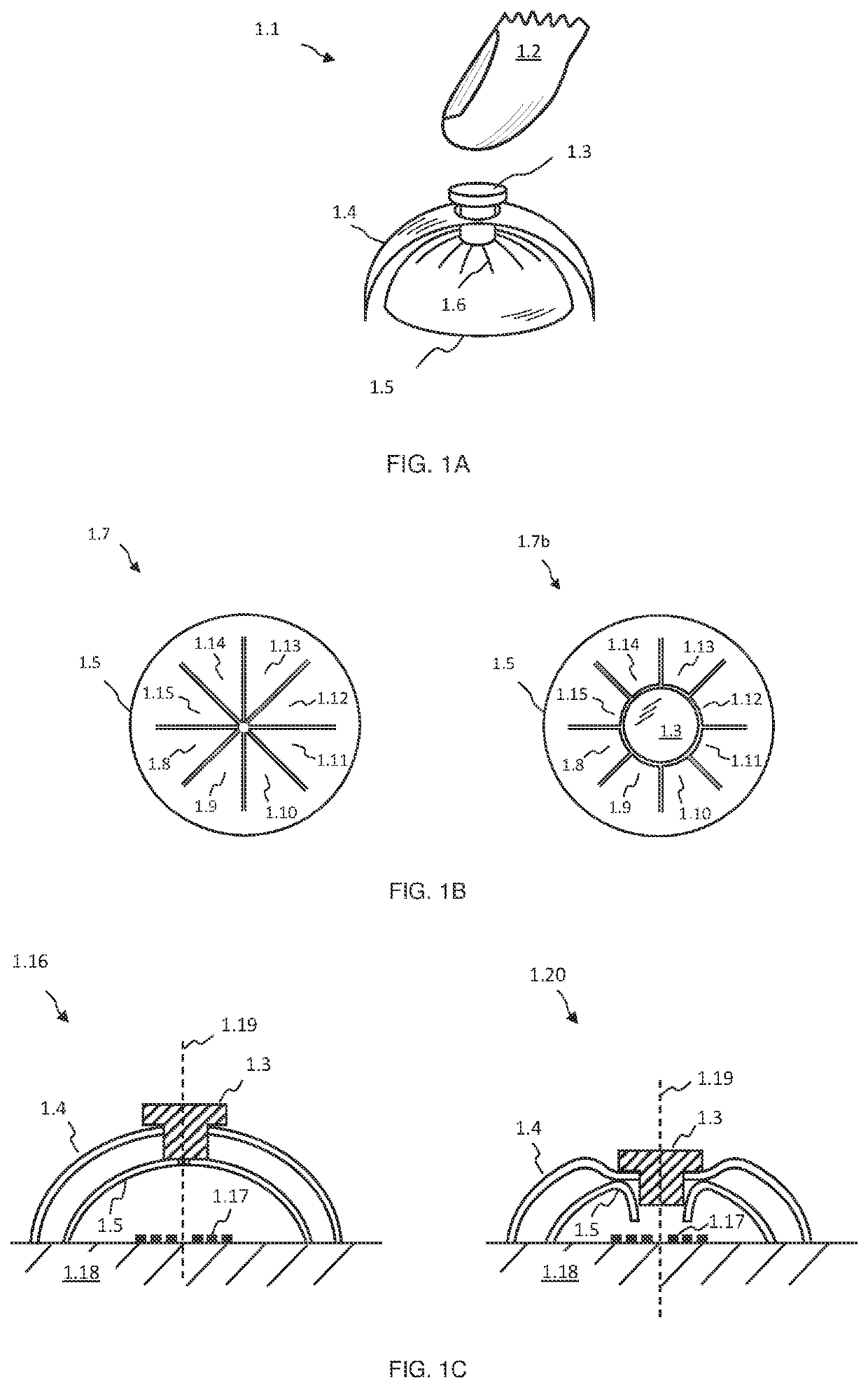
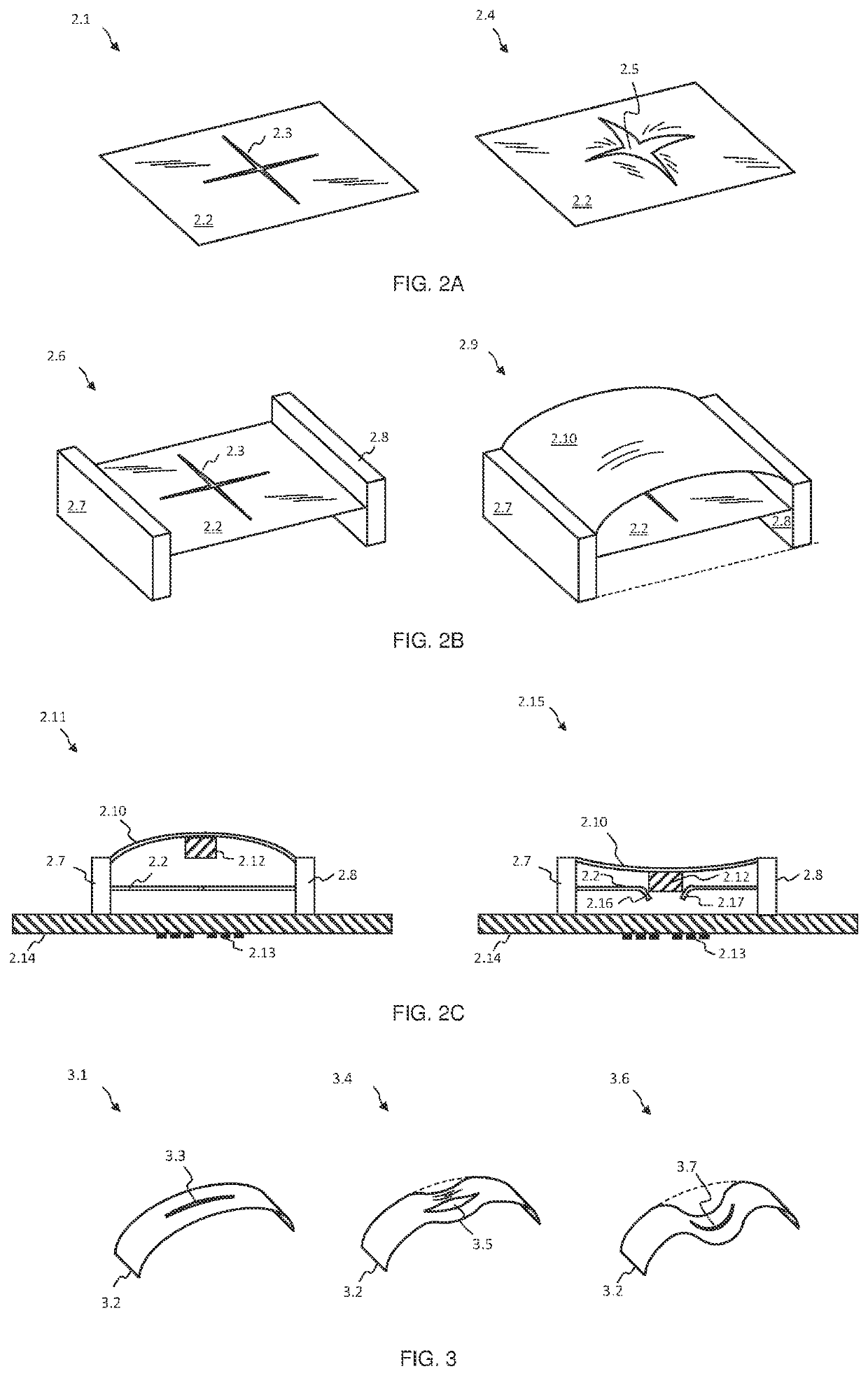
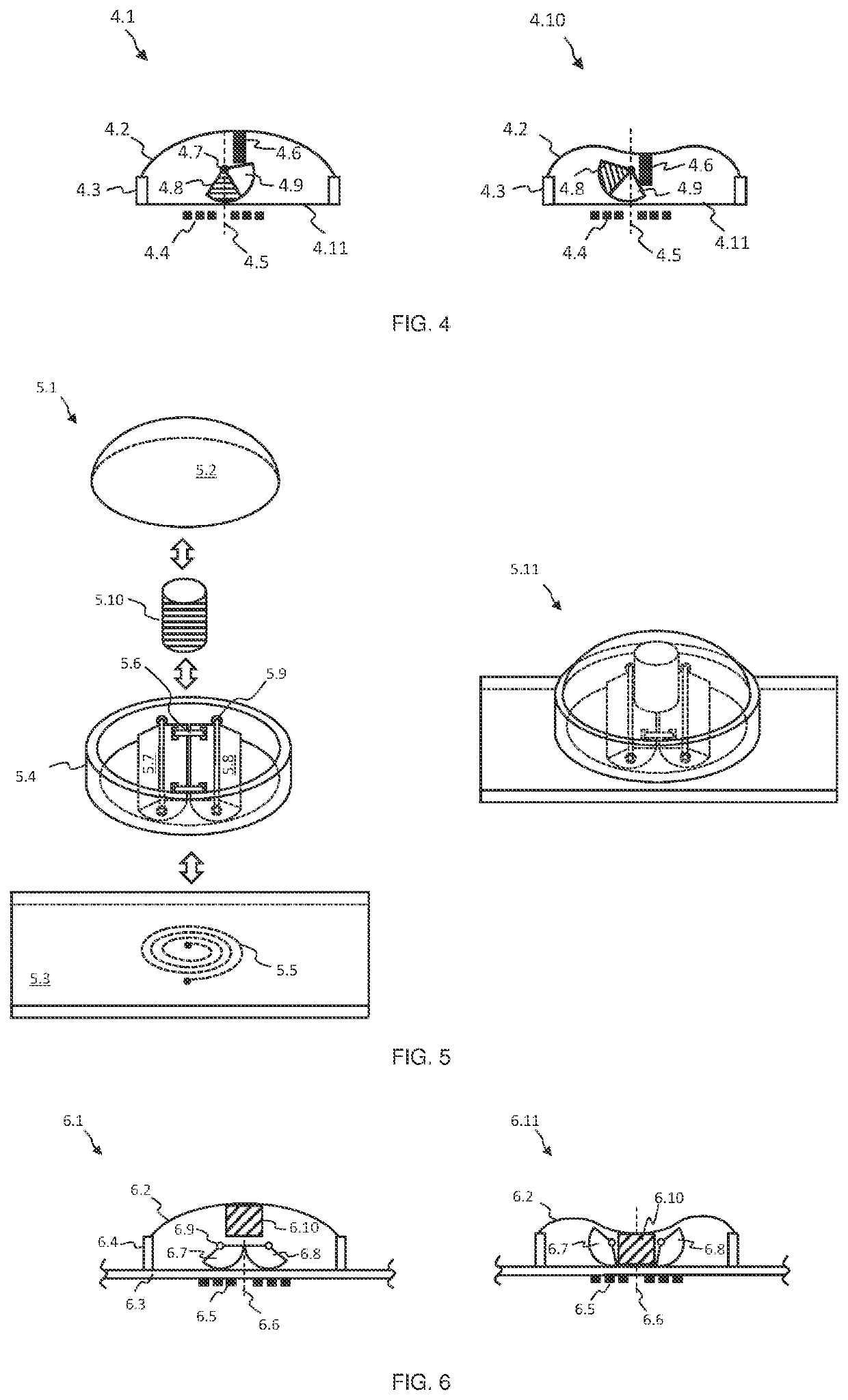
[0007]In a first embodiment of the present invention, a push button structure may be realized as follows. A conductive dome structure may be located over a coil structure. The conductive dome structure may have a number of slits cut into its apex. When the apex is pressed downwards, an opening in the dome structure is formed due to said slits. A magnetic member, for example a ferrite member, may be located above the dome structure, and aligned with the centre of said apex. Said magnetic member may be resiliently supported and held in place by a flexible member. When a user applies less than a specific amount of force to the magnetic member or to the flexible member in a downwards direction, said magnetic member may move slightly and apply a finite amount of pressure on said dome apex. However, if a user applies more than a specific amount of force to said magnetic or flexible members, the flexible member may suddenly deflect downwards, also known as snapping through. This may result in the magnetic member pressing with sufficient force on said apex and slits to cause an opening to form in the dome apex, wherein said magnetic member may protrude through said opening. In other words, when said flexible member snaps through, the magnetic member may suddenly move through the opening in said dome apex, and may come close to said coil structure. Therefore, the snap through action of the flexible member and / or said dome structure, due to more than said specific amount of force applied to said push button structure, may be discerned from measured inductance values of the coil structure. For example, a charge transfer based inductance measurement circuit may be used to monitor the inductance of the coil structure. When less than said specific amount of force is applied to the push button structure, said dome structure remains more or less closed, and may cause significant eddy current losses, reducing said coil structure inductance. When more than said specific amount of force or pressure is applied to the push button structure causing the flexible member to snap through, and said magnetic member to move closer to the coil structure through an opening in said dome, the measured inductance may increase suddenly due to a reduced magnetic field path reluctance, allowing detection of the snap through event with a large signal to noise ratio.
[0043]According to the present invention, the selective short-circuiting of a coil wound around a magnetic member may also be advantageously applied to push-buttons. This may allow robust user interface buttons to be created cost-effectively across sealed surfaces. For example, a first coil may be placed on one side of a sealed surface which allow passage of magnetic fields at a first frequency. A magnetic member, for example a ferrite member, with a second coil wound around it, may be located at the other side of said sealed surface, and may couple or guide magnetic flux emanating from said first coil. The terminals of the second coil may be either connected together, i.e. short circuited, or open-circuit. When the terminals are open circuit, magnetic field from the first coil may couple with the magnetic member in such a manner that the amount of inductance measured for the first coil increases. However, when the terminals of the second coil are short-circuited, coupling of the magnetic field generated by said first coil with the magnetic member may be adversely affected, resulting in a decrease in measured inductance for said first coil. A dome structure may be placed over said magnetic member and second coil, and used to short-circuit the terminals of the second coil. For example, a conductive member may be attached to the apex of said dome structure in such a manner that it connects the two terminals of the second coil together when the dome is pressed with sufficient force to cause it to snap through. Thereby, the snap through event may be discerned as a sudden decrease in inductance of the first coil. As an alternative, said dome structure itself may be fashioned out of conductive material, and used to short-circuit said second coil terminals when the dome is pressed to snap through.


 Login to View More
  Login to View More