Check patentability & draft patents in minutes with Patsnap Eureka AI!

Routing in data communications network

Inactive Publication Date: 2000-07-18
IBM CORP
View PDF2 Cites 118 Cited by
  • Summary
  • Abstract
  • Description
  • Claims
  • Application Information

AI Technical Summary

Problems solved by technology

Communications networks can be worldwide and of any size and complexity (the simple network configurations such as where all nodes are directly connected to a single central node or where every node is directly connected to every other are not feasible with networks of any significant size).
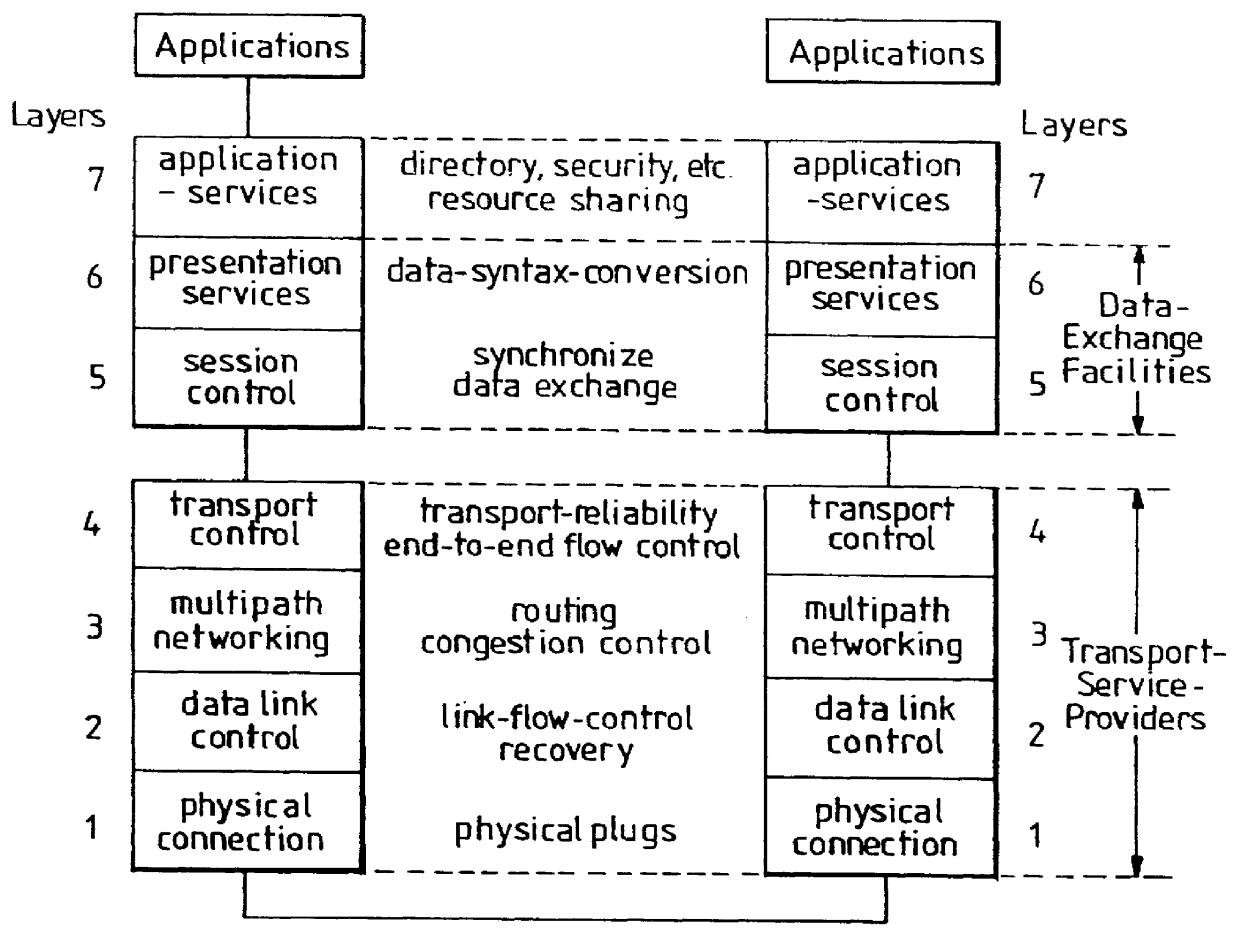
While computer networking has produced gains in productivity and efficiency, it has also introduced the problem of how to enable cooperation between disparate communication networks and operating platforms (which may be created by different vendors) so that they can interoperate, allowing businesses to integrate all of their data processing resources.
The problem with this approach, particularly for message-based systems where the network topology may change dynamically, is how to endow the nodes with knowledge of routes.
While beacon messaging has the advantage of not requiring operator input, it also has the problem, particularly in large and complex networks, of considerably increasing network traffic unless imperfect knowledge of the network status is accepted (as in WO 93 / 16539 where beaconing is periodic rather than in response to every change).
If out-of-date information is used for routing determinations, network resources will be wasted and communication delays introduced by attempts to create routes which include unavailable nodes or links.
The need for human intervention is a weakness in a complex, dynamically changing network.
None of the above routing techniques works well in an environment in which the network configuration is dynamically changing, because of the considerable overhead in updating the information held by each of the network nodes together with the need both to ensure that interconnected nodes hold consistent information and to avoid the processing delays that result if communications have to wait while updates are performed, or while the POC is unavailable.
This solution has severe limitations in large networks or networks where reconfigurations are frequent, since the CST may become out of date before it reaches all of the network nodes and because different nodes may have inconsistent information for unacceptably long periods of time.
The amount of information that must be held by each node and the overhead in updating that information are both considerable.
The networks may be highly complex, with many intermediate nodes being involved in any data transmission between source and destination nodes.
(If each node were reliant on an application-level communications session with the directory service being available, then routing to the directory service would be more complex and a failure to obtain such a session would make routing impossible).

Method used

the structure of the environmentally friendly knitted fabric provided by the present invention; figure 2 Flow chart of the yarn wrapping machine for environmentally friendly knitted fabrics and storage devices; image 3 Is the parameter map of the yarn covering machine
View more

Image

Smart Image Click on the blue labels to locate them in the text.
Viewing Examples
Smart Image
  • Routing in data communications network
  • Routing in data communications network
  • Routing in data communications network

Examples

Experimental program
Comparison scheme
Effect test

Embodiment Construction

A communications network is represented schematically in FIG. 2. Within the overall network 50 are a plurality of administrative subnetwork units 60 and 65 known as cells. Each cell may include a plurality of network nodes 70. As an example, a network node may be a server process, such as an air-line booking service, running on a computing device such as an IBM AS / 400 computer (running OS / 400 operating system software). Nodes may also comprise, for example, processes running on an IBM PS / 2 personal computer running OS / 2 operating system software, or on an IBM RISC System / 6000 running AIX, all within the same network. In the client-server model of distributed processing, some of these nodes will be server processes connected for communication to computing devices on which client processes are located (e.g. an AS / 400 computer may have a plurality of workstations connected thereto). Some client processes may not need to be involved in network routing, other than requiring communication...

the structure of the environmentally friendly knitted fabric provided by the present invention; figure 2 Flow chart of the yarn wrapping machine for environmentally friendly knitted fabrics and storage devices; image 3 Is the parameter map of the yarn covering machine
Login to View More

PUM

No PUM Login to View More

Abstract

Data communication systems and methods in which information for routing of messages between nodes of a communications network is provided by a directory service (such as the DCE directory service), accessible from all network nodes. The provision of such information by the directory service removes the requirement for routing tables to be set up and maintained at each of the network nodes, whose maintenance can involve considerable network traffic in dynamically changing networks or problems of inconsistent data being held at different nodes.

Description

1. Technical FieldThe present invention relates to an improved method and system for providing data communications and, in particular, to an improved method and system for providing data communications within a distributed computing network. Still more particularly, the present invention relates to an improved method and system of providing route determination information used to determine a route within a distributed computing network for data communications utilizing a distributed directory service.2. Description of the Prior ArtA distributed data processing system typically consists of a number of data processors interconnected by a data communications network. In a distributed system, data and programs for processing the data may be stored at several network sites with the object of locating them near to the network locations at which they are most commonly accessed. This avoids dependence on a single central processor providing all processing functions and can reduce the data t...

Claims

the structure of the environmentally friendly knitted fabric provided by the present invention; figure 2 Flow chart of the yarn wrapping machine for environmentally friendly knitted fabrics and storage devices; image 3 Is the parameter map of the yarn covering machine
Login to View More

Application Information

Patent Timeline
no application Login to View More
IPC IPC(8): H04L12/56H04L45/42
CPCH04L45/00H04L45/42
Inventor LEWIS, JONATHAN RHYS
Owner IBM CORP
Features
  • R&D
  • Intellectual Property
  • Life Sciences
  • Materials
  • Tech Scout
Why Patsnap Eureka
  • Unparalleled Data Quality
  • Higher Quality Content
  • 60% Fewer Hallucinations
Social media
Patsnap Eureka Blog
Learn More