Steerable parachute control system and method

a control system and parachute technology, applied in the field of unmanned parachutes, to achieve the effect of improving performance, high speed and great control

US6889942B2Inactive Publication Date: 2005-05-10ATAIR AEROSPACE +1
8 Cites 56 Cited by

Patent Information

Authority / Receiving Office
US · United States
Current Assignee / Owner
Publication Date
2005-05-10
Estimated Expiration
Not applicable · inactive patent

Smart Images

  • Figure 1
    Figure 1
  • Figure 2
    Figure 2
  • Figure 3
    Figure 3
Patent Text Reader

Abstract

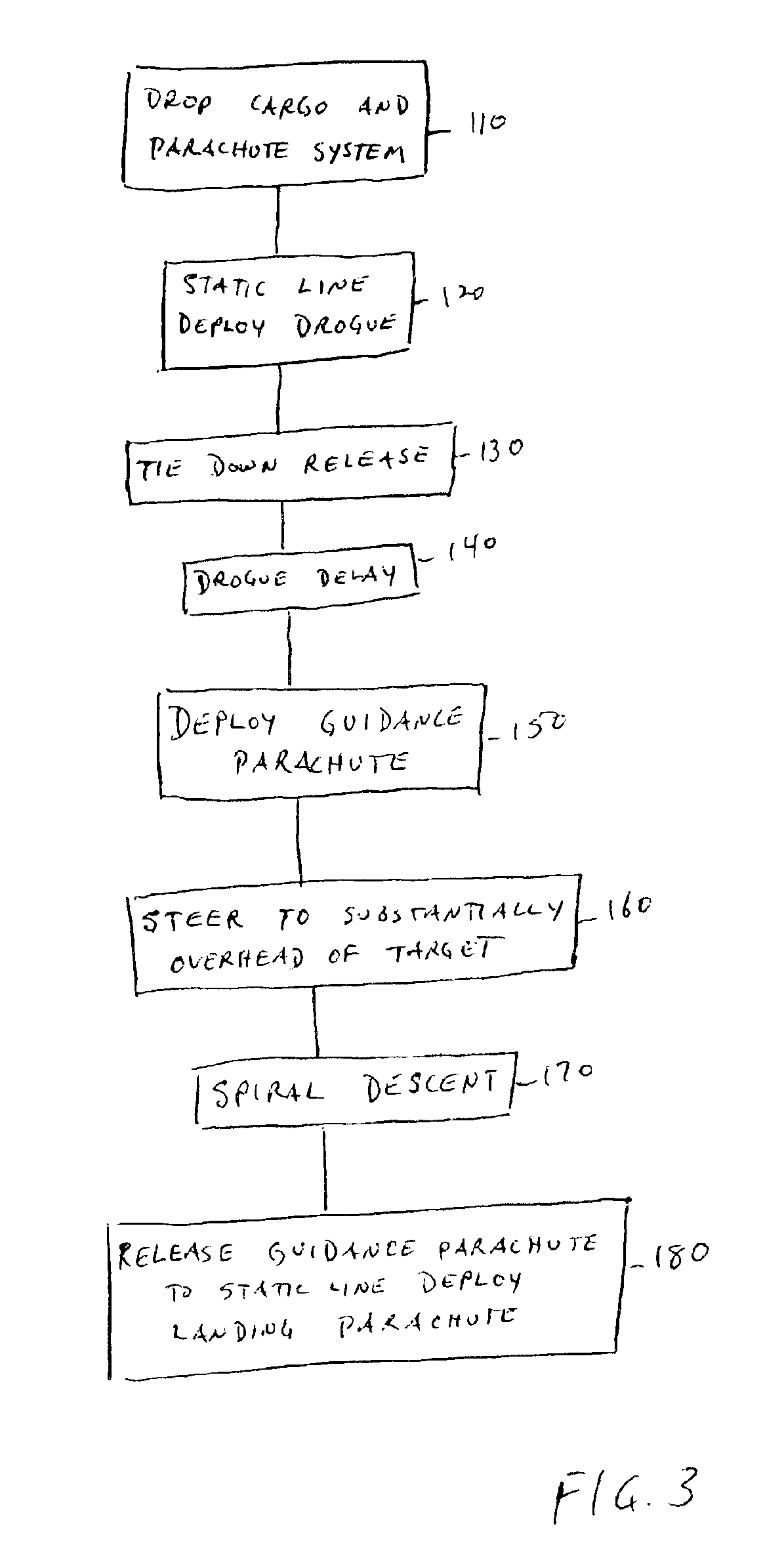
An autonomous guided parachute system for cargo drops that divides the requirements of guidance and soft landing into separate parachutes. Said invention includes a high wing-loaded ram air parachute for guidance, a larger round parachute for soft landing, a harness / container system, flight computer, position sensors and actuation system. The system is dropped from an airplane. A predetermined period of drogue fall ensures a stable position prior to deploying the guidance parachute. The flight controller determines a heading to intersect with an area substantially above the desired target and controls the guidance parachute via pneumatic actuators connected to the parachutes steering lines to fly on that heading. At a minimum altitude prior to the system's impact with the ground the flight computer transitions the system from the fast high performance guidance parachute to a larger landing parachute by releasing the guidance parachute to static line extract and deploy the landing parachute. If the system reaches a position substantially above target area prior to the parachute transition altitude the flight computer controls the system into a spiral dive or other rapid altitude dropping maneuver until the transition altitude is reached. Once transitioned to the landing parachute the system descends for a brief period unguided under the landing parachute until touchdown.
Need to check novelty before this filing date? Find Prior Art

Description

[0001] This application claims priority to U.S. Provisional Application Ser. No. 60 / 341,006 filed Dec. 7, 2001.BACKGROUND OF THE INVENTION

[0002] 1. Field of the Invention

[0003] The invention relates generally to unmanned parachutes for cargo drops. More particularly, it relates to a control system and method for targeted landing of cargo using controllable parachutes.

[0004] 2. Discussion of Related Art

[0005] Parachutes have evolved over the years into highly sophisticated systems, and often include features that improve the safety, maneuverability, and overall reliability of the parachutes. Initially, parachutes included a round canopy. A skydiver was connected to the canopy via a harness / container to suspension lines disposed around the periphery of the canopy. Such parachutes severely lacked control. The user was driven about by winds without any mechanism for altering direction. Furthermore, such parachutes had a single descent rate based upon the size of the canopy and the weight of ...

Examples

Embodiment Construction

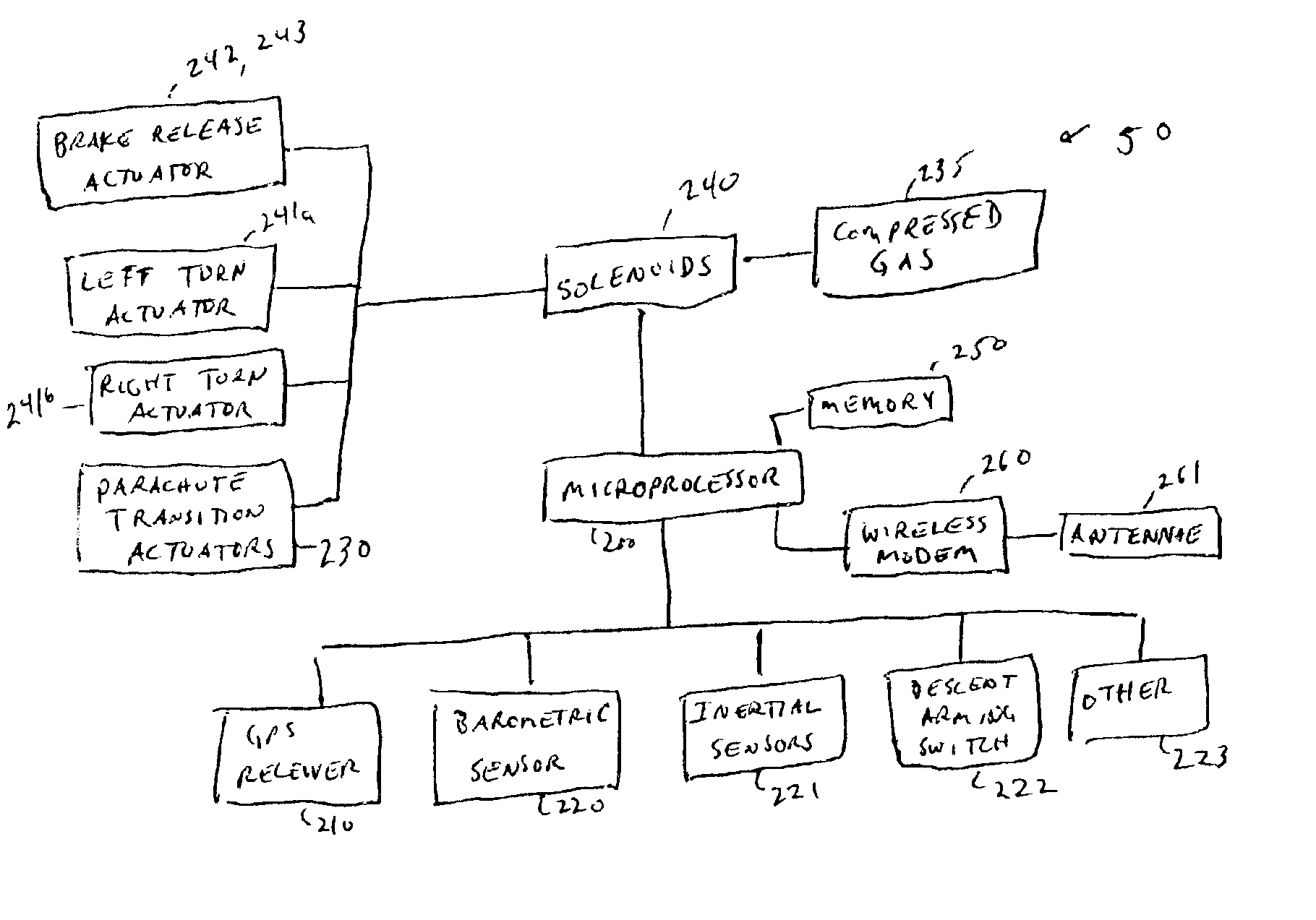
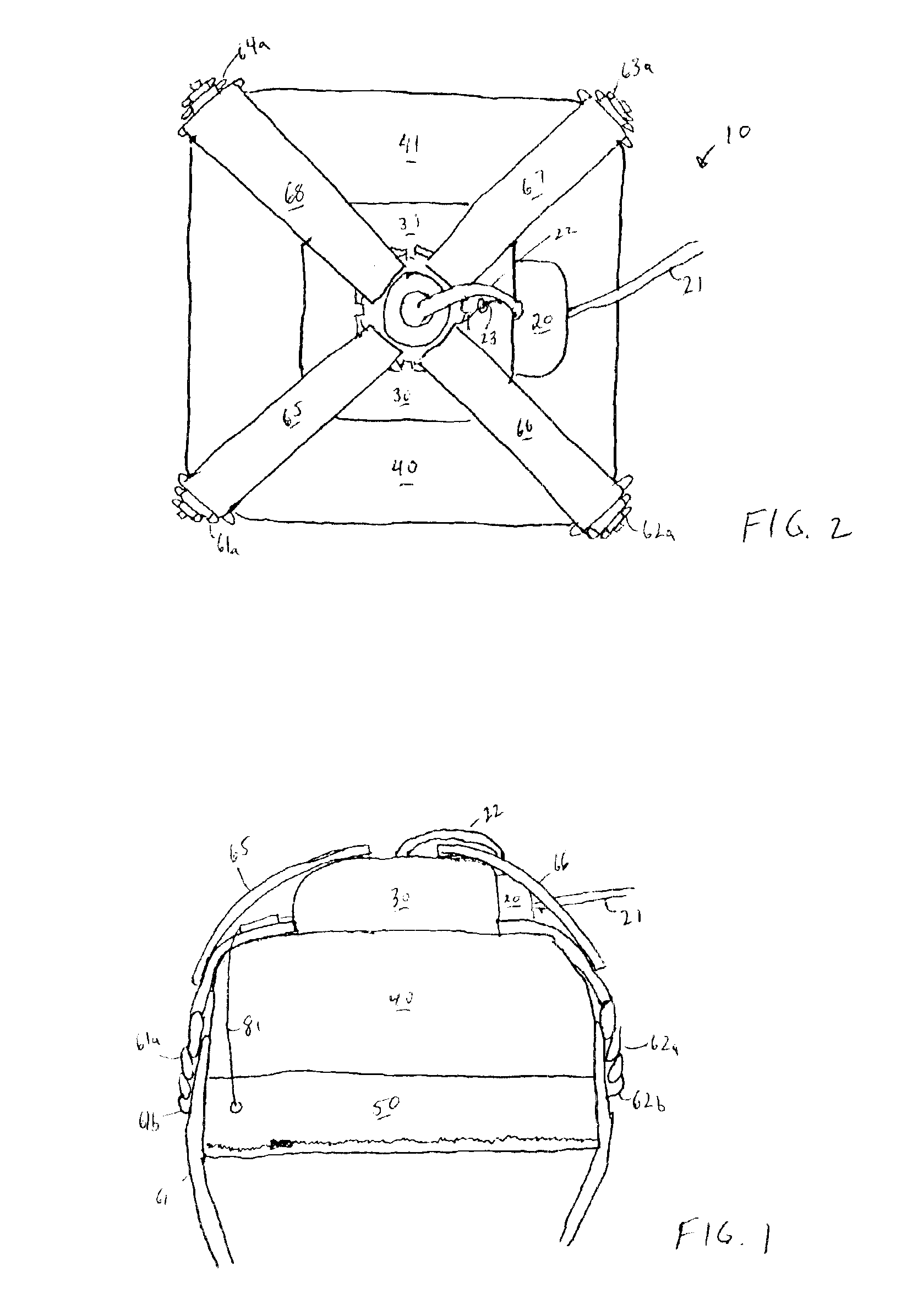
[0026]In order to provide improved performance for automatic control of cargo drops, the parachute system of the present invention includes multiple parachutes and a flight controller. FIGS. 1 and 2 are respectively a side view and a top view of an embodiment of the parachute system 10 of the present invention when packed for deployment. The parachute system includes a drogue 20, a high wing loaded, guidance parachute or wing 30, and a landing parachute 40. Preferably, the guidance parachute is a high wing loaded, high speed, steerable, ram air parachute. However, any controllable wing or parachute may be used. Preferably, the landing parachute is a larger parachute allowing slow unguided vertical descent. A flight controller 50 is disposed below the parachutes and operates to control deployment of the parachutes and steering of the guidance parachute. The parachutes 20, 30, 40 may be of any known design based upon the type of chute required for the specific operation.

[0027]FIG. 3 i...