
Selective protection for ring topologies
a topology and selective protection technology, applied in the field of network communication systems and protocols, can solve the problems of packets likely to reach their destinations out of order, packets must travel a much longer path, and packet loss, and achieve the effect of sufficient bandwidth and reducing the number of packets los
- Summary
- Abstract
- Description
- Claims
- Application Information
AI Technical Summary
Benefits of technology
Problems solved by technology
Method used
Image

Examples
Embodiment Construction
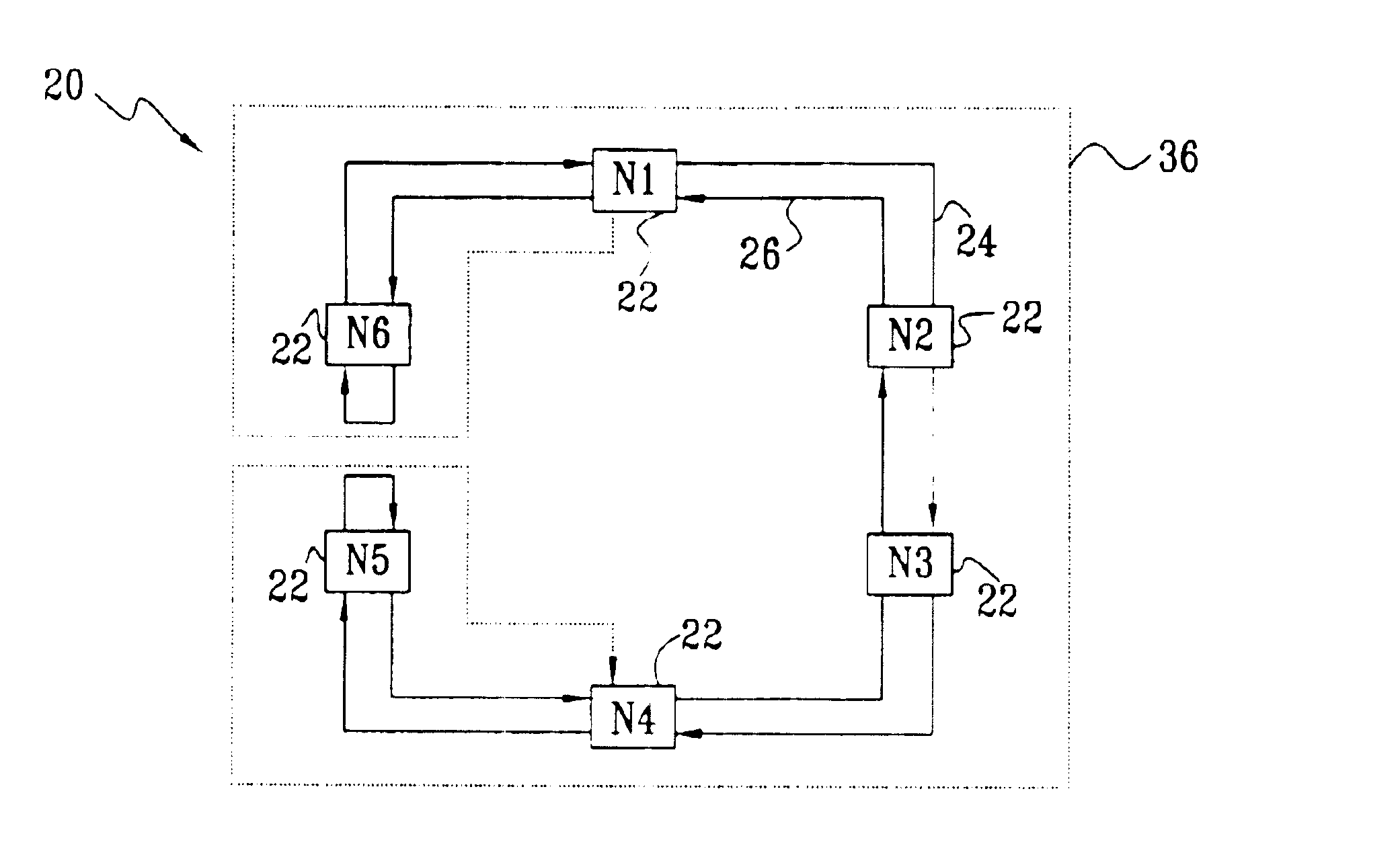
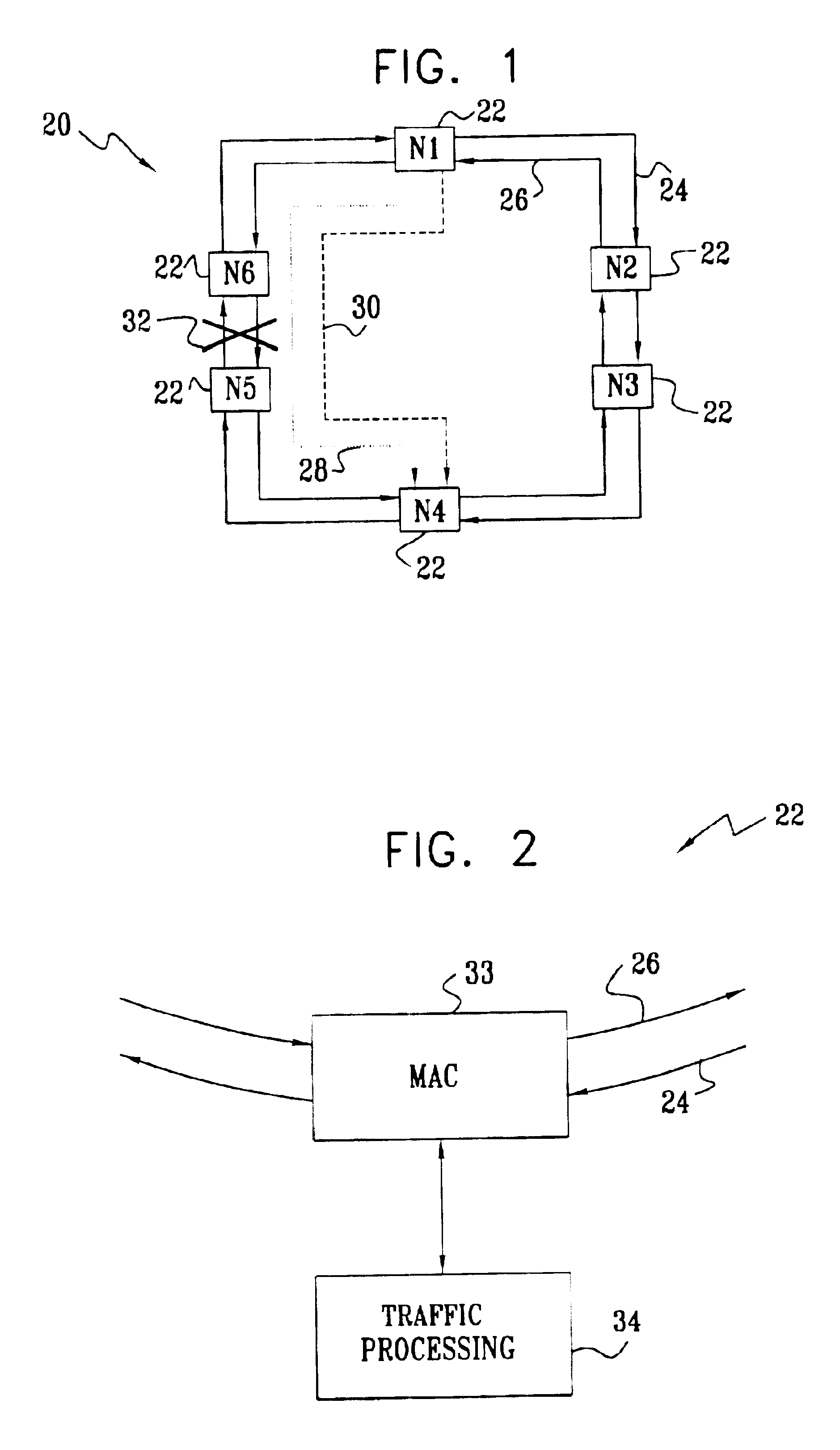
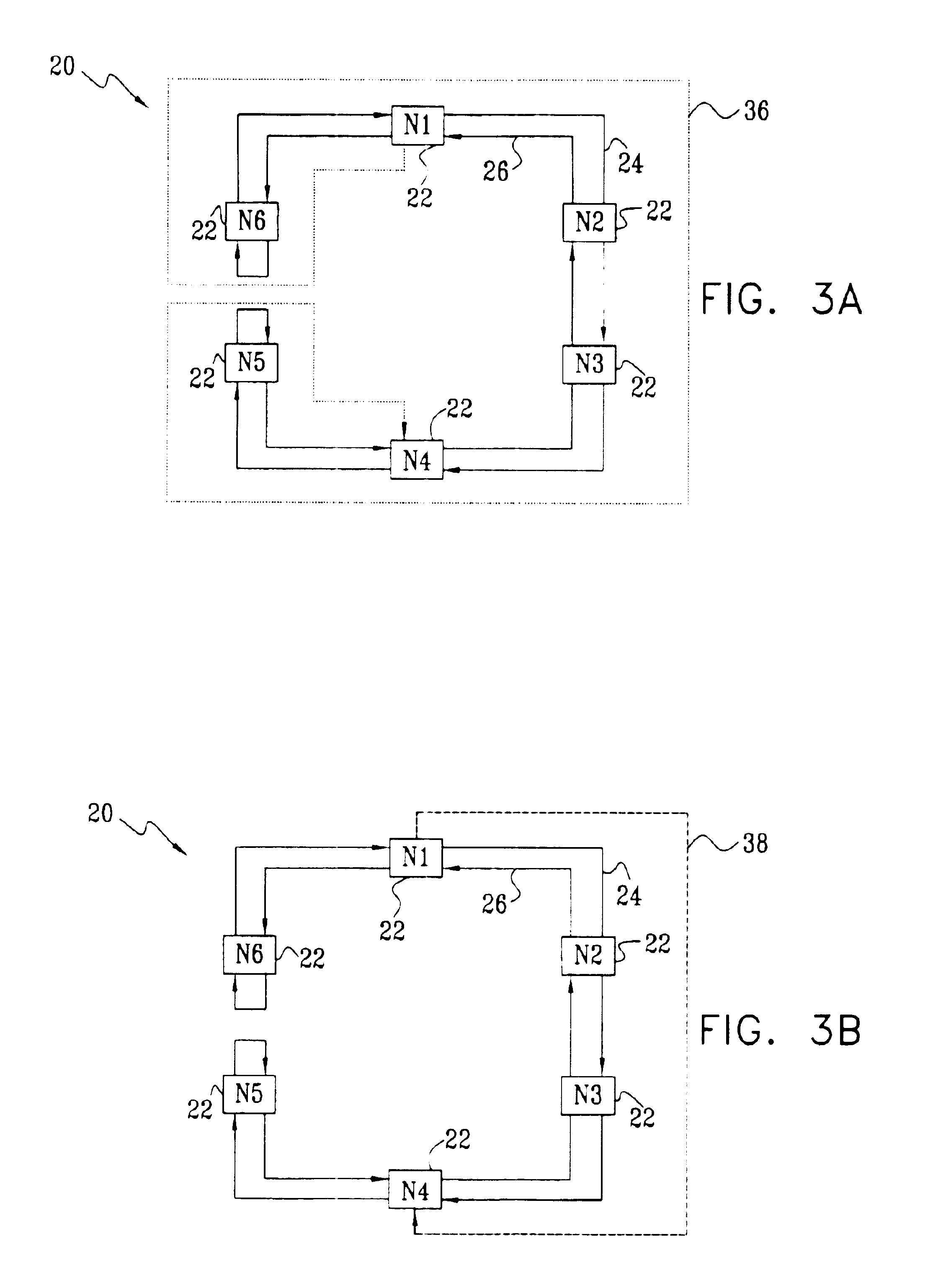
[0037]FIG. 1 is a block diagram that schematically shows a packet ring network 20, in accordance with a preferred embodiment of the present invention. Network 20 comprises nodes 22, marked N1 through N6, which are mutually connected by bidirectional communication media, such as optical fibers or conductive wires. The nodes typically comprise switching equipment, and serve as either access points or gateways to other networks (aggregation points). The communication media in network 22 are configured to define an outer ring 24, over which packets are conveyed between the nodes in a clockwise direction, and an inner ring 26, over which the packets are conveyed in a counterclockwise direction. As noted above, however, the designations of “inner,”“outer,”“clockwise” and “counterclockwise” are arbitrary and are used here simply for convenience and clarity of explanation. Furthermore, the designation and number of nodes in network 20 are chosen here by way of example, and the network may, ...
PUM
 Login to View More
 Abstract
Description
Claims
Application Information
 Login to View More