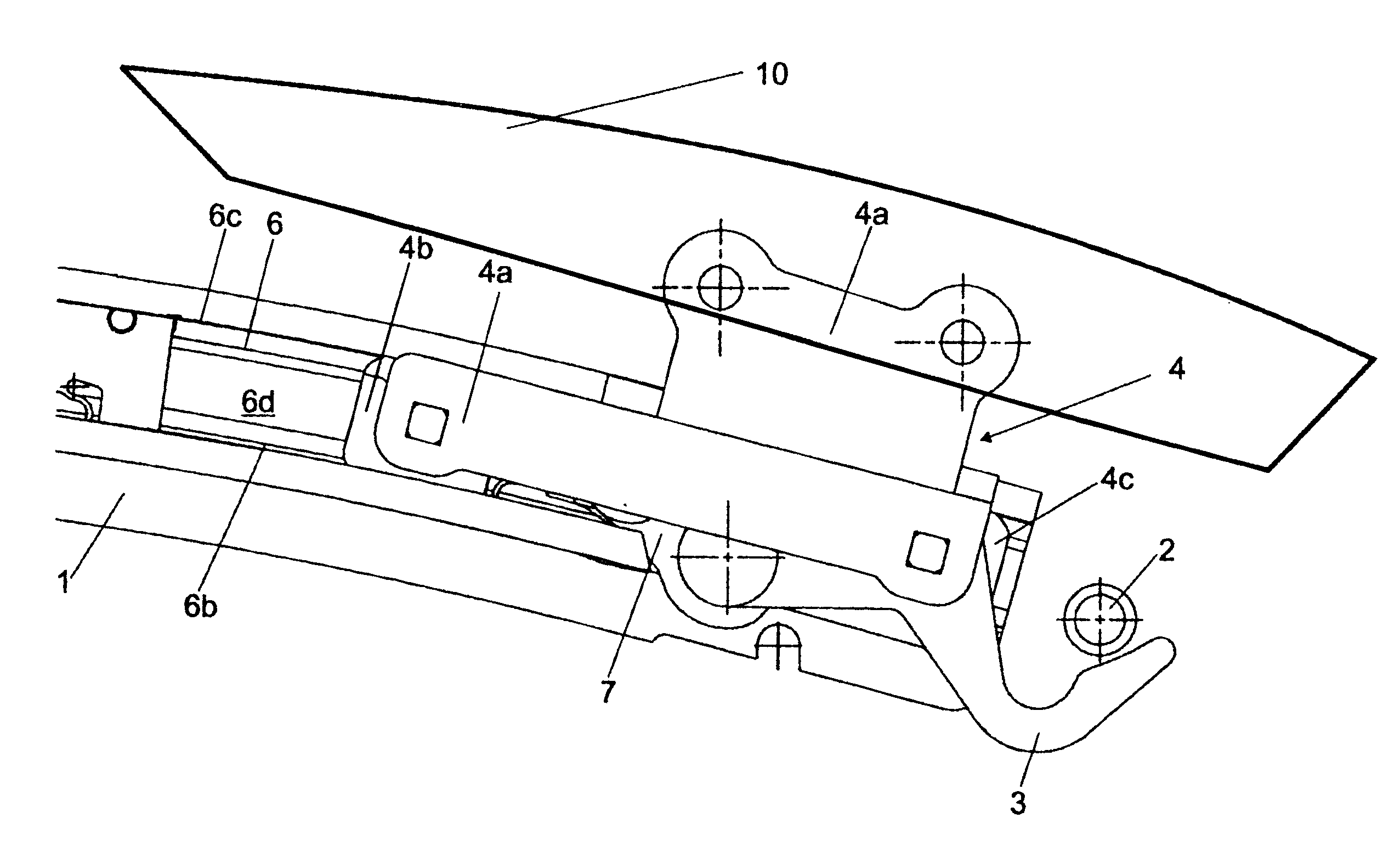
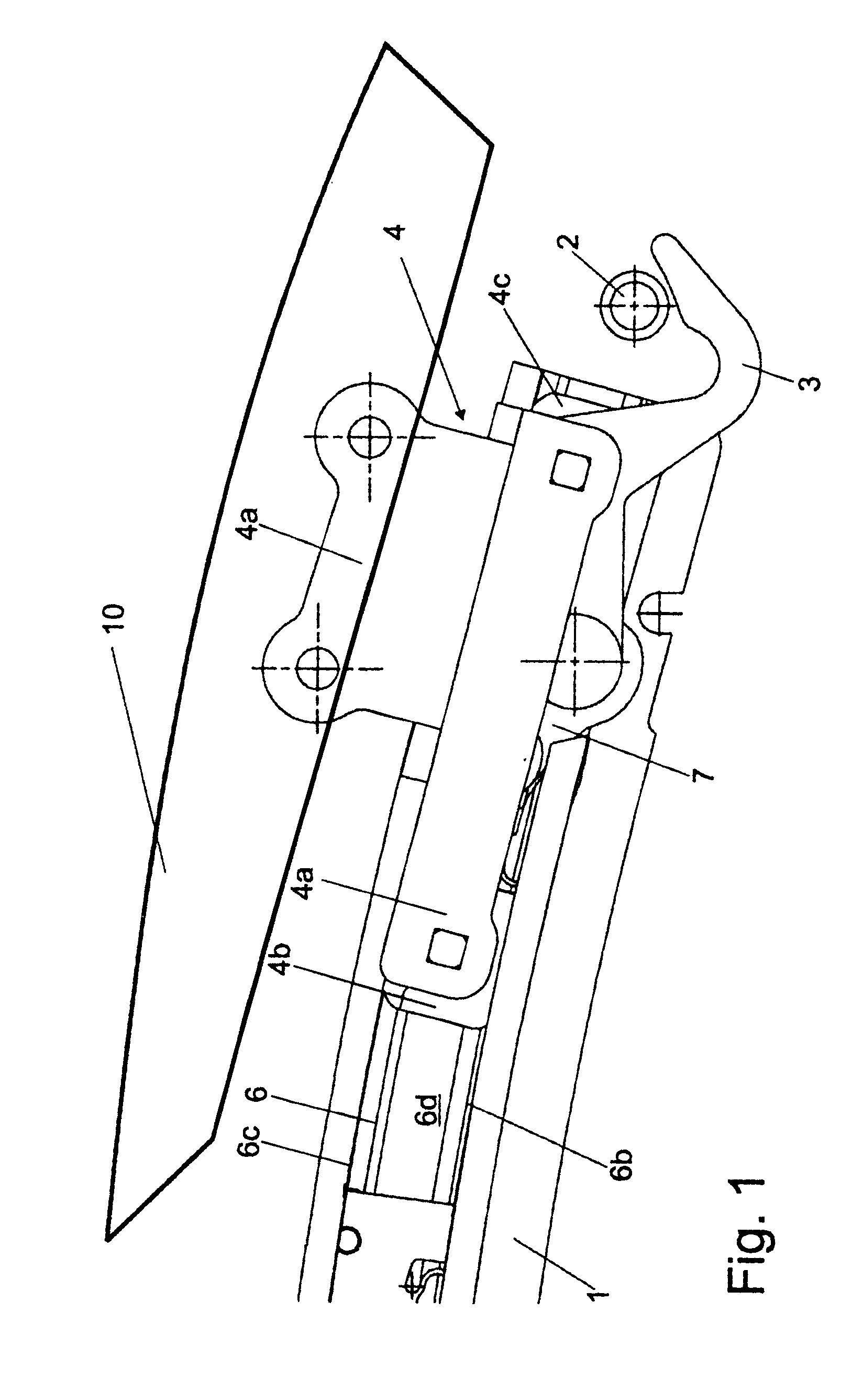
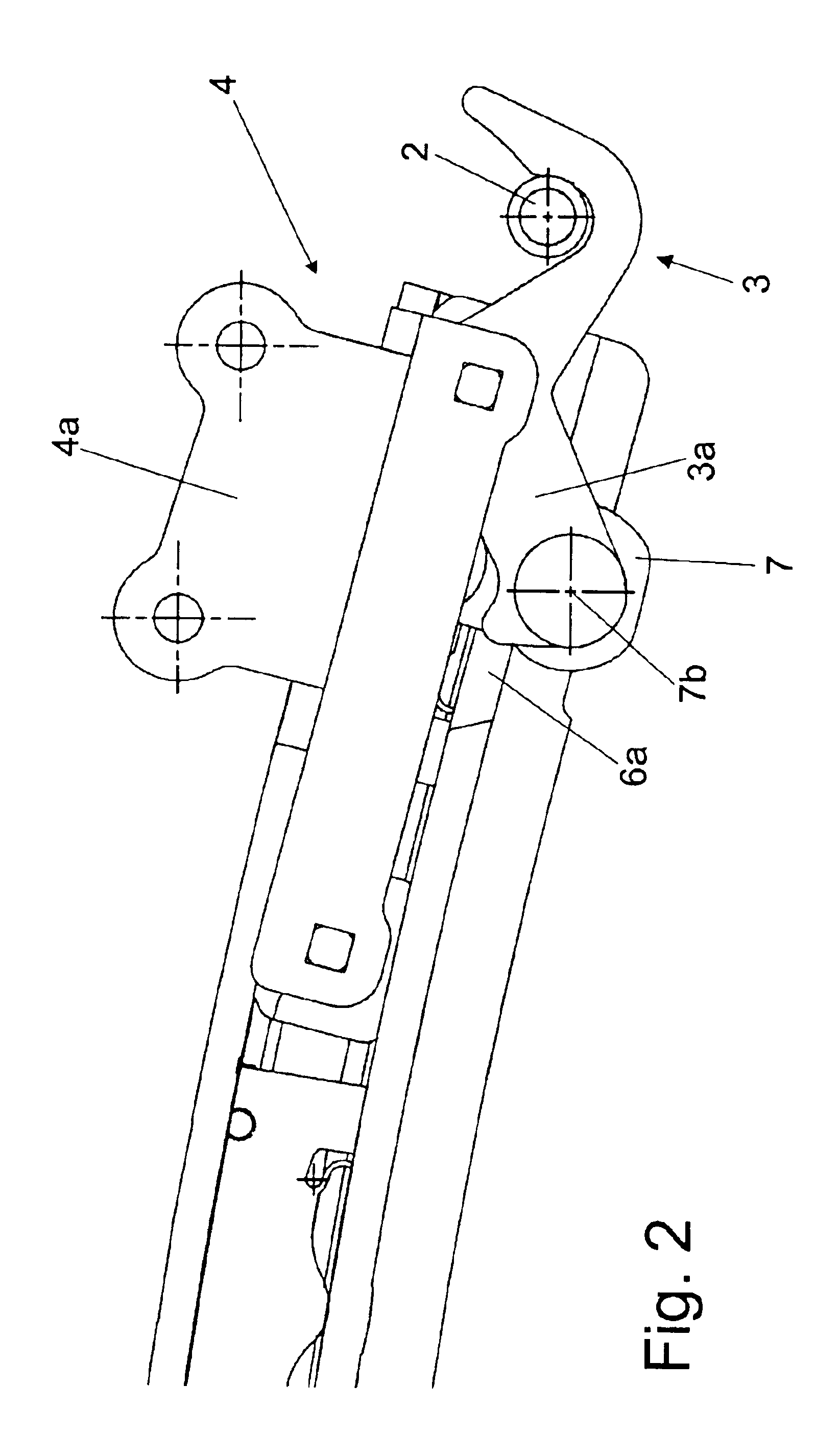
[0008]The provision of a second, drivable sliding element advantageously achieves the situation where, on the one hand, force transmission can take place during driving of the hook, which is secured in a pivotable manner on the first sliding element, and, on the other hand, the second sliding element can be optimized in respect of its low-friction guidance, while the first sliding element, which bears the closure hook, can be guided and dimensioned in respect of the closing and retaining forces which are to be applied.
[0009]In a preferred embodiment of the present invention, the first sliding element and the second sliding element are guided linearly on the roof frame in a linear guide, with the result that particularly straightforward movements and particularly straightforward structural arrangements are made possible.
[0010]A control link is particularly advantageously connected, on the one hand, in an articulated manner to the hook and, on the other hand, in an articulated manner to the second sliding element, with the result that corresponding force deflection, which makes it possible for the driven linear movement of the second sliding element to be converted into a rotary movement of the hook, can easily be realized with just a small number of components.
[0011]The second sliding element is particularly advantageously guided such that it can be moved linearly in a linear guide, the control link, over a first part of the linear movement, being retained relative to the second sliding element in a first position by means of the linear guide, and it being possible for the control link, over a second part of the linear movement, to be moved in relation to the second sliding element by means of a recess provided in the linear guide. In this way, a, in respect of the sliding elements, location-dependent activation of the rotary movement of the hook is achieved using extremely straightforward means, without additional or complex parts, for example special slot guides, having to be provided. It is possible, in principle, to provide a commercially available linear guide, formed for example as an extruded profile, for the purpose of guiding the sliding elements, it being possible for the activating means which triggers the
closure operation to be designed by a simple recess in the linear guide.
[0013]Furthermore, it may particularly advantageously be provided that, in a position in which the hook is in full engagement with the hoop catch, the control link is arranged in a dead-center position or in an over-dead-center position in relation to the hook. As a result, in the case of the convertible top being subjected, from the outside, to the action of forces which ultimately subject the rotatable hook to a torque, a force which is directed essentially in the longitudinal direction of the control link is transmitted to the control link, this preventing further force transmission for example to a
linear drive of the closure device. As a result, the roof frame is secured particularly reliably on the bodywork-mounted frame element.
[0014]Furthermore, a front bow of the convertible top may be secured, particularly advantageously, on the first sliding element. By virtue of rearward displacement of the first sliding element, the front bow is thus also displaced rearwardly relative to the roof frames. If the front bow is a front bow of a fully convertible top, then an essentially U-shaped region which is open to the front is produced in the front end region of the convertible top, this U-shaped region, in the case of many convertible vehicles, in particular in the case of small convertible vehicles, allowing the open convertible top to be advantageously stowed in the rear region of the vehicle since the roof frames, when they project freely in the forward direction, can be stowed to the sides of the rear passenger seats and thus do not take up a large amount of space. In the case of the front bow being designed as a front bow of a folding / sliding top, the combination of the first sliding element with the front bow provides a driven movement for the front bow and / or the entire folding / sliding top.


 Login to View More
  Login to View More