
Feed forward amplifier
a forward amplifier and amplifier technology, applied in amplifiers, amplifiers with semiconductor devices/discharge tubes, amplifiers, etc., can solve the problems of increasing the overall cost and complexity of the ffa circuit, requiring additional care, cost and/or complexity, and increasing the overall cost and complexity of the ffa design. to achieve the effect of reducing cost and complexity
- Summary
- Abstract
- Description
- Claims
- Application Information
AI Technical Summary
Benefits of technology
Problems solved by technology
Method used
Image

Examples
Embodiment Construction
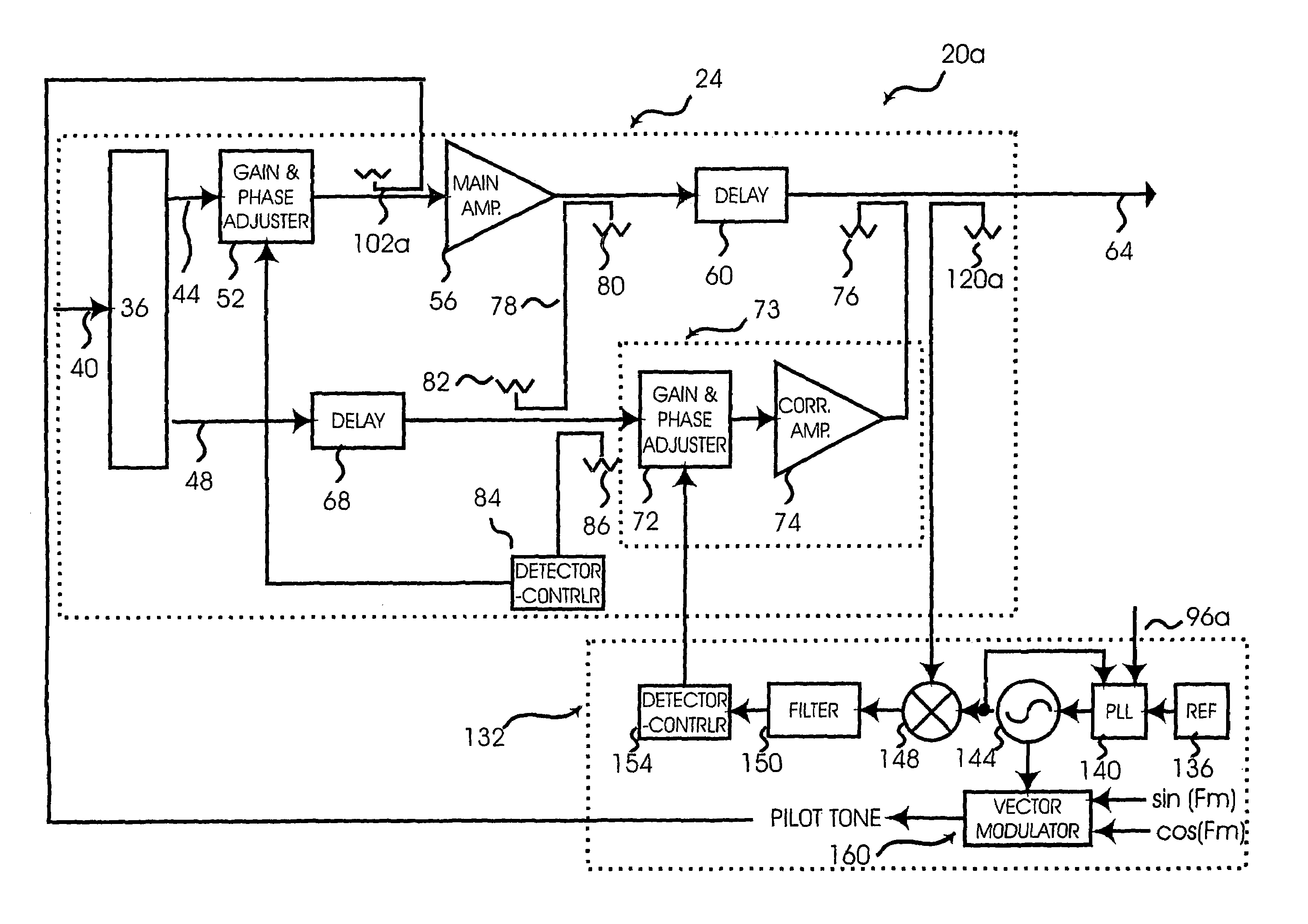
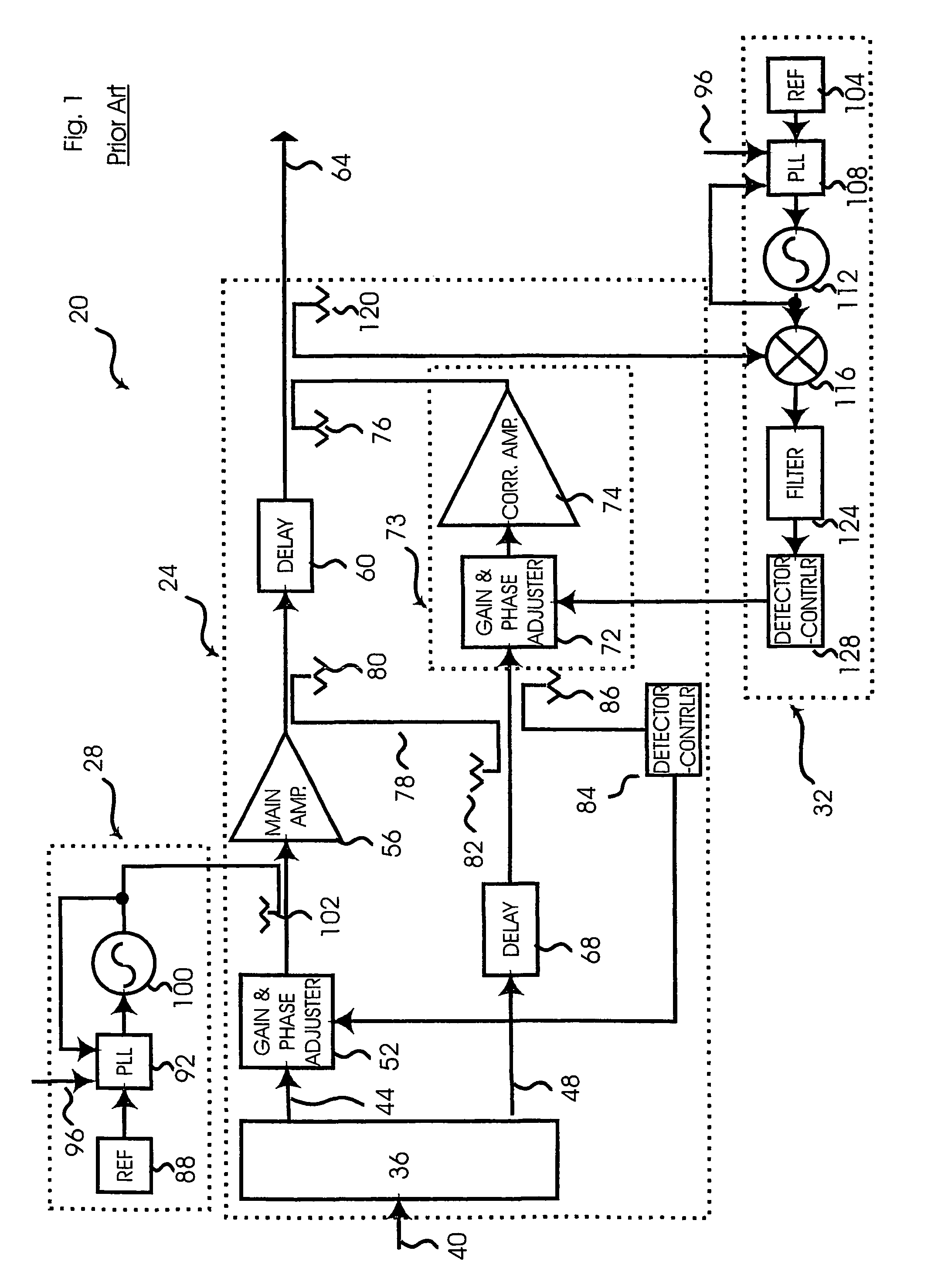
[0015]Referring now to FIG. 1, a prior art feed forward amplifier (“FFA”) is indicated generally at 20. FFA 20 comprises an amplifier portion 24, a pilot tone generator 28, and a pilot tone receiver 32.
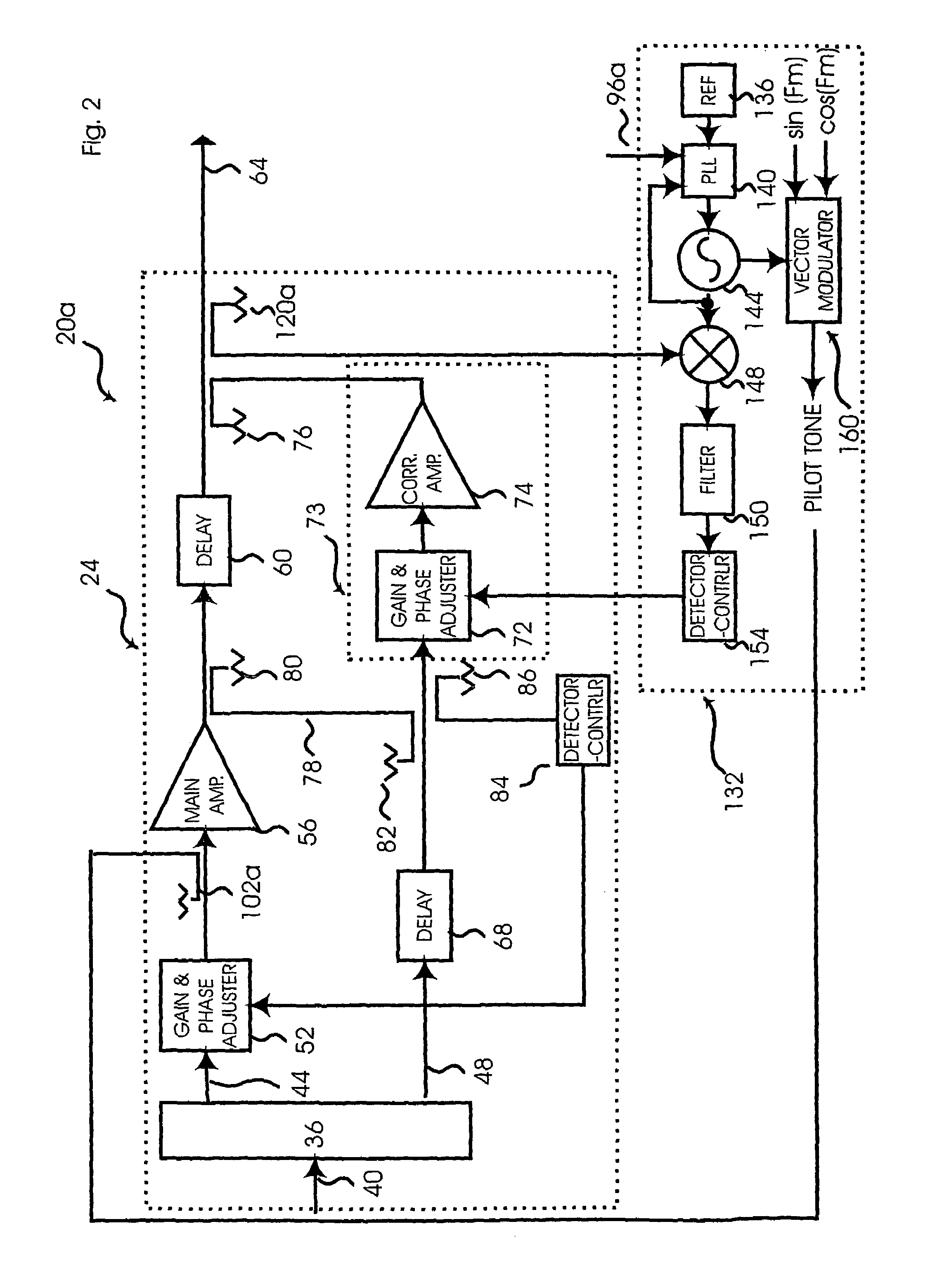
[0016]Amplifier portion 24 includes a coupler 36 that is connected to an input signal path 40. Coupler 36 is operable to split an incoming signal from path 40 into a first signal path 44 and a second signal path 48. First signal path 44, which carries the main signal from coupler 36, is characterized by a gain and phase adjuster 52, a main amplifier 56 and a delay element 60 that outputs to an output signal path 64. Second signal path 48, which carries a sample of the input signal generated by coupler 36, is characterized by a delay element 68, a gain and phase adjuster 72 and a correctional amplifier 74, the output of which connects to output signal path 64 via a coupler 76. Those of skill in the art will recognize that adjuster 72 and correctional amplifier 74 form an error correcti...
PUM
 Login to View More
 Abstract
Description
Claims
Application Information
 Login to View More