
Adjustable multi-band antenna
a multi-band antenna and adjustable technology, applied in the direction of resonant antennas, substation equipment, transmission, etc., can solve the problems of increasing the difficulty or the inability to cover the frequency range used by more than one radio system, the distance between the radiating plane and the ground plane of an internal planar antenna unavoidably becoming shorter, and the inability to match and improve the matching efficiency of the antenna
- Summary
- Abstract
- Description
- Claims
- Application Information
AI Technical Summary
Benefits of technology
Problems solved by technology
Method used
Image

Examples
Embodiment Construction
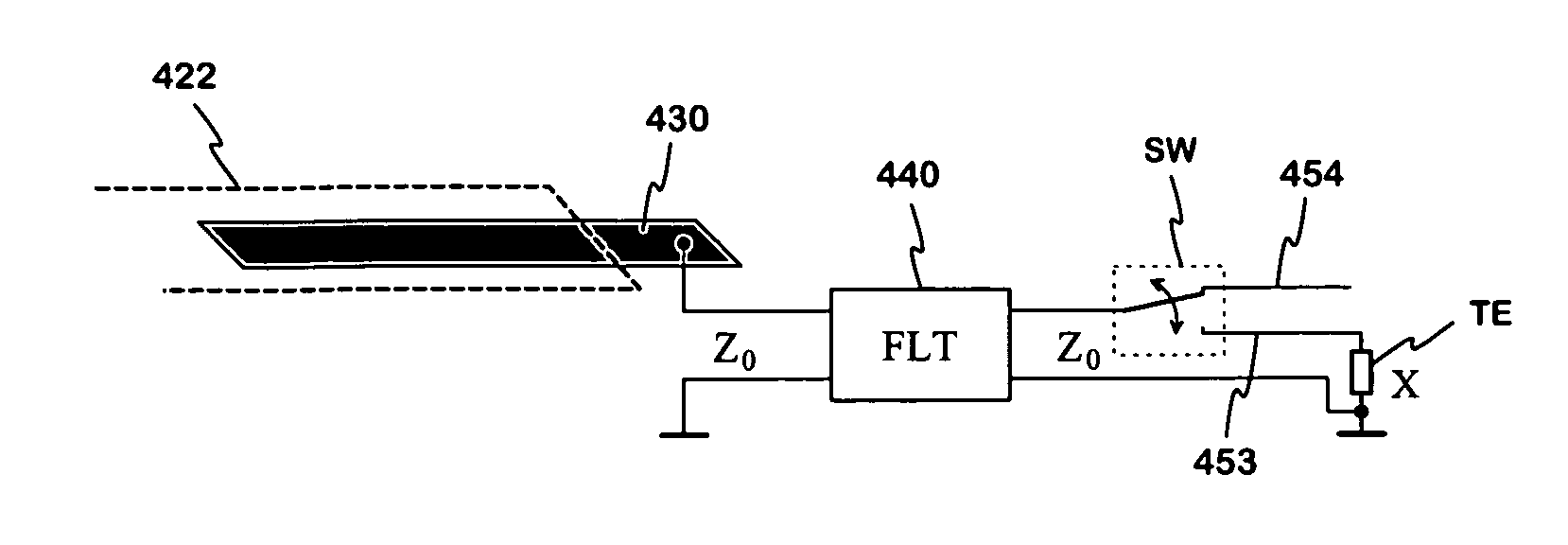
[0025]FIG. 4 presents a structure showing the principle of the invention. From the antenna's base structure it is drawn only a part 422 of the radiating plane. The antenna's structure comprises, in addition to the base structure, an adjusting circuit having a parasitic element 430, a filter 440, a switch SW and a terminal element TE. The parasitic element has a significant electromagnetic coupling with the radiating plane's part 422 and it is connected through a short transmission line to the input port of the filter 440. The output port of the filter is connected through a second short transmission line to the two-way switch SW, the “hot” terminal of the output port to the first terminal of the switch SW. The first terminal can be connected either to the second or to the third terminal of the switch by controlling the switch. The second terminal is fixedly connected to one conductor 453 of a third short transmission line. In the opposite end of the third transmission line is the te...
PUM
 Login to View More
 Abstract
Description
Claims
Application Information
 Login to View More